
 By
By End of January. Caleb is beginning to put two words together — CJ calls these utterances and Shanice calls them mini-sentences and I call them the beginning of everything, because once a child starts combining words the world opens up for them in a way that cannot be closed again. He says more please, which Shanice has been modeling, and no thank you, which CJ taught him by being patient and consistent and which Caleb deploys now with the authority of someone who understands that they have rights. He says hot stove because Loretta said it to him, CJ reports, and Caleb has incorporated it as one phrase, a compound noun: hotstove. A hotstove is the thing near the Nana that you do not touch. He knows. He is learning everything in the right order.
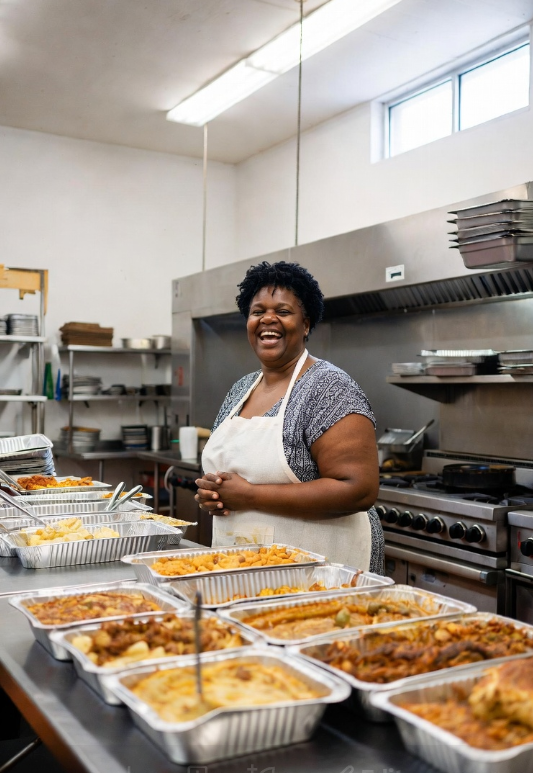
I made a big pot of chicken and dumplings this week — the recipe I recovered from memory and gave to Kezia to make four years ago. The weather called for it and I answered. Standing at the stove waiting for the dumplings to set, I thought about the conversation Kezia had about recipe as document. This recipe is a document. It is the record of my mother making something in her kitchen with her hands, transmitted to me through watching, which I transmitted to Kezia the same way, which Kezia is now learning at a school that has given it a formal name. Everything that gets named was already happening before it had a name. The naming just makes it visible. The doing made it real.
The chicken and dumplings I made this week isn’t in the database yet — it lives still mostly in my hands and in memory, the way my mother’s version did before I wrote it down. But this roasted vegetable and chèvre quiche is the same kind of recipe: something you stand over, something that requires patience while things set, something that asks you to be present in the kitchen in a way that a child will one day remember. I made it the following weekend, after the dumplings, because I was still in that mood — the mood of doing things slowly and on purpose, the mood of cooking as document.
Roasted Vegetable and Chevre Quiche
Prep Time: 25 min | Cook Time: 55 min | Total Time: 1 hr 20 min | Servings: 8
Ingredients
- 1 9-inch unbaked pie crust (homemade or store-bought)
- 1 medium zucchini, sliced into half-moons
- 1 red bell pepper, chopped
- 1 cup cherry tomatoes, halved
- 1/2 medium red onion, sliced thin
- 2 tablespoons olive oil
- 1/2 teaspoon salt, divided
- 1/4 teaspoon black pepper, divided
- 4 large eggs
- 1 cup heavy cream
- 1/2 cup whole milk
- 1 teaspoon fresh thyme leaves (or 1/2 teaspoon dried)
- 4 oz chèvre (soft goat cheese), crumbled
- 2 tablespoons fresh basil, torn
Instructions
- Preheat and prep. Preheat oven to 400°F. Toss zucchini, bell pepper, cherry tomatoes, and red onion with olive oil, 1/4 teaspoon salt, and 1/8 teaspoon pepper on a large rimmed baking sheet. Spread in a single layer.
- Roast the vegetables. Roast for 20–25 minutes, stirring once halfway through, until edges are caramelized and any liquid has evaporated. Remove from oven and let cool slightly. Reduce oven temperature to 375°F.
- Blind bake the crust. Fit the pie crust into a 9-inch pie dish and crimp the edges. Line with parchment and fill with pie weights or dried beans. Bake at 375°F for 12 minutes. Remove weights and parchment and bake 3 minutes more. Set aside.
- Make the custard. In a large bowl, whisk together eggs, heavy cream, milk, thyme, remaining 1/4 teaspoon salt, and remaining 1/8 teaspoon pepper until fully combined and smooth.
- Assemble the quiche. Scatter the roasted vegetables evenly over the bottom of the par-baked crust. Crumble the chèvre over the top. Pour the custard slowly and evenly over everything.
- Bake. Bake at 375°F for 35–40 minutes, until the custard is just set in the center with only a slight jiggle. If the crust edges begin to over-brown, cover them loosely with foil.
- Rest and serve. Let the quiche rest for at least 10 minutes before slicing. Scatter torn fresh basil over the top. Serve warm or at room temperature.
Nutrition (per serving)
Calories: 310 | Protein: 9g | Fat: 22g | Carbs: 18g | Fiber: 2g | Sodium: 340mg