
 By
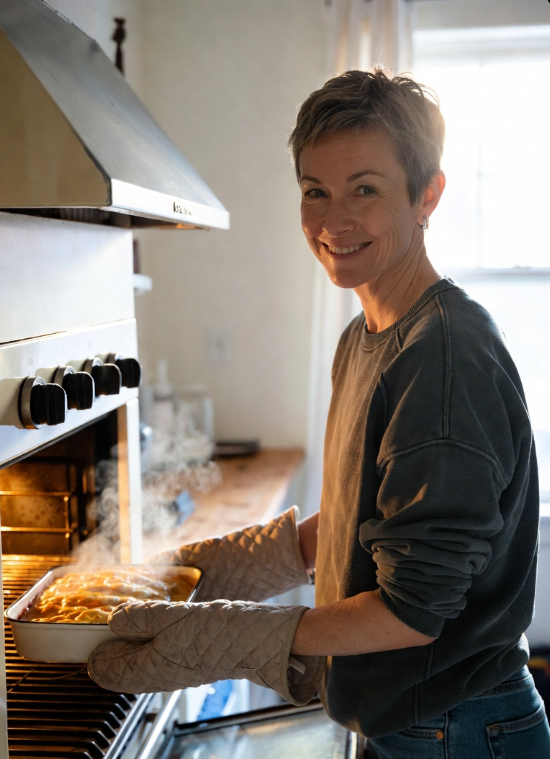
By The kitchen is in full winter mode. The oven at 375 (always 375), the crockpot on the counter, the pantry stocked with jars from last August's canning — the evidence of a woman who preserves summer against winter and loss against forgetting and food against everything.
Thursday was tater tot hotdish, because Thursday is always tater tot hotdish and the schedule doesn't change for anything — not pandemics, not loss, not the passage of years. The tater tots go in at 375 and come out golden and the family eats them and the eating is the Thursday and the Thursday is the structure and the structure holds. But I also made potato soup earlier this week, because the kitchen doesn't only look backward. The kitchen grows.
January. The real winter. Dark and cold, the wind off the prairie personal in its grudge. We endure with soup and blankets and the belief that spring comes eventually. I made bread — sourdough from the starter named Marlene, the bread rising in a warm kitchen while Iowa does its worst outside.
After a week of tater tot hotdish and potato soup and sourdough rising on the counter while Iowa pushed back against us, I needed something that proved the kitchen was still moving forward — not just holding the line. Icebox butterhorns felt exactly right: you make them the night before, tuck them in the refrigerator, and let the cold do the slow work while you sleep. The next morning they rise on the counter like a quiet promise, and by the time you bake them the whole house smells like butter and yeast and the particular warmth of January endured.
Icebox Butterhorns
Prep Time: 30 min | Cook Time: 15 min | Total Time: 8–12 hrs (includes overnight rise) | Servings: 24 rolls
Ingredients
- 2 packages (1/4 oz each) active dry yeast
- 1 cup warm water (110°–115°F)
- 1/2 cup sugar, divided
- 1/2 cup butter, softened
- 3 large eggs, beaten
- 1 teaspoon salt
- 4 to 4 1/2 cups all-purpose flour
- 2 tablespoons butter, melted (for brushing)
Instructions
- Proof the yeast. In a small bowl, dissolve yeast in warm water with 1 teaspoon of the sugar. Let stand until foamy, about 5 minutes.
- Make the dough. In a large bowl, cream the softened butter with the remaining sugar until light. Beat in the eggs and salt. Stir in the yeast mixture. Gradually add flour, 1 cup at a time, mixing until a soft dough forms. It should be slightly tacky but not sticky.
- First rise. Cover the bowl tightly with plastic wrap and refrigerate overnight, or for at least 8 hours. The dough will rise slowly in the cold.
- Shape the rolls. Remove dough from refrigerator and let it rest at room temperature for 30 minutes. Punch down, then divide into two equal portions. On a lightly floured surface, roll each portion into a 12-inch circle. Brush generously with melted butter. Cut each circle into 12 wedges.
- Roll the butterhorns. Starting at the wide end of each wedge, roll up tightly toward the point. Place point-side down on greased baking sheets, curving the ends slightly to form a crescent shape. Leave about 2 inches between rolls.
- Second rise. Cover loosely with a clean towel and let rise in a warm place until doubled in size, about 1 to 1 1/2 hours.
- Bake. Preheat oven to 375°F. Bake for 12–15 minutes, until golden brown on top and the rolls sound hollow when tapped. Brush with additional melted butter as soon as they come out of the oven.
Nutrition (per serving)
Calories: 145 | Protein: 3g | Fat: 5g | Carbs: 21g | Fiber: 1g | Sodium: 125mg