
 By
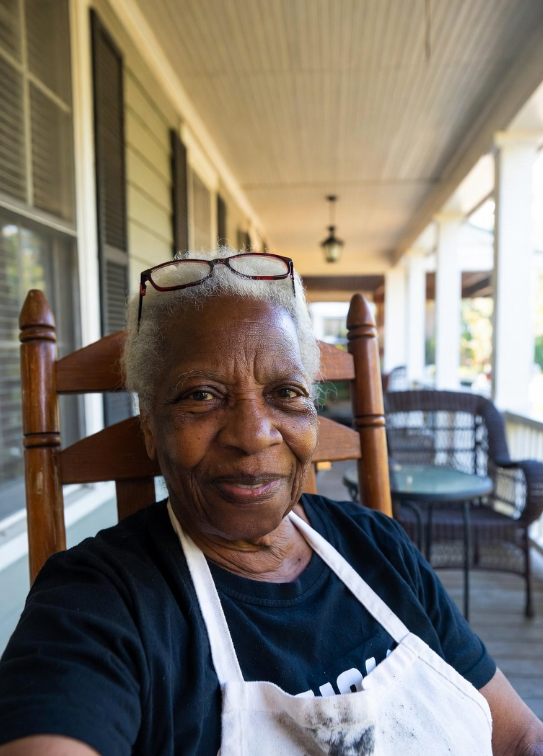
By The cooking class started this week. Six students in the first class — the community center limited enrollment because the kitchen is small and my patience is large but not infinite. Six adults, ranging in age from twenty-four to sixty-seven, standing in a kitchen that is not mine but that I am treating as mine because a cook treats every kitchen as hers when the stove is on.
Week one: shrimp and grits. The foundation. I started with the history because the food doesn't make sense without the history. I told them about the Muskogee people who grew the corn that became grits. About the West African women who were brought to the Lowcountry on slave ships and who carried food knowledge in their bodies the way they carried children — as a form of survival, as a gift they refused to let the ocean take. About the Gullah-Geechee culture that merged African cooking with Lowcountry ingredients and created a cuisine that is more than food — it's resistance. It's memory. It's a people saying, "You took everything from us but you cannot take our cooking because our cooking is in our hands and our hands are ours."
The room was quiet. Not bored quiet — learning quiet. The quiet of people hearing something they didn't know they needed to hear.
Then we cooked. Stone-ground grits, the real kind, from the mill on Sapelo Island. I showed them the stir — low, slow, patient. "Grits are not instant oatmeal," I said. "Grits are a meditation. You stir and you wait and the grits become what the grits are going to become, and if you rush them, they punish you with lumps." They stirred. Some of them too fast. I corrected. I corrected the way Hattie Pearl corrected me — not with words but with my hand over their hand, guiding the spoon, slowing the rhythm, until the stirring was right.
The shrimp went in at the end. Thirty seconds per side. No more. The class watched me cook the shrimp with the attention of people who understood they were seeing something pass from one pair of hands to another, which is what teaching is, which is what cooking is, which is what love is: a passing. A giving. A transfer of the thing you know to the person who needs to know it.
Everyone ate. Everyone was quiet while they ate. That is the highest compliment food can receive: the silence of people who are too moved to speak.
Now go on and feed somebody.
After I sent those six students home on Tuesday, I stood in the community center kitchen a long while before I packed up. I kept thinking about Hattie Pearl’s hand over my hand, slowing my spoon, and how I had just done the same thing for six strangers who trusted me enough to let me correct them. When I got home I made these rolls — Grandma’s Orange Rolls, the ones Hattie Pearl herself learned from her own mother. They are not a Lowcountry dish, but they carry the same truth: you cannot rush the dough, you cannot rush the rise, and the sweetest thing you can offer another person is something you made with patience and with love.
Grandma’s Orange Rolls
Prep Time: 30 min + 2 hrs rising | Cook Time: 25 min | Total Time: ~3 hrs | Servings: 12 rolls
Ingredients
- 2 1/4 tsp (1 packet) active dry yeast
- 1/2 cup warm water (110°F)
- 1/2 cup whole milk, warmed
- 1/3 cup granulated sugar
- 1/3 cup unsalted butter, softened
- 1 tsp fine salt
- 2 large eggs, room temperature
- 3 1/2 to 4 cups all-purpose flour, plus more for dusting
Orange Filling:
- 1/2 cup granulated sugar
- 1/4 cup unsalted butter, softened
- 2 tbsp fresh orange zest (from about 2 large oranges)
Orange Glaze:
- 1 1/2 cups powdered sugar, sifted
- 3 tbsp fresh orange juice
- 1 tsp orange zest
- Pinch of salt
Instructions
- Proof the yeast. Combine warm water and yeast in a large bowl. Let stand 5–8 minutes until foamy. If it does not foam, your yeast is not active — start again with a fresh packet.
- Make the dough. Add the warm milk, sugar, softened butter, salt, and eggs to the yeast mixture. Stir to combine. Add flour one cup at a time, mixing until a soft, slightly tacky dough forms. Turn out onto a lightly floured surface and knead by hand for 8–10 minutes, until the dough is smooth and elastic. It should spring back slowly when you press a finger into it.
- First rise. Shape the dough into a ball and place it in a lightly oiled bowl. Cover with a clean towel and set in a warm spot for 1 hour to 1 hour 30 minutes, until doubled in size. Do not rush this. The dough becomes what the dough is going to become.
- Make the filling. Beat together the softened butter, sugar, and orange zest until smooth and spreadable. Set aside.
- Shape the rolls. Punch the dough down and turn it out onto a lightly floured surface. Roll into a rectangle roughly 12 by 18 inches. Spread the orange filling evenly to the edges. Starting from the long side, roll the dough tightly into a log. Pinch the seam closed. Slice into 12 equal rolls using a sharp knife or unflavored dental floss.
- Second rise. Arrange the rolls cut-side up in a buttered 9-by-13-inch baking dish, leaving a little space between each. Cover loosely and let rise 45 minutes to 1 hour, until puffed and touching.
- Bake. Preheat oven to 375°F. Bake rolls 22–25 minutes, until golden on top and cooked through. Tent with foil during the last 5 minutes if they are browning too fast.
- Glaze. Whisk together the powdered sugar, orange juice, zest, and salt until smooth. Drizzle over the rolls while they are still warm — not piping hot, just warm enough to let the glaze settle in. Serve immediately or within a few hours of baking.
Nutrition (per serving)
Calories: 310 | Protein: 5g | Fat: 9g | Carbs: 52g | Fiber: 1g | Sodium: 215mg