
← Back to Blog

Golden Egg Bread — The Loaf That Smells Like Home and Feeds Like Love

A food writer from a national outlet reached out. Not Milwaukee-level — national. A writer for an online food magazine with millions of readers. She'd seen the Lockdown Kitchen videos and wanted to do a profile: "How a Milwaukee Brewer Is Feeding His Neighborhood One Pierogi at a Time." I said yes. The interview was over Zoom on Thursday — my first Zoom interview, my first interview where I'm wearing a decent shirt on top and sweatpants on the bottom, the universal lockdown fashion. She asked about Babcia, about the deliveries, about why I'm cooking for other people when I could just be cooking for myself. I said: "My grandmother spent sixty years feeding people. Not because it was her job. Because it was her nature. Food was how she said I love you, I'm worried about you, I'm glad you're here. I'm doing the same thing. I'm just using a car and a porch instead of a kitchen table." The article will run next month. I can't think about what happens when a national audience reads about a twenty-three-year-old making pierogi in Milwaukee. I'll think about it later. The delivery schedule has expanded. Three more people this week: an elderly couple on my block who I've never met but who Mike told me about (they haven't left their house in six weeks), and a single mom with two kids on the floor below Mike who can't afford groceries every week. I made extra: a big pot of chicken soup for the couple, pierogi and go┼é─àbki for the single mom. I left the food on their doors. The elderly man — Frank, I learned later — opened his door while I was walking away and called out, "Young man! This is the best soup I've had in twenty years!" I waved and kept walking because I didn't want him to see me cry. This is what Babcia would do. Not because she was saintly — she was human, she was stubborn, she complained about the weather and the Packers and the price of mushrooms. But she fed people. In every season, in every crisis, in every ordinary Tuesday. She fed people. I'm making bread three times a week now. The sourdough starter is thriving. The apartment smells like a bakery around the clock. I'm going through fifty pounds of flour a week. This is not sustainable financially, but it's necessary in every other way.

The bread is what started making everything feel real. The soup and the pierogi and the gołàbki — those came from Babcia’s recipes, from muscle memory, from a place I already knew how to reach. But the bread was something I grew into on my own this spring, loaf by loaf, fifty pounds of flour at a time. When Frank called out from his doorway and I had to keep walking so he wouldn’t see me cry, I had a fresh loaf of this golden egg bread sitting in the bag I’d left for him — soft, rich, the kind of bread that tastes like someone meant it. This is the one I bake three times a week. This is the one the apartment smells like. If Babcia taught me that food is how you say I love you, then this loaf is the sentence I keep repeating.

Golden Egg Bread

Prep Time: 25 min + 1 hr 45 min rise | Cook Time: 30 min | Total Time: ~2 hr 40 min | Servings: 16 slices (1 large loaf)

Ingredients

  • 1 package (1/4 oz) active dry yeast
  • 1/4 cup warm water (110°–115°F)
  • 1 cup warm whole milk (110°–115°F)
  • 3 tablespoons granulated sugar
  • 2 tablespoons unsalted butter, softened
  • 1 1/2 teaspoons kosher salt
  • 3 large eggs, room temperature, divided
  • 4 to 4 1/2 cups all-purpose flour
  • 1 tablespoon water (for egg wash)

Instructions

  1. Activate the yeast. In a large mixing bowl, dissolve yeast in warm water and let stand until foamy, about 5 minutes. If it doesn’t foam, your yeast may be expired — start again.
  2. Build the dough. Add the warm milk, sugar, butter, salt, and 2 of the eggs to the yeast mixture. Stir to combine. Add flour one cup at a time, mixing until a shaggy dough forms. Turn onto a lightly floured surface and knead for 8–10 minutes until smooth and elastic, adding flour a tablespoon at a time if the dough sticks.
  3. First rise. Place dough in a greased bowl, turning once to coat. Cover with a clean towel or plastic wrap and let rise in a warm spot until doubled, about 1 hour.
  4. Shape the loaf. Punch down the dough and turn it onto a lightly floured surface. Shape into a smooth oval log and place in a greased 9x5-inch loaf pan, tucking the ends under.
  5. Second rise. Cover loosely and let rise again until the dough crowns about 1 inch above the rim of the pan, 45–55 minutes.
  6. Egg wash and bake. Preheat oven to 375°F. Whisk together the remaining egg with 1 tablespoon water. Gently brush the top of the loaf with the egg wash for a deep golden finish. Bake for 28–32 minutes, until the crust is rich golden brown and the loaf sounds hollow when tapped on the bottom.
  7. Cool before slicing. Remove from the pan and transfer to a wire rack. Let cool at least 20 minutes before slicing — the interior needs time to set. Wrap tightly and it keeps at room temperature for 3 days, or freeze whole loaves for up to 2 months.

Nutrition (per serving)

Calories: 158 | Protein: 5g | Fat: 3g | Carbs: 27g | Fiber: 1g | Sodium: 145mg

Jake Kowalski
About the cook who shared this
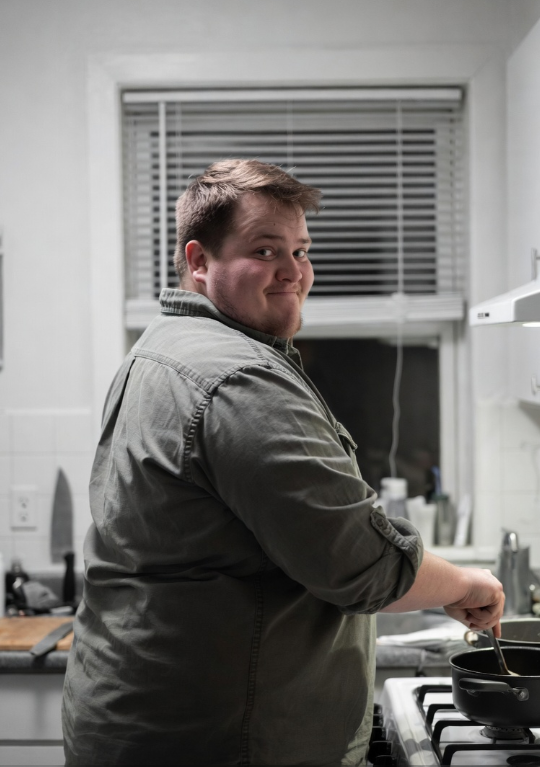
Jake Kowalski
Week 214 of Jake’s 30-year story · Milwaukee, Wisconsin
Jake is a twenty-nine-year-old brewery worker, newlywed, and proud Polish-American from Milwaukee's Bay View neighborhood. He didn't start cooking until his grandmother Babcia Helen passed away and left behind a stack of grease-stained recipe cards. Now he makes pierogi from scratch, smokes meats on a balcony smoker his landlord pretends not to notice, and writes for guys who want to cook good food but don't know a roux from a rub.

How Would You Spin It?

Put your own twist on this recipe — what would you add, remove, or swap?