
 By
By New Year. I called Lourdes at midnight Alaska time. She picked up on the second ring. She had been awake. She always picks up at midnight. She said, "Salamat sa Diyos." I said, "Yes, Mama, thanks be to God." The matriarch was the bell that rang the year.
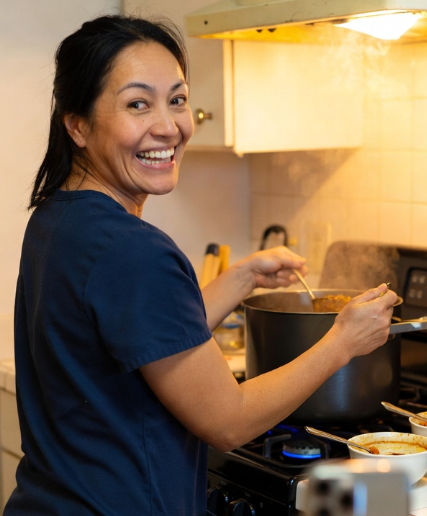
Lourdes is 74. She is in the kitchen. She is luminous. Joseph and Suki sent photos of the kids this week.
I made arroz caldo Saturday. The rice porridge, the soft food, the dish for the body in transition.
The blog has four hundred subscribers now who get the posts via email. The subscribers are the loyal core. The loyal core is the chorus.
Pete texted me Saturday. He retired three years ago. He still texts me Saturday. The friendship is the broth.
Pete and I had a long phone conversation Tuesday. We talked about the family — his and mine. The talking was the keeping.
I took inventory of the freezer Sunday. The freezer had: twelve quarts of broth, eight pounds of adobo in vacuum bags, six pounds of sinigang base, fourteen lumpia trays at fifty rolls each, three pounds of marinated beef for caldereta, and a small bag of pandan leaves Tita Nening had sent me. The inventory was the proof of preparation. The preparation was the proof of love.
The salmon in the freezer is from August. Joseph's catch. The bag is labeled in his handwriting — "for Grace." I will use it next week.
I read three chapters of the novel Saturday night before sleep. The novel was about a Filipina nurse in California. The nurse was being undone by her work. I knew the unraveling. I had lived the unraveling. I read on. The reading was the witnessing.
The grocery store had no calamansi. I substituted lime. The substitution was acceptable. The acceptable is the working version of perfect.
I read a chapter of a novel before bed each night this week. The novel was about a Filipina nurse in California. The novel was good. The novel was, in some way, my own life adjacent.
Angela texted me a photo of the kids. I texted back a heart. The exchange took thirty seconds. The thirty seconds was the keeping.
I drove the Glenn Highway out to Eklutna on Saturday. The mountains were the mountains. The lake was the lake. The body needed the open road. The open road did its work.
A reader from New Jersey wrote in about her grandmother's adobo, which used pineapple. I had never heard of pineapple in adobo. I tried it. It was strange. It was also good. The strange and the good are not opposites.
The therapy session this month was about pacing. Dr. Reeves said, "Grace. The pacing is the love for the future self." I am working on the pacing. The pacing is harder than the loving.
I cleaned the kitchen Sunday afternoon. I wiped the stove. I scrubbed the sink. I reorganized the spice cabinet. The cleaning was the small reset. The reset was the marker. The marker said: the week is over, the next week begins, the kitchen is ready.
The neighbors invited us over for a small dinner Thursday. They are an Iñupiaq family — Aana and her grandson Joe. We ate caribou stew and rice. I brought lumpia. The kitchens of Anchorage have always been the small UN. The food is the proof.
Lourdes called me twice this week. The first call was about a church event. The second was about a recipe variation she had remembered from her childhood. The remembering was the gift.
I made arroz caldo on Saturday because my body asked for it — the soft food, the holding food — but later in the week I needed something with more weight to it, something that could stand up to the inventory and the driving and the phone calls and the grief-adjacent fatigue that a new year can carry. Creamy beef and potatoes is that dish for me: it is not complicated, it does not perform, it simply shows up warm and asks nothing back. Dr. Reeves said pacing is love for the future self, and I think this recipe is that — made on a Sunday, eaten across three nights, proof that I had planned ahead even when I was tired.
Creamy Beef & Potatoes
Prep Time: 15 min | Cook Time: 35 min | Total Time: 50 min | Servings: 4
Ingredients
- 1 1/2 lbs beef sirloin or chuck, cut into 1-inch cubes
- 1 1/2 lbs Yukon Gold potatoes, peeled and cut into 1-inch chunks
- 1 medium yellow onion, diced
- 3 cloves garlic, minced
- 2 tablespoons olive oil
- 1 1/2 cups beef broth
- 3/4 cup sour cream
- 2 tablespoons all-purpose flour
- 1 tablespoon Worcestershire sauce
- 1 teaspoon smoked paprika
- 1/2 teaspoon black pepper
- 1 teaspoon salt, plus more to taste
- 2 tablespoons fresh parsley, chopped (for garnish)
Instructions
- Season and sear the beef. Pat beef cubes dry and season with salt, pepper, and smoked paprika. Heat olive oil in a large heavy-bottomed pot or Dutch oven over medium-high heat. Working in batches, sear beef on all sides until deeply browned, about 3—4 minutes per batch. Transfer to a plate and set aside.
- Soften the aromatics. Reduce heat to medium. Add onion to the same pot and cook, stirring occasionally, until softened and translucent, about 4—5 minutes. Add garlic and cook 1 minute more until fragrant.
- Build the base. Sprinkle flour over the onion and garlic and stir to coat, cooking for 1 minute. Pour in beef broth while stirring, scraping up any browned bits from the bottom of the pot. Add Worcestershire sauce and stir to combine.
- Simmer with potatoes. Return the seared beef to the pot along with the potato chunks. Bring to a gentle boil, then reduce heat to low. Cover and simmer for 20—25 minutes, until potatoes are fork-tender and beef is cooked through.
- Finish with cream. Remove pot from heat. Stir in sour cream until fully incorporated and the sauce is smooth and creamy. Taste and adjust salt as needed.
- Serve. Ladle into bowls and garnish with fresh parsley. Serve with crusty bread or over steamed rice.
Nutrition (per serving)
Calories: 480 | Protein: 36g | Fat: 20g | Carbs: 34g | Fiber: 3g | Sodium: 620mg