
 By
By November first. All Saints' Day. In the Philippines, this is Undas — the day families visit cemeteries, clean the graves, bring food, light candles, and spend the night with their dead. It's not morbid. It's communal. The living and the dead share a meal and the boundary between them is thin enough to feel like a suggestion rather than a wall. Lourdes observes it in Alaska the way she observes everything Filipino — adapted, persistent, refusing to let geography erase tradition.
She took me to Angelus Memorial Cemetery where Reynaldo is buried. We brought flowers — sampaguita garlands ordered from a Filipino shop in Anchorage that imports them frozen from Manila, which sounds like a supply chain poem and is actually just Lourdes's refusal to put American flowers on a Filipino grave. We cleaned the headstone. We lit a candle in a glass jar because the Alaskan wind would eat a bare flame. We stood in the cold and Lourdes said a prayer in Ilonggo and I stood next to her and didn't understand every word but understood all of it.
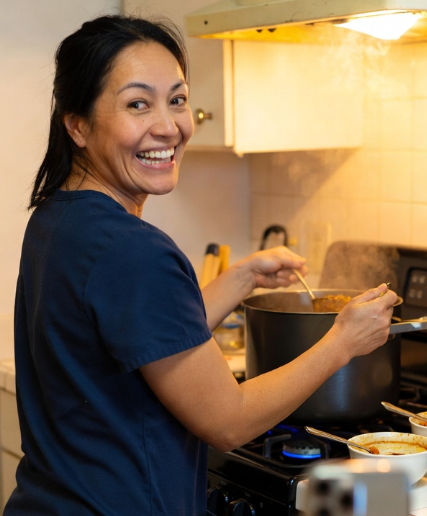
Afterwards, we went home and I made dinuguan — the blood stew, traditional for All Saints' Day, the dark dish for a dark holiday. I'd made it last week as practice. This time it was for Reynaldo. Not literally — he's gone, he's been gone eight years, he can't eat blood stew — but the cooking was for him, the way every recipe from his kitchen is for him, a ritual of remembrance dressed up as dinner.
Lourdes ate the dinuguan with puto and told me about Undas in Iloilo when she was a child — how the whole family would spend the night at the cemetery, sleeping on mats, the graves lit by hundreds of candles, the children playing between the headstones while the adults prayed and ate and gossiped about the dead as though they could still hear. "Maybe they can," Lourdes said. "Your father was always nosy." I laughed. Lourdes made a joke about a dead man and I laughed, and the laughing was the most honest thing I've done in months.
I drove home through the darkness — 5 PM and black, the stars out in force above the city, the mountains invisible, the world compressed to headlights and road. I thought about Reynaldo. I thought about what he'd say about the blog, about the writing, about his daughter making his sinigang and putting it on the internet. I think he'd be confused and then proud and then he'd ask if I used enough tamarind. The answer is always no. The answer is always: one more squeeze.
I won’t pretend this Asian barbecue sauce is dinuguan — nothing on this list is, and some dishes can’t be substituted without losing the whole point. But after an afternoon at Angelus Memorial and an evening making Reynaldo’s blood stew, I kept coming back to this sauce, which I’d tested earlier in the week: dark, fermented-sweet, built from soy and hoisin and a patience that feels almost funerary in the best way. It shares something with that stew — the willingness to be unapologetically deep and brown and strong, the kind of flavor that doesn’t apologize for itself. Reynaldo, I think, would have respected that.
Asian Barbecue Sauce
Prep Time: 10 minutes | Cook Time: 20 minutes | Total Time: 30 minutes | Servings: 12 (about 1 1/2 cups)
Ingredients
- 1/2 cup soy sauce (low-sodium preferred)
- 1/3 cup hoisin sauce
- 3 tablespoons rice vinegar
- 2 tablespoons sesame oil
- 2 tablespoons brown sugar, packed
- 1 tablespoon honey
- 4 cloves garlic, minced
- 1 tablespoon fresh ginger, grated
- 1 teaspoon five-spice powder
- 1/2 teaspoon red pepper flakes (or to taste)
- 1 tablespoon cornstarch
- 2 tablespoons cold water
- 1 teaspoon toasted sesame seeds, for finishing
Instructions
- Combine the base. In a small saucepan over medium heat, whisk together the soy sauce, hoisin sauce, rice vinegar, sesame oil, brown sugar, and honey until the sugar begins to dissolve, about 2 minutes.
- Add aromatics. Stir in the garlic, ginger, five-spice powder, and red pepper flakes. Bring the mixture to a gentle simmer, stirring frequently to prevent scorching on the bottom of the pan.
- Thicken the sauce. In a small bowl, whisk together the cornstarch and cold water until smooth. Pour the slurry into the simmering sauce while stirring constantly. Continue to cook over medium-low heat for 5–7 minutes, until the sauce coats the back of a spoon.
- Taste and adjust. Remove from heat. Taste and adjust: more vinegar for brightness, more honey for sweetness, more soy for depth. The sauce should feel bold but balanced — savory first, with a long sweet finish.
- Finish and store. Stir in the toasted sesame seeds. Use immediately as a glaze or dipping sauce, or let cool completely before transferring to an airtight jar. Keeps refrigerated for up to 2 weeks. The flavors deepen overnight.
Nutrition (per serving)
Calories: 58 | Protein: 1g | Fat: 2g | Carbs: 9g | Fiber: 0g | Sodium: 480mg