December, and I'm in the thick of the MTM program buildout. Twelve cardiac patients enrolled so far, each one requiring an initial consultation, a medication review, a care plan, and monthly follow-ups. I'm building protocols from scratch — forms, documentation templates, communication channels with the cardiology team. It's the most intellectually demanding work I've done since pharmacy school, and I love it with a ferocity that surprises me.
Dr. Okafor, the cardiology chief, pulled me aside this week and said, "The patients love you." He said this with the mild surprise of a man who doesn't understand why patients would have feelings about their pharmacist. But they do. Mrs. Chen, who brings me dumplings every appointment. Mr. DiNapoli, who tells me about his grandchildren while I review his warfarin levels. Mrs. Patel (not related to Raj — there are approximately four million Patels in New Jersey), who holds my hand while I explain her new medication and says, "You remind me of my daughter."
I am building something. It's small — twelve patients, one pharmacist, a stack of forms — but it's mine, and it's real, and it's helping people. This is what Amma's sacrifice was for. Not the salary or the title, but this: the ability to sit across from Mrs. Chen and explain her medication in a way that makes her less afraid.
At home, I'm trying to balance the expanded work hours with the cooking I refuse to give up. Some nights it's elaborate — Amma's kootu, or a new recipe from the India notebooks. Other nights it's scrambled eggs and toast, which I eat standing at the counter with no guilt, because I've learned this year that feeding yourself simply is not a failure. It's survival. And survival counts.
Tonight was a kootu night. Chow chow kootu — chayote squash cooked with moong dal and coconut, tempered with cumin and curry leaves. It's a simple dish, the kind of weeknight food that Amma makes without thinking. I make it with great deliberation and it comes out tasting almost like hers, which at this point feels like a miracle I've earned.
Raj ate two helpings and said, "Your cooking has changed since India." He's right. Something shifted there — not in technique, but in intention. I cook now not just to feed, but to remember. To connect. To preserve.
The notebooks from India are on the bookshelf now, next to the Madhur Jaffrey book. Two notebooks of recipes. One from the source. The other from the woman who left the source and never stopped cooking.
Kootu night calls for something that rewards deliberate, unhurried hands — the kind of cooking that asks you to be present even when the week has pulled you in twelve directions at once. This tomato and lentil curry captures that same spirit: lentils softened low and slow, tomatoes dissolving into something rich and grounding, spices bloomed in oil the way Amma’s kitchen always smelled on a Tuesday. It’s not the exact dish I made that night, but it lives in the same tradition — the one where feeding yourself simply is never a failure, and sometimes a bowl of dal is the most honest thing you can offer the people you love.
Tomato and Lentil Curry
Prep Time: 10 minutes | Cook Time: 30 minutes | Total Time: 40 minutes | Servings: 4
Ingredients
- 1 cup red lentils (masoor dal), rinsed and drained
- 2 tablespoons coconut oil or neutral oil
- 1 teaspoon cumin seeds
- 1 medium yellow onion, finely diced
- 4 cloves garlic, minced
- 1 tablespoon fresh ginger, grated
- 1 (14 oz) can crushed tomatoes
- 1 teaspoon ground coriander
- 1 teaspoon ground turmeric
- 1/2 teaspoon ground cumin
- 1/2 teaspoon garam masala
- 1/4 teaspoon cayenne pepper (or to taste)
- 2 1/2 cups vegetable broth or water
- 1/2 cup full-fat coconut milk
- 1 teaspoon salt, plus more to taste
- Fresh cilantro and a squeeze of lemon juice, to finish
- Cooked rice or warm flatbread, for serving
Instructions
- Bloom the cumin. Heat the oil in a heavy-bottomed pot or Dutch oven over medium heat. Once shimmering, add the cumin seeds and let them sizzle for 30–45 seconds until fragrant and just beginning to darken.
- Build the base. Add the diced onion and cook, stirring occasionally, for 6–8 minutes until soft and translucent. Stir in the garlic and ginger and cook another 2 minutes until the raw smell cooks off.
- Add the spices. Sprinkle in the coriander, turmeric, ground cumin, garam masala, and cayenne. Stir to coat the onions and cook for 1 minute, letting the spices toast lightly in the oil.
- Add tomatoes and lentils. Pour in the crushed tomatoes and stir well, scraping any spices off the bottom of the pot. Add the rinsed lentils, vegetable broth, and salt. Stir to combine.
- Simmer until tender. Bring to a gentle boil, then reduce heat to medium-low. Simmer uncovered for 20–22 minutes, stirring occasionally, until lentils are completely soft and have broken down into a thick, porridge-like consistency.
- Finish with coconut milk. Stir in the coconut milk and simmer for another 3–5 minutes. Taste and adjust salt as needed. The curry should be thick but spoonable — add a splash of broth to loosen if needed.
- Serve. Ladle over rice or alongside warm flatbread. Finish with fresh cilantro and a squeeze of lemon juice to brighten the flavors.
Nutrition (per serving)
Calories: 310 | Protein: 14g | Fat: 12g | Carbs: 38g | Fiber: 9g | Sodium: 480mg
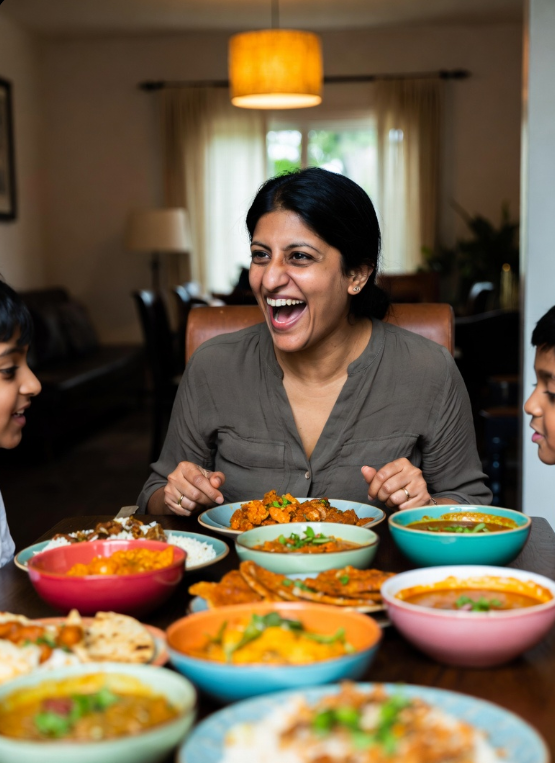
About the cook who shared this
Priya Krishnamurthy
Week 37 of Priya’s 30-year story
· Edison, New Jersey
Priya is a pharmacist, wife, and mom of two in Edison, New Jersey — the town she grew up in, surrounded by the sights and smells of her mother's South Indian kitchen. These days, she splits her time between the hospital pharmacy, school pickups, and her own kitchen, where she cooks nearly every night. Her style is a blend of the Tamil recipes her mother taught her and the American comfort food her kids actually want to eat. She writes about the beautiful mess of balancing two cultures on one plate — and she wants you to know that ordering pizza is also an act of love.
