
 By
By Mother's Day. The bakery's biggest single event — fifty-two cake orders this year, the most ever. Sofia managed the production with military precision (a phrase I use deliberately, because Sofia's event management resembles a military operation more than a bakery operation, and the resemblance is a compliment, because the military gets things done, and getting things done is Sofia's love language). Fifty-two cakes, delivered on time, each one decorated, each one someone's love for their mother compressed into frosting and flour.
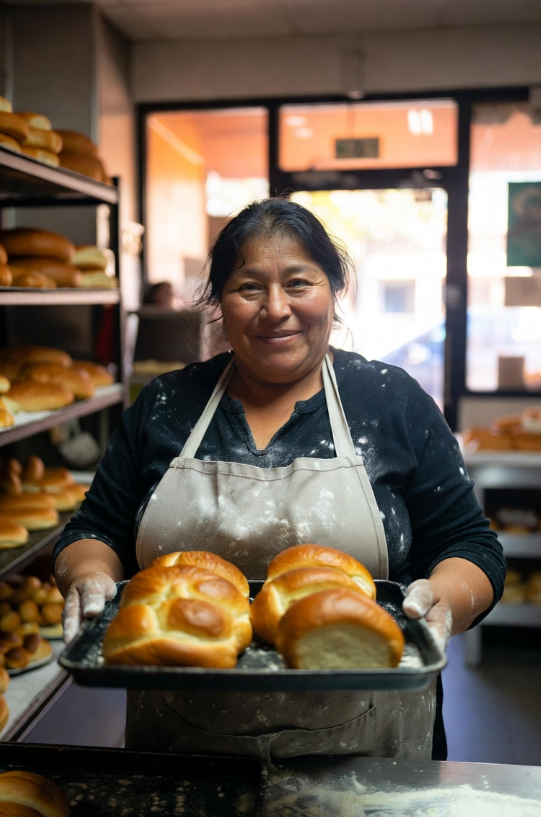
Luis Jr. gave me a gift that completed the wall. The wall behind the bakery register — Rosa's photographs, the naturalization certificate, the plaque, the concha clock, the photo of soldiers with conchas — is full now, every inch covered, a gallery of the things that matter. Luis Jr.'s gift: a framed photograph of me and Sofia, taken by Andrea, behind the bakery counter. We are both in aprons. We are both flour-dusted. We are both smiling. The photograph is the present tense of the bakery — not Rosa's ghost, not the promise of the past, but the living, breathing, flour-covered present: a mother and a daughter, making bread, together. Luis Jr. hung it in the center of the wall. The center. The most important position. I said: "That should be Rosa." He said: "Rosa is all of them. You and Sofia are the now." The now. My soldier son just defined the wall's curatorial philosophy: Rosa is the collection. Maria Elena and Sofia are the featured exhibit.
I made enchiladas suizas — the tradition, the Mother's Day dinner, the green tomatillo cream enchiladas that the family now expects the way they expect Sunday caldo. The tradition is seven years old and feels ancient, because ancient is not measured in years but in repetitions, and seven repetitions of the same meal on the same day is ancient in the way that language is ancient — spoken enough times, it becomes the word for the thing, and "enchiladas suizas" is the word for "Mother's Day" in the Gutierrez dictionary.
Seven years of enchiladas suizas means seven years of tomatillo cream and melted cheese and the particular silence that falls over a table when everyone is eating something they already love before they taste it — that silence is the tradition itself. But before the enchiladas came together that evening, still flour-dusted from the fifty-two cakes, I needed something quick and grounding just for me: eggs, potatoes, olive oil, and a hot pan. The Spanish omelet has that same quality as the suizas — humble ingredients repeated with intention until they become the word for something bigger — and on a night when Luis Jr. had just hung my face at the center of Rosa’s wall and called it the now, I needed food that felt exactly that present.
Spanish Omelet
Prep Time: 15 min | Cook Time: 25 min | Total Time: 40 min | Servings: 4
Ingredients
- 1/3 cup olive oil, divided
- 1 1/2 lbs Yukon Gold potatoes, peeled and thinly sliced (about 1/8 inch)
- 1 medium yellow onion, thinly sliced
- 1 teaspoon kosher salt, divided
- 1/2 teaspoon freshly ground black pepper, divided
- 6 large eggs
- 1 tablespoon fresh flat-leaf parsley, chopped (optional, for garnish)
Instructions
- Cook the potatoes and onion. Heat 1/4 cup olive oil in a 10-inch nonstick or cast-iron skillet over medium heat. Add the sliced potatoes and onion in overlapping layers. Season with 3/4 teaspoon salt and 1/4 teaspoon pepper. Cook, turning gently every few minutes, until the potatoes are fully tender but not browned, about 15–18 minutes. Remove from heat and let cool slightly.
- Beat the eggs. In a large bowl, whisk the eggs with the remaining 1/4 teaspoon salt and 1/4 teaspoon pepper until smooth and slightly frothy. Add the cooked potato and onion mixture to the eggs and fold gently to combine. Let rest 5 minutes so the potatoes absorb the egg.
- Cook the first side. Wipe out the skillet and heat the remaining olive oil over medium heat. Pour in the egg-and-potato mixture, spreading it evenly. Cook undisturbed until the edges are set and the center is just slightly jiggly, about 6–8 minutes. Run a spatula around the edges to loosen.
- Flip and finish. Place a large flat plate or lid over the skillet. In one confident motion, invert the omelet onto the plate. Slide it back into the skillet, uncooked side down. Cook until just set through, about 3–4 minutes more. The center should be creamy, not dry.
- Rest and serve. Slide the finished omelet onto a cutting board or serving plate. Allow to rest 5 minutes before slicing into wedges. Garnish with parsley if desired. Serve warm or at room temperature.
Nutrition (per serving)
Calories: 340 | Protein: 12g | Fat: 20g | Carbs: 28g | Fiber: 2g | Sodium: 420mg