
 By
By Let me tell you something about Hartford, Connecticut, in August. It is hot. Not Bayamón hot — nothing outside of Puerto Rico is Bayamón hot — but it is a thick, heavy hot that presses down on this city like a hand on the back of your neck, and by rights it should drive a person indoors and away from the stove. I come home from a ten-hour shift at the hospital cafeteria, change out of my work clothes, and turn the burner on. That is how I know I am Puerto Rican. Normal people avoid heat in August. I walk into my kitchen and start making sofrito.
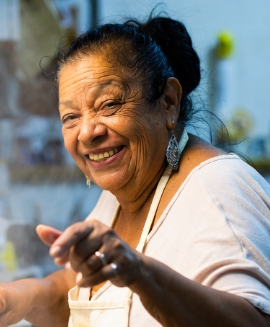
My name is Carmen Iris Delgado-Ortiz. I am fifty years old. I was born in Bayamón, Puerto Rico, the fifth of seven children, in a concrete block house in Barrio Hato Tejas where the walls were thin and the noise was constant and the kitchen was the center of the known universe. I have lived in Hartford, Connecticut, for twenty-eight years, which means I have spent more of my adult life here than I ever spent on the island, and this fact still catches me off guard sometimes — usually in February, when the snow has been on the ground for two months and the sky is the color of old dishwater and I cannot for the life of me remember what sunlight feels like on my arms. The answer to “how did a girl from the Caribbean end up here” is: Eduardo, my husband, who followed a job opportunity north in 1988 and brought me with him; and also ambition; and also the particular stubbornness of Puerto Rican women who, once they decide to be somewhere, are going to be there, completely, without apology. So here I am. Hartford. Twenty-eight years. Four children, a career running the food service department of a major hospital, and a kitchen on Stonington Street that has cooked enough arroz con gandules to fill a municipal swimming pool.
Tonight is a Thursday. Nobody is coming for dinner. My husband Eduardo will be home at six-thirty and he will eat whatever I put in front of him with the same quiet gratitude he has brought to every meal for twenty-eight years, which is one of the reasons I married him. My youngest, Sofía — seventeen years old, volleyball practice three nights a week, the baby of the family and my favorite, which I deny when asked — will drift in around seven, still in her practice clothes, and eat standing at the counter because she is seventeen and sitting down at a table is apparently optional at that age. My other three are grown and mostly gone: Miguel has his own family across town; Rosa is down in New Haven; David is working his way up in a restaurant kitchen somewhere in New York, learning to cook on a professional line and calling me on weekends to tell me about technique, and I listen and I nod and I do not tell him that Abuela Consuelo taught me more about technique before I was twelve than any restaurant will teach him in a decade. I keep that thought to myself. I am generous that way.
There is no occasion tonight. The occasion is: it is Thursday, I am tired down to the marrow, and I need to smell the thing that smells like where I came from.
My mother — Luz María Ortiz de Delgado, eighty-one years old, still living in the Bayamón house where she raised seven children, still with opinions about everything and the energy to share them — called me this morning, as she does every morning. She told me that the mango tree in the backyard finally gave fruit this year after three bad seasons. She told me that the neighbor’s dog got into her garden again. She asked me if I was eating enough, because in Luz María’s assessment I have never once in fifty years been eating enough. When I told her I was making arroz con gandules tonight, she said — without missing a beat, without pausing to consider whether this was necessary information — “Put enough sazón in it, Carmen. You never put enough sazón.”
I put enough sazón, Mami. I have been making this rice for thirty years. But I have learned that with Luz María, the correct response is not argument. The correct response is “Yes, Mami” and then doing it however you were going to do it anyway, because you are fifty years old and you know your sazón levels.
She made sofrito on Saturday mornings, my mother. That is my earliest kitchen memory — not the finished dish, not the Sunday table, but Saturday morning before the house was awake: Luz María at the blender, culantro and recao from the garden, ají dulce, garlic, onion, tomato, all of it going into the machine and coming out smelling like the DNA of Puerto Rican cooking, like the base note underneath every dish she ever made. She froze it in ice cube trays so there was always sofrito at hand, always the foundation ready to go. When I moved to Hartford, the first thing I unpacked was my blender. When I made sofrito for the first time in this city that was not my city, in an apartment that smelled like nothing yet, and the smell came up off that pan — I want to tell you I was brave and practical and kept it together. I cried. I am not ashamed. I was twenty-two, and it smelled like home, and home was 1,700 miles away.
Twenty-eight years later I am not crying. I am standing at this stove, sofrito already defrosted from the batch I made last Saturday, and the smell coming off the caldero is the smell of every Sunday of my childhood. Mami at the stove. Abuela Consuelo in the chair behind her, supervising — which meant criticizing, which meant loving, because Abuela Consuelo expressed love exclusively through critique and the food she produced was perfect, so you did not question the method. My father Miguel somewhere in the house, sober on Sundays because Mami put her foot down on Sundays and my father, for all his complications, knew which fights he could win. Six of my siblings underfoot. The coquí frogs outside. The heat. The noise of a house that was too full and exactly right.
Arroz con gandules is not a side dish. I want to say this clearly, because I have spent twenty-eight years in the mainland and I have seen the misunderstanding up close. People put it next to things. They treat it like it is accompaniment. It is not accompaniment. Arroz con gandules — rice and pigeon peas and pork and sofrito and sazón and olives, cooked together in a caldero until the rice on the bottom gets a little crispy, the pegáo that everyone in the family fights over — is a complete statement. It stands alone. It is Puerto Rico in a pot. My abuela said you could judge a Puerto Rican cook entirely by this one dish: the color of the rice (golden, never pale), the texture (each grain separate, never mushy), the depth of flavor (sofrito has to be cooked into the fat before anything else goes in, this is not optional, this is law). I have been judged by this standard my entire life and I have never failed it. My son David, who is becoming a real cook in a real kitchen, has his own opinions about many things. He does not have opinions about my arroz con gandules. He knows better.
I write this recipe down for you today because the knowledge that lives in my hands started in my mother’s hands and before that in Abuela Consuelo’s hands, and that kind of knowledge needs to live somewhere permanent. I write it for Sofía, who is seventeen and thinks she doesn’t care about recipes yet, and who will someday want this more than she can imagine. I write it for every Puerto Rican woman cooking on the mainland, far from Park Street and the bodegas and the heat, making the food that keeps her people together. I write it for anyone who knows what it is to be homesick for a place you can’t reach by driving — for the hunger that is not about calories but about belonging.
This is what food does for the diaspora, mi amor. This is what nobody tells you about migration. They tell you about culture shock. They tell you about language and cold weather and bureaucracy. They do not tell you about the specific hunger for your grandmother’s kitchen, the way a smell can collapse twenty-eight years of distance in the time it takes sofrito to hit hot oil. You cannot pack Bayamón in a suitcase. But you can pack the recipe. You can stand in your kitchen in Hartford, Connecticut, on a hot August Thursday, and make the rice that makes you whole.
Come in. The sofrito is ready. Let’s start.
So this is the recipe I made that Thursday — the one I’m telling you about, the one that collapsed the distance. When the homesickness gets that particular weight to it, the kind that isn’t just longing but hunger, sometimes the answer isn’t the dish you expect. That night I opened the cupboard and saw the can of pumpkin, the chipotles I keep for emergencies, and something in me said yes, this — something smoky and warm and a little bit fierce, the way my grandmother’s kitchen always smelled when she was making something out of almost nothing. This hummus is not from Bayamón, mi amor, but it carries the same lesson: that home is what your hands decide to make of whatever is in front of you.
Smoky Chipotle Pumpkin Hummus
Prep Time: 15 min | Cook Time: None | Total Time: 15 min | Servings: 10
Ingredients
- 2 tablespoons lemon juice
- 1/4 cup tahini
- 3 cloves garlic
- 1 teaspoon kosher salt
- 1 (15 ounce) can chickpeas, drained and rinsed
- 2 teaspoons olive oil, plus more, to top
- 2 chipotle chiles in adobo, plus adobo sauce, to taste
- 1 (15 ounce) can pumpkin puree
- 1 teaspoon ground cumin
- 1/2 teaspoon smoked paprika, plus more to top
- Roasted, salted pumpkin seeds, to top
Instructions
- Blend the base. Pulse the lemon juice, tahini, garlic, and salt together in a food processor or blender until it forms a paste. Add in the chickpeas, olive oil, and chipotle chiles and pulse until smooth. Add in the pumpkin puree, cumin, and smoked paprika and pulse until well-combined.
- Serve. Transfer the hummus to a bowl and swirl the top using the back of the spoon. Drizzle over a little additional olive oil. Sprinkle with smoked paprika and top with roasted pumpkin seeds. Serve or refrigerate until ready to serve.
Nutrition (per serving)
Nutrition information not available for this recipe.