Father's Day at the brewery.
I told Dad to meet me at Lakefront at 10 AM Saturday (we celebrated a day early so Sunday could be for relaxing). He showed up in his cleanest flannel, which is Tom Kowalski in formal wear. I gave him the full tour: the grain room, the brewhouse, the fermentation hall, the cold room, the quality lab. I showed him the tanks where Helen's Wheat and Forest Floor and Babcia's Kitchen and Day Off live. I showed him the taproom board where five of my beers are listed.
Dad walked through the brewery the way he walks through hardware stores: slowly, touching things, reading labels, asking questions that proved he understood more than he let on. He stood in front of the fermentation tanks — twelve feet tall, stainless steel, holding thousands of gallons of beer — and said, "You make all this?" I said, "I help make all this. Marcus is the one who keeps it from falling apart." Dad nodded. "Good man, that Marcus."
I poured him a flight — all five of my beers, smallest to biggest. Helen's Wheat, Bay View Bloom, Day Off, Kowalski Lager (pre-release taste), and Forest Floor. He tasted each one methodically, the way he'd check a circuit. Helen's Wheat: "That's your best." Bay View Bloom: "The flower thing is interesting." Day Off: "Strong." Kowalski Lager: long pause. "That's a good beer, Jake. That's a beer a man could drink every day." Forest Floor: "The dark one. That's for special occasions."
Dad had just reviewed my entire portfolio in five sentences. Each one perfect. Each one exactly right.
After the tasting, I took him to the back room where the oak barrels are aging a special batch — something Marcus and I are working on, a barrel-aged version of Forest Floor, spending six months in bourbon barrels. Dad stood between the barrels in the dim light and said, "Your Babcia made food because she loved people. You make beer for the same reason." Then he cleared his throat and said, "Let's eat."
I took him to lunch at a Polish place on Mitchell Street — not cooking for him this time, just eating together, two Kowalski men at a table, ordering pierogi and kielbasa from someone else's kitchen for once. The pierogi weren't as good as mine. Dad didn't say it. I didn't say it. But we both knew.
That's the best Father's Day gift I could give him: the knowledge that his son makes better pierogi than a restaurant.
We didn’t cook that day — Dad and I just ate, side by side, at a booth on Mitchell Street — but the meal stayed with me. Those pierogi and that kielbasa, the sauerkraut tang cutting through everything, the smell of pork fat and caraway: that’s what Babcia’s kitchen smelled like, and it’s the reason one of my beers carries her name. When I got home, I wanted to cook something that matched the feeling of the day — something honest and Polish and built for two men who don’t need a lot of words. This sparerib and sauerkraut supper is exactly that. It’s the dish I’ll make next time Dad comes over, and I’ll pour him a Forest Floor while it braises.
Simple Sparerib & Sauerkraut Supper
Prep Time: 15 min | Cook Time: 1 hr 45 min | Total Time: 2 hrs | Servings: 4
Ingredients
- 2 1/2 lbs pork spareribs, cut into 2-rib sections
- 1 tablespoon vegetable oil
- 1 medium yellow onion, thinly sliced
- 2 cloves garlic, minced
- 1 can (27 oz) sauerkraut, drained and rinsed
- 1 cup low-sodium chicken broth
- 1/2 cup water
- 1 teaspoon caraway seeds
- 1/2 teaspoon black pepper
- 1/2 teaspoon smoked paprika
- 1/4 teaspoon salt, plus more to taste
- 1 bay leaf
Instructions
- Season and sear the ribs. Pat the sparerib sections dry with paper towels. Season all sides with salt, pepper, and smoked paprika. Heat vegetable oil in a large Dutch oven or heavy-bottomed pot over medium-high heat. Working in batches, sear the ribs until deeply browned on all sides, about 3–4 minutes per side. Transfer to a plate and set aside.
- Soften the aromatics. Reduce heat to medium. Add the sliced onion to the same pot and cook, stirring occasionally, until softened and starting to turn golden, about 5 minutes. Add the garlic and caraway seeds and cook 1 minute more, until fragrant.
- Build the braise. Add the drained sauerkraut to the pot and stir to combine with the onion mixture. Nestle the seared ribs into the sauerkraut, bone side up. Pour in the chicken broth and water. Tuck the bay leaf into the liquid. The ribs should be partially submerged.
- Braise low and slow. Bring the liquid to a gentle boil, then reduce heat to low. Cover tightly and cook for 1 hour 30 minutes, turning the ribs once halfway through, until the meat is tender and beginning to pull away from the bone.
- Rest and finish. Remove the bay leaf. Taste the sauerkraut and adjust seasoning with salt and pepper as needed. Let the pot rest uncovered for 5 minutes before serving so the braising liquid tightens slightly.
- Serve. Divide the ribs among plates and spoon plenty of sauerkraut and braising juices alongside. Serve with dark rye bread or boiled potatoes to soak up the liquid.
Nutrition (per serving)
Calories: 490 | Protein: 34g | Fat: 34g | Carbs: 9g | Fiber: 4g | Sodium: 820mg
About the cook who shared this
Jake Kowalski
Week 169 of Jake’s 30-year story
· Milwaukee, Wisconsin
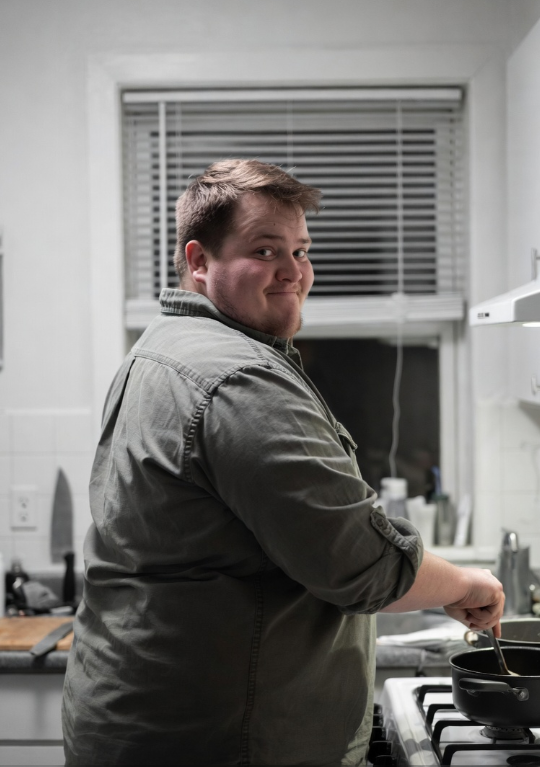
Jake is a twenty-nine-year-old brewery worker, newlywed, and proud Polish-American from Milwaukee's Bay View neighborhood. He didn't start cooking until his grandmother Babcia Helen passed away and left behind a stack of grease-stained recipe cards. Now he makes pierogi from scratch, smokes meats on a balcony smoker his landlord pretends not to notice, and writes for guys who want to cook good food but don't know a roux from a rub.
