Sophie's daughter Ingrid is one year old this season. The Kenwood kitchen has a high chair again. The high chair is a thirty-five-year-old artifact pulled from the basement and scrubbed clean and assembled at the same kitchen table where Anna and Peter and Elsa once sat in it. Ingrid sits in it now. Ingrid eats the same applesauce and the same banana bread and the same baby version of meatballs. The kitchen receives the new generation without comment, the way the kitchen has always received everyone.
Anna had a small surgery. She is fine. I drove to Minneapolis for two weeks to help. I cooked. I cleaned. I cared. Anna said: "Mom, I had forgotten you were a nurse." I said: "I haven't." The thirty-five years at St. Mary's are not the kind of thing that fades. The skills come back at the first request. The hands remember how to take a pulse. The eyes remember how to read a face for pain. The role is permanent.
Elsa and Tom came for the weekend. Tom helped me move the heavy planters in the garden — the big terracotta ones I bought at a yard sale in 1995 that I cannot lift anymore. He did not ask. He just did it. He is the quiet kind of man Paul was. I see why Elsa loves him. The quiet men are not the loudest in the room, but they are usually the most useful. Paul taught me this by example. Tom is teaching it by repetition.
I cooked Whitefish chowder this week. Lake Superior whitefish from Russ Kendall's. Potato, leek, celery, cream, butter, dill. The chowder that lives in the bones of a Duluth November.
Thursday: soup. Always soup. Gerald said, "You are the most reliable woman in Duluth." I said, "I am the most reliable woman in this kitchen." He said, "Same thing." I do not think that is the same thing. I think that is a kindness Gerald gives me because Gerald is kind. I take the kindness. I do not argue.
I lit a candle in the kitchen for no particular reason. Maybe for Mamma. Maybe for Pappa. Maybe for Lars. Maybe for Paul. Maybe for all of them. The candle is a tall white tapered one, set in a brass holder Mamma had on her dining room table for forty years. I let it burn down. The dripping wax made a small white pool on the brass. I cleaned it off. I lit another one the next night.
It is enough. Paul is not here. Mamma is not here. Pappa is not here. Erik is not here. They are all here in the kitchen, in the smell, in the taste, in the wooden spoon and the bread pans and the marble slab. The dead are not where the body went. The dead are in the kitchen.
I have learned, slowly, that there is a kind of competence that comes only with age. Not wisdom, exactly — wisdom is a word too grand for what I mean. Competence. The competence of having watched many things go wrong and many things go right and having developed an internal database of which is which. The competence is, perhaps, the only thing that improves with age in a body that is otherwise declining. I will take the trade.
It is enough.
The chowder was Thursday. By Saturday I wanted something sweet — not for any occasion, just because the kitchen had been so savory and so serious all week, and Ingrid was in the high chair making her small sounds, and the light through the window was the particular pale gold that comes in late afternoon in a Duluth autumn. Rhubarb cheesecake is a thing Mamma made in June when the garden came up, and I make it any month I need to feel her standing beside me at the counter. I pulled the rhubarb from the freezer — cut and bagged in July, the way I always do — and I made it for no one in particular and for everyone who has ever sat at this table.
Rhubarb Cheesecake Dessert
Prep Time: 25 minutes | Cook Time: 50 minutes | Total Time: 1 hour 15 minutes (plus 2 hours cooling) | Servings: 12
Ingredients
- Crust:
- 1 1/2 cups graham cracker crumbs
- 1/4 cup granulated sugar
- 1/3 cup unsalted butter, melted
- Rhubarb Layer:
- 3 cups fresh or frozen rhubarb, cut into 1/2-inch pieces
- 1/2 cup granulated sugar
- 1 tablespoon cornstarch
- 1 tablespoon water
- Cheesecake Filling:
- 2 (8 oz) packages cream cheese, softened
- 3/4 cup granulated sugar
- 2 large eggs
- 1 teaspoon pure vanilla extract
- 1/2 cup sour cream
Instructions
- Preheat and prepare. Heat oven to 350°F. Lightly grease a 9x13-inch baking dish.
- Make the crust. Combine graham cracker crumbs, 1/4 cup sugar, and melted butter in a bowl. Stir until the crumbs are evenly moistened. Press firmly into the bottom of the prepared baking dish. Bake for 8 minutes, then set aside to cool slightly.
- Cook the rhubarb. In a small saucepan over medium heat, combine rhubarb, 1/2 cup sugar, cornstarch, and water. Stir and cook until the rhubarb softens and the mixture thickens, about 8—10 minutes. Remove from heat and let cool for 10 minutes.
- Make the cheesecake filling. Beat softened cream cheese and 3/4 cup sugar together with a hand mixer or stand mixer on medium speed until smooth and fluffy, about 2 minutes. Add eggs one at a time, beating well after each. Mix in vanilla and sour cream until fully combined.
- Layer and bake. Pour the cheesecake filling over the baked crust and spread evenly. Spoon the rhubarb mixture over the top in an even layer. Bake for 38—42 minutes, until the center is just set and the edges are lightly golden.
- Cool completely. Remove from oven and let cool at room temperature for 30 minutes, then refrigerate for at least 2 hours before cutting. Cut into bars and serve cold.
Nutrition (per serving)
Calories: 318 | Protein: 5g | Fat: 18g | Carbs: 35g | Fiber: 1g | Sodium: 208mg
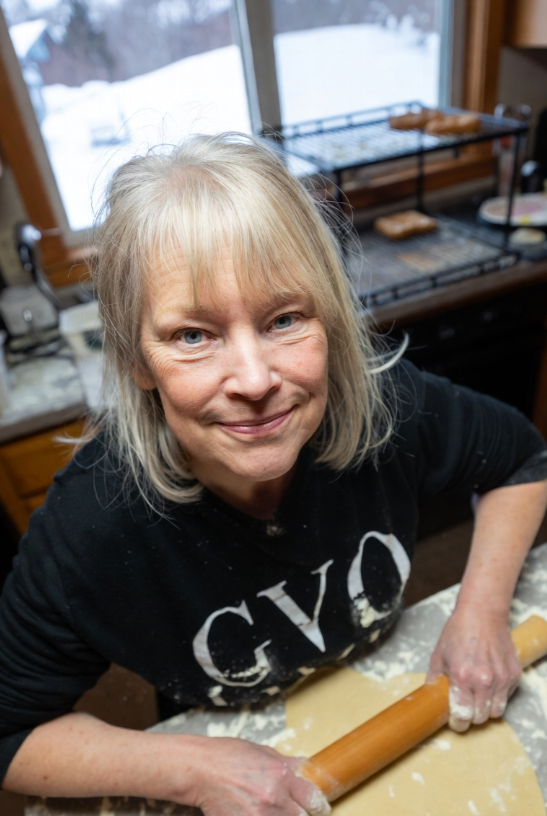
About the cook who shared this
Linda Johansson
Week 501 of Linda’s 30-year story
· Duluth, Minnesota
Linda is a sixty-three-year-old retired nurse from Duluth, Minnesota, living alone in the house where she raised her children and said goodbye to her husband. She lost Paul to ALS in 2020 after two years of watching the kindest man she'd ever known lose everything but his dignity. She cooks Scandinavian comfort food and Minnesota hotdish and the pot roast Paul loved, and she sets two places at the table out of habit because it makes her feel less alone. Every recipe she writes is a person she's loved.
