I baked at 6 AM because the house was too quiet and the oven is the surest way I know to make a house feel inhabited. The oven generates heat, smell, the small ticks of metal expanding, the predictable rise of dough on the counter, the timer I can hear from three rooms away. The oven is, in some real sense, my roommate. I have not told this to my children. They would gently suggest something. The oven and I prefer no suggestions.
Erik came over Sunday. He chopped wood for me without being asked — the pile by the back door was getting low, and Erik had noticed, and Erik had brought his ax, and Erik had spent forty-five minutes splitting and stacking and not making a single comment about how the wood needed to be done. He drank coffee. He left. The whole visit was forty-five minutes. It was perfect. Erik is a perfect brother in the specific way of Scandinavian brothers — silent, useful, present.
Mamma called Tuesday. Her voice was small but her mind was sharp. She wanted to talk about Pappa, of all people. About the time he fixed her bicycle in 1962. About how he always said "there" when he had finished a job, the same way every time, the small declarative finality. She had not thought of this in years, she said. The memory came to her in the kitchen, while she was peeling an apple. I listened. I did not interrupt. The memory was unprovoked and total. The memory is everything.
I cooked Easter ham this week. A bone-in ham, scored, glazed with brown sugar and mustard and orange juice, baked low for hours, basted often. The kitchen smells like Easter from every year of every life.
The Damiano Center on Thursday: wild rice soup, fifty gallons. Gerald helped me ladle. He told me about a regular who got into a sober house this week — a man named Curtis, who has been coming for soup for eight years and who has been sober for forty-three days now. The soup did not get him sober. The soup was there when he was hungry. The soup is the door, again. The door is the chance.
I read one of Paul's books in the evening. The Edmund Fitzgerald chapter. I have read it forty times now. The fortieth time is no less affecting than the first. The transmission still gives me a chill: "We are holding our own." Captain McSorley's last known words. The chapter ends with the wreck on the bottom of Lake Superior, and the men still inside, and the lake refusing to give up its dead. Paul read this chapter to me in 1989, on a winter evening, in the living room. I did not know then that he was reading me his own future.
It is enough. Paul is not here. Mamma is not here. Pappa is not here. Erik is not here. They are all here in the kitchen, in the smell, in the taste, in the wooden spoon and the bread pans and the marble slab. The dead are not where the body went. The dead are in the kitchen.
I have been thinking about the kitchen as a kind of slow-moving river. The river has carried things for a hundred and fifty years now — Mormor's recipes from Uppsala, brought across the Atlantic in steerage in the 1880s; Mamma's adaptations of those recipes for the cold of Minnesota; my own modifications, picked up over fifty years; the small experiments my granddaughters bring home from cooking shows they watch on phones. The river keeps moving. I am one bend in it. There will be others.
It is enough.
The ham came out of the oven at noon, and by afternoon the kitchen had given everything it had — the brown sugar crust, the orange and mustard in the air, the slow satisfaction of something tended well. But the morning had still been very early and very quiet, and at 6 AM there is a particular need for something small and manageable, something that comes together in stages and asks you to pay attention. These Mini Apricot Turnovers were that thing. The apricot jam carries a brightness that feels like early spring, and folding the pastry edges together — that small, repetitive, deliberate act — is exactly the kind of work a quiet house needs done before the rest of the day arrives.
Mini Apricot Turnovers
Prep Time: 20 min | Cook Time: 18 min | Total Time: 38 min | Servings: 16 turnovers
Ingredients
- 1 package (17.3 oz) frozen puff pastry sheets (2 sheets), thawed
- 3/4 cup apricot jam or preserves
- 1 teaspoon fresh lemon juice
- 1/2 teaspoon vanilla extract
- 1 egg, beaten
- 1 tablespoon water
- 2 tablespoons coarse sugar or granulated sugar, for sprinkling
- 1/4 teaspoon cinnamon (optional)
Instructions
- Preheat oven. Heat oven to 400°F. Line two baking sheets with parchment paper and set aside.
- Prepare filling. In a small bowl, stir together the apricot jam, lemon juice, vanilla extract, and cinnamon if using. Set aside.
- Cut pastry. Unfold each puff pastry sheet on a lightly floured surface. Cut each sheet into 8 equal squares (4 cuts per sheet), giving you 16 squares total.
- Fill. Spoon about 1 heaping teaspoon of the apricot filling into the center of each square. Do not overfill or the edges won’t seal properly.
- Fold and seal. Fold each square diagonally to form a triangle. Press the edges firmly together with your fingertips, then crimp with a fork to seal completely.
- Egg wash. In a small bowl, whisk the egg with 1 tablespoon of water. Brush the top of each turnover lightly with egg wash, then sprinkle with coarse sugar.
- Vent. Use a sharp knife or fork to make one small slit in the top of each turnover to allow steam to escape during baking.
- Bake. Arrange turnovers on prepared baking sheets, spacing them at least 1 inch apart. Bake 16–18 minutes, until deeply golden and puffed. Rotate pans halfway through if your oven runs uneven.
- Cool. Let turnovers rest on the baking sheet for 5 minutes before transferring to a wire rack. They are good warm or at room temperature.
Nutrition (per serving)
Calories: 165 | Protein: 2g | Fat: 9g | Carbs: 20g | Fiber: 0g | Sodium: 95mg
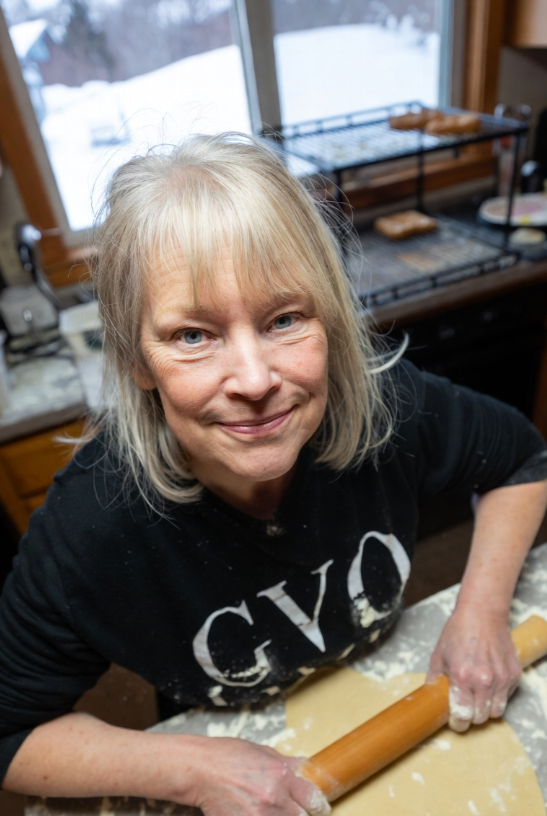
About the cook who shared this
Linda Johansson
Week 315 of Linda’s 30-year story
· Duluth, Minnesota
Linda is a sixty-three-year-old retired nurse from Duluth, Minnesota, living alone in the house where she raised her children and said goodbye to her husband. She lost Paul to ALS in 2020 after two years of watching the kindest man she'd ever known lose everything but his dignity. She cooks Scandinavian comfort food and Minnesota hotdish and the pot roast Paul loved, and she sets two places at the table out of habit because it makes her feel less alone. Every recipe she writes is a person she's loved.
