
 By
By Spring in Alaska is tentative, like a patient who's been cleared to leave the hospital but keeps looking back at the building. The snow is melting — really melting now, not the false starts of March but the real, committed melt that turns the city into a network of rivulets and puddles and the particular brownness of a landscape shedding its winter coat. The air smells like wet earth and spruce and freedom, and the moose calves are starting to appear, leggy and ungainly, following their mothers through suburban yards with the blind confidence of creatures who don't know they weigh forty pounds and will eventually weigh a thousand.
I wrote a new blog post this week: "King Crab Lumpia: The Fusion My Mother Would Never Approve Of." It's about the lumpia I make with king crab instead of the traditional ground pork — a recipe that exists because I live in Alaska, where king crab is available and affordable (relatively) and because my parents taught me that cooking is adaptation, that the recipe from Iloilo doesn't have to stay in Iloilo, that the kitchen moves with you and the ingredients change and the food is still yours.
Lourdes, predictably, has opinions about king crab lumpia. "It's not lumpia," she says. "It's king crab wrapped in a spring roll. That's different." She eats them anyway. She eats six. The opinions and the eating coexist in Lourdes the way they coexist in all Filipino mothers — the critique is the tradition, the eating is the acceptance, and both happen simultaneously, without contradiction, because Filipino mothers contain multitudes.
The king crab lumpia are simple: king crab meat — real, not imitation, because imitation crab is a personal insult — mixed with cream cheese, green onions, and a dash of garlic. Wrapped in spring roll wrappers. Fried until golden. The crab is sweet and the cream cheese is rich and the wrapper is crispy and the whole thing disappears in two bites, which means you need to make a lot of them, which means the kitchen fills with the smell of hot oil and the sound of sizzling and the particular satisfaction of creating something that exists because you live where you live and cook with what's in front of you.
I brought a batch to the ER. Gone in four minutes. Sarah said, "Santos, you're making these for every holiday." Pete said, "I will pay you actual money." Dr. Martinez googled Filipino food on his phone while eating his third one. The ER loves my food. I love that the ER loves my food. Feeding the people who feed the world's broken — it's the most useful version of myself I've found.
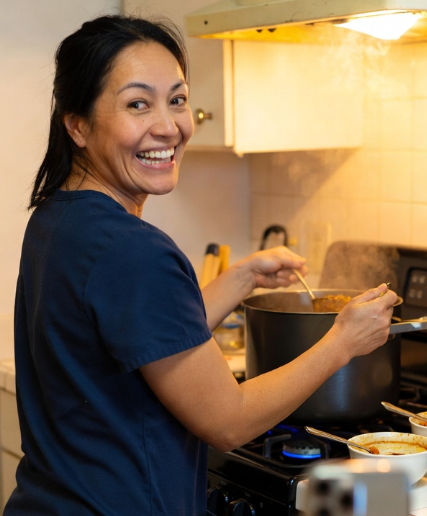
The batch I brought to the ER was gone before I even got my coat off, and Pete’s offer to pay me actual money is still on the table — so it felt right to write down the closest thing to a proper recipe I follow when I make these. Mary’s Very Authentic Egg Rolls is the backbone I learned from, the technique my hands remember even when my brain is running on a twelve-hour shift and adrenaline: a crispy wrapper, a savory filling, hot oil, patience. I swap in king crab and cream cheese because that’s what Alaska gives me, but the frying, the folding, the smell that takes over the whole apartment — that part is universal, and that part is entirely Lourdes’s fault.
Mary’s Very Authentic Egg Rolls
Prep Time: 25 min | Cook Time: 20 min | Total Time: 45 min | Servings: 24 egg rolls
Ingredients
- 1 lb king crab meat, picked over and roughly chopped (or ground pork for traditional)
- 8 oz cream cheese, softened
- 4 green onions, thinly sliced
- 3 cloves garlic, minced
- 1 cup shredded cabbage
- 1/2 cup shredded carrots
- 2 tablespoons soy sauce
- 1 tablespoon sesame oil
- 1 teaspoon fresh ginger, grated
- 1/2 teaspoon white pepper
- 24 egg roll wrappers (7-inch square)
- 1 egg, beaten (for sealing)
- Vegetable oil, for frying (about 4 cups)
- Sweet chili sauce or soy-ginger dipping sauce, for serving
Instructions
- Make the filling. In a large bowl, combine the crab meat, softened cream cheese, green onions, garlic, cabbage, carrots, soy sauce, sesame oil, ginger, and white pepper. Mix until evenly combined. Taste and adjust seasoning as needed.
- Set up your rolling station. Lay an egg roll wrapper on a clean surface with one corner pointing toward you (diamond orientation). Place about 2 tablespoons of filling in the lower center of the wrapper, leaving a 1-inch border on the sides.
- Roll and seal. Fold the bottom corner up over the filling, then fold in the two side corners snugly. Roll upward firmly, then brush the top corner with beaten egg and press to seal. Repeat with remaining wrappers and filling.
- Heat the oil. Pour vegetable oil into a heavy-bottomed pot or deep skillet to a depth of about 2 inches. Heat over medium-high until it reaches 350°F. A small piece of wrapper dropped in should sizzle immediately.
- Fry in batches. Working in batches of 4–6, carefully lower egg rolls into the hot oil seam-side down. Fry for 3—4 minutes, turning occasionally, until deep golden brown and crispy on all sides. Do not crowd the pot.
- Drain and rest. Transfer fried egg rolls to a wire rack set over a baking sheet or a plate lined with paper towels. Let rest for 2 minutes before serving — the filling is very hot.
- Serve. Arrange on a platter with sweet chili sauce or a soy-ginger dipping sauce on the side. Serve immediately. They will not last long.
Nutrition (per serving)
Calories: 148 | Protein: 7g | Fat: 8g | Carbs: 12g | Fiber: 1g | Sodium: 310mg