Sophie's daughter Ingrid is one year old this season. The Kenwood kitchen has a high chair again. The high chair is a thirty-five-year-old artifact pulled from the basement and scrubbed clean and assembled at the same kitchen table where Anna and Peter and Elsa once sat in it. Ingrid sits in it now. Ingrid eats the same applesauce and the same banana bread and the same baby version of meatballs. The kitchen receives the new generation without comment, the way the kitchen has always received everyone.
Anna had a small surgery. She is fine. I drove to Minneapolis for two weeks to help. I cooked. I cleaned. I cared. Anna said: "Mom, I had forgotten you were a nurse." I said: "I haven't." The thirty-five years at St. Mary's are not the kind of thing that fades. The skills come back at the first request. The hands remember how to take a pulse. The eyes remember how to read a face for pain. The role is permanent.
Elsa and Tom came for the weekend. Tom helped me move the heavy planters in the garden — the big terracotta ones I bought at a yard sale in 1995 that I cannot lift anymore. He did not ask. He just did it. He is the quiet kind of man Paul was. I see why Elsa loves him. The quiet men are not the loudest in the room, but they are usually the most useful. Paul taught me this by example. Tom is teaching it by repetition.
I cooked Tater tot hotdish this week. The first frost dish. Ground beef, soup, green beans, tots in concentric rings.
Damiano Thursday: soup. The crowd was the usual size — about a hundred and twenty plates served between five and seven. Gerald and I worked side by side without talking. The not-talking was the friendship. The work has its own rhythm: ladle, hand, smile, ladle, hand, smile. The rhythm carries us through.
I sat in the kitchen at 11 PM with a glass of wine and Paul's photograph. I did not cry. I just sat. The not-crying is its own form of being with him. We did not need to talk all the time when he was alive. We do not need to talk all the time now. The companionable silence has carried over.
It is enough. Paul is not here. Mamma is not here. Pappa is not here. Erik is not here. They are all here in the kitchen, in the smell, in the taste, in the wooden spoon and the bread pans and the marble slab. The dead are not where the body went. The dead are in the kitchen.
Paul used to say that the difference between a place and a home was that a home was a place where you knew, from any room, what was happening in any other room. I knew, from the kitchen, when he was reading in the living room. I knew, from the bedroom, when he was getting coffee in the kitchen. The Kenwood house is still that kind of home. From the kitchen I know that Sven is asleep on his bed in the dining room (the small specific snore). From the kitchen I know what time the radio in the living room is set to come on. The home is the body of knowledge of itself. I still live inside that body of knowledge, even though Paul is not the one creating most of the data anymore.
I keep a small notebook on the kitchen counter — green spiral-bound, from the drugstore. I write in it most days. The notebook holds the things I do not want to forget — Erik's stories about Pappa, Karin's notes about Mormor, Sophie's first words about her babies, the recipes I have changed slightly and want to remember in their changed form. The notebook is a small museum. The museum will go to Anna eventually, and then to Sophie, and then to Sophie's daughter Ingrid, and then onward.
It is enough.
The week I made the Tater tot hotdish — the first frost dish, the one that tells me summer is officially done — I also kept something out on the counter for grazing, because there were always people coming through: Elsa and Tom moving planters, Anna recovering, Ingrid in the high chair reaching for whatever was nearest. A Harvest Snack Mix is exactly right for that kind of week — it asks nothing of you, it feeds whoever is standing in the kitchen at any hour, and it disappears without ceremony. That is the highest compliment I know how to give a recipe.
Harvest Snack Mix
Prep Time: 10 min | Cook Time: 45 min | Total Time: 55 min | Servings: 16
Ingredients
- 3 cups corn or rice square cereal
- 3 cups small pretzels or pretzel sticks
- 2 cups roasted mixed nuts
- 2 cups candy corn or autumn harvest candy pieces
- 1 cup dried cranberries
- 1 cup pumpkin seeds (pepitas), roasted and salted
- 3 tablespoons unsalted butter, melted
- 1 tablespoon Worcestershire sauce
- 1/2 teaspoon garlic powder
- 1/2 teaspoon onion powder
- 1/2 teaspoon seasoned salt
Instructions
- Preheat oven. Heat oven to 250°F. Line a large rimmed baking sheet with foil.
- Combine dry ingredients. In a large bowl, toss together the cereal, pretzels, nuts, and pumpkin seeds. Set aside the candy corn and dried cranberries — these go in after baking.
- Make the seasoning butter. Whisk together the melted butter, Worcestershire sauce, garlic powder, onion powder, and seasoned salt in a small bowl.
- Coat the mix. Drizzle the butter mixture over the dry ingredients and stir gently until everything is evenly coated.
- Bake. Spread in a single layer on the prepared baking sheet. Bake for 45 minutes, stirring every 15 minutes, until the mix is lightly golden and toasted.
- Cool and finish. Remove from oven and let cool completely on the baking sheet, about 20 minutes. Stir in the candy corn and dried cranberries once fully cooled.
- Store. Transfer to an airtight container or set out in a bowl. Keeps at room temperature for up to one week.
Nutrition (per serving)
Calories: 210 | Protein: 5g | Fat: 11g | Carbs: 25g | Fiber: 2g | Sodium: 220mg
About the cook who shared this
Linda Johansson
Week 551 of Linda’s 30-year story
· Duluth, Minnesota
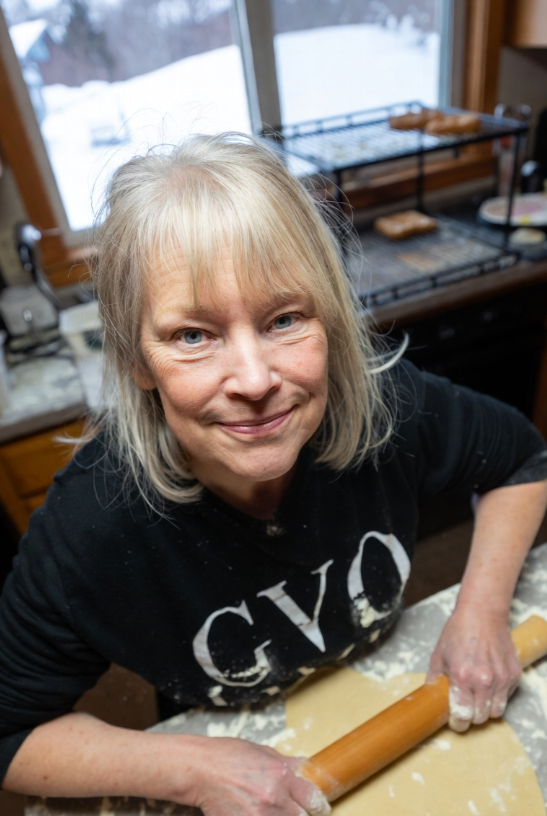
Linda is a sixty-three-year-old retired nurse from Duluth, Minnesota, living alone in the house where she raised her children and said goodbye to her husband. She lost Paul to ALS in 2020 after two years of watching the kindest man she'd ever known lose everything but his dignity. She cooks Scandinavian comfort food and Minnesota hotdish and the pot roast Paul loved, and she sets two places at the table out of habit because it makes her feel less alone. Every recipe she writes is a person she's loved.
