
 By
By Rosa died on Thursday. September 15, 2016. Mexican Independence Day. She died on the day Mexico celebrates freedom, and I don't know if that is poetry or cruelty or both, and I don't know if it matters, and I don't know anything except that my mother is dead and the world is darker and smaller and the kitchen is colder and the flour on my hands feels different now — not like bread but like dust, like ash, like the remains of something that burned out.
Carmen called at 6 AM. I was at the bakery. I had just put the first tray of conchas in the oven. Carmen said, "Maria Elena," and nothing else, and I knew. You always know. The silence between your name and the news is the loudest silence in the world. I said, "When?" She said, "During the night. Beatriz found her this morning. She was in the kitchen. She was sitting in her chair in the kitchen." Of course she was. Of course Rosa died in the kitchen. Where else would she die? The kitchen was her kingdom and her prison and her church and her life, and she died there the way queens die on their thrones — seated, surrounded by the things they built.
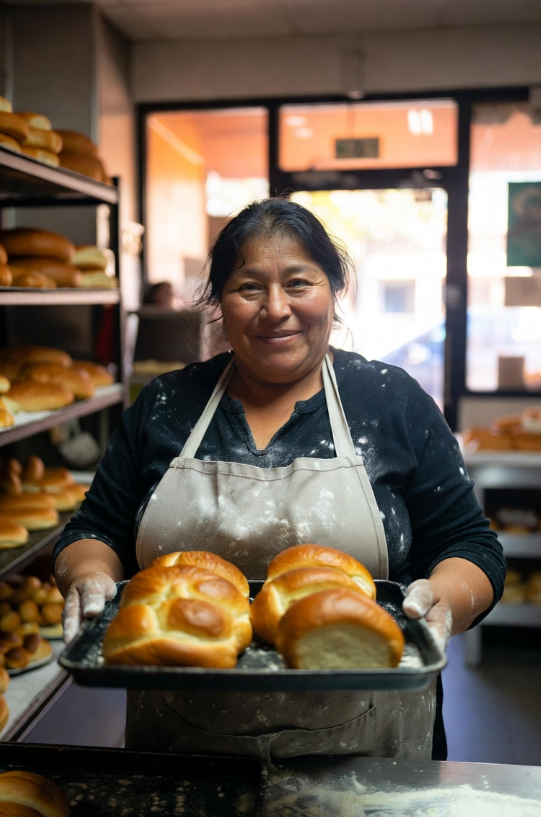
I closed the bakery. I pulled the conchas out of the oven — they were perfect, golden, Rosa's recipe, the last batch I will ever make without knowing my mother is dead, and the next batch I make she will already be gone, and every batch after that will be an act of memory instead of an act of communication, and the difference is a chasm I cannot see the bottom of.
I crossed the bridge that afternoon with Luis and Carmen. We drove to Anapra. The house was full of people — family, neighbors, women from the maquiladora where Rosa worked for twenty years. The kitchen smelled like food because someone was cooking, because that is what you do when someone dies — you cook, you feed the living, you fill the silence with the sound of chopping and stirring because the silence without it is unbearable.
I saw her. Beatriz had dressed her in her good dress — the blue one, the one she wore to Luis Jr.'s baptism. Her hands were folded on her chest and I looked at her hands and thought: those hands. Those hands that made ten thousand tortillas, that sewed jeans, that found Javier on the street, that held me when I was small and afraid and didn't know the world was hard. Those hands are still now. Those hands will never move again. And I held them — her cold, still hands — and I said, in Spanish, because some things only exist in Spanish: "Mamá, I have your recipes. I have all of them. They will not die. I promise. They will not die."
The funeral was Saturday. A small church in Anapra, the same church where we buried Javier twenty-three years ago. The priest said Rosa's name and I heard it in the stone walls, echoing, and I thought: her name is on my bakery. Her name is on a building in a country she never lived in, and now her name is in the air of a church in the country she never left, and between those two countries, across that bridge, her name is all I have of her, and it is enough, and it is not enough, and it will never be enough.
We buried her next to Javier. Mother and son. I stood at the grave and promised what I promised in the hospital: the recipes. The bakery. The name. I promised and I meant it with every cell in my body, with every grain of flour in my hands, with every tortilla I have ever made and every tortilla I will ever make. The recipes will live. Rosa will live in them. That is the deal I am making with death, and death does not get to negotiate.
I did not cook this week. I could not cook this week. The kitchen felt like a museum — every pot, every pan, every spice an artifact of a woman who is gone. Luis made sandwiches. Carmen brought food. The children ate. I did not eat. I could not eat. My mother is dead and eating feels like betrayal, like moving on, like forgetting, and I am not ready to do any of those things. I am not ready. I am not ready. I am not ready.
Carmen brought guacamole the second day, store-bought in a plastic container, and the children ate it with chips on the couch while I sat and watched them and thought: this I can do. Not Rosa’s mole, not her tamales — those recipes are sacred and I am not ready to touch them yet — but this. Ten minutes. No heat. No standing over a stove in a kitchen that still smells like her. Just a bowl and a fork and avocados that ask nothing of me. This week I am sharing guacamole, because it is the only thing I could bring myself to make, and sometimes that is enough.
Guacamole — For the Weeks You Cannot Cook
Prep Time: 10 minutes | Cook Time: None | Total Time: 10 minutes | Servings: 4
Ingredients
- 3 ripe avocados, halved and pitted
- 1 lime, juiced
- 1/2 teaspoon kosher salt, plus more to taste
- 1/2 small white onion, finely diced
- 2 Roma tomatoes, seeded and finely diced
- 2 tablespoons fresh cilantro, chopped
- 1 serrano or jalapeño pepper, stemmed, seeded, and minced
- 1 clove garlic, minced (optional)
Instructions
- Scoop the avocado. Scoop the avocado flesh into a medium bowl. Add the lime juice and salt.
- Crush it. Use a fork or a molcajete to mash the avocado to your preferred texture — some people want it smooth, some want it rough and real. Both are right. There is no wrong way to do this.
- Add the rest. Fold in the onion, tomatoes, cilantro, and pepper. Add the garlic if using. Stir gently to combine.
- Taste and adjust. Add more salt or lime until it tastes like something. Eat it with chips, with bread, with a spoon standing over the counter. No one is watching. No one is judging. Eat it however you can.
Nutrition (per serving)
Calories: 160 | Protein: 2g | Fat: 14g | Carbs: 10g | Fiber: 7g | Sodium: 150mg