
 By
By Portland fall. The Japanese maple turning the color of sunset. Sunday farmers market. Tomatoes, shiso, kabocha when in season, mushrooms in fall. The shopping list is short and exact.
Miya, 9, can shape onigiri without falling apart. She uses wet hands. She knows the order without being told.
Roasted vegetables — kabocha, brussels sprouts, beets — finished with miso butter. The Pacific Northwest fall meal.
I made dashi at five. The day began.
Sunday farmers market in the rain. The vendors knew me. The Hood River apple stand had honeycrisps. I bought four pounds.
I read for an hour Sunday night. A book of essays by a Korean-American writer about food and grief. I underlined a paragraph that said exactly what I had been trying to say in the newsletter for months.
The rain in long sheets Tuesday afternoon. I made tea. I watched it from the porch. The cottonwoods on the next block were silver in the wet.
The neighbor's dog barked at nothing for twenty minutes Sunday afternoon. The neighbor apologized. I told him I had been writing through it and the white noise was helpful. He laughed.
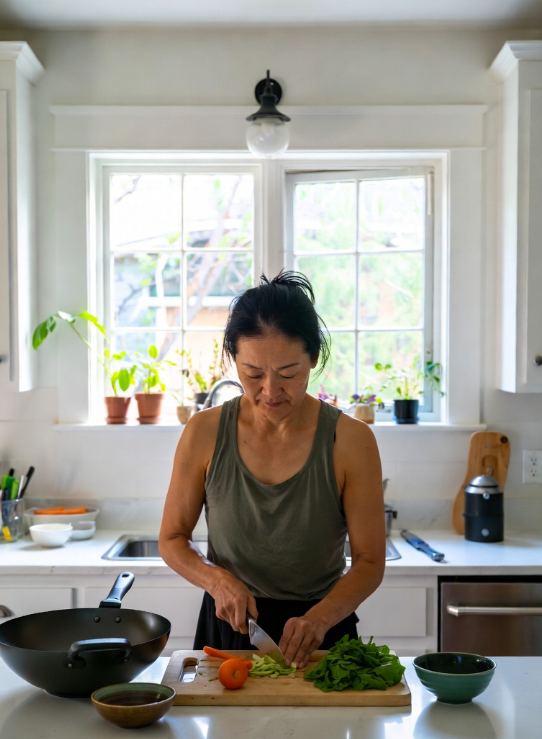
I cleaned the kitchen Sunday afternoon. Wiped the counters. Reorganized the drawer where the chopsticks live. Sharpened the knife. The reset was the reset.
A panic flicker Tuesday evening, brief, manageable. I breathed. I drank water. I went outside and walked around the block. The flicker passed. The body did its work.
The cat was the cat. Mochi at fifteen sleeps most of the day. She still eats with enthusiasm. She still sits at the kitchen window watching the back garden.
I texted Miya a photo of the shiso. She texted back a heart and a single word: home.
Tomi watered the garden Saturday morning. The shiso was head-high. The shishito peppers were producing. The kabocha was running on the fence.
Miya is in elementary school. The Saturday Japanese school continues. She still complains. She is still going.
A reader sent me a handwritten card this week. Her grandmother had cooked Japanese food in 1970s Boise. She had felt alone in it. The newsletter, she wrote, made her feel less alone. I taped the card to the wall above my desk.
Therapy Tuesday. We talked about the wedding. We talked about Barbara. We talked about Fumiko. The hour passed. The work continues.
Made dashi at five-thirty AM. Ten minutes in the kitchen alone with the kombu and the bonito flakes. The day's first prayer.
I drove to Uwajimaya Wednesday. Kombu, bonito flakes, white miso, a small bag of mochiko for tomorrow's project. The store smells like home.
Coffee with a friend Saturday morning. We talked about books, about kids, about the way our forties became our fifties. The talking is the thing.
I made onigiri for tomorrow's lunch. Three triangles. Salted plum in the center. Wrapped in nori. The cling wrap. The drawer where I keep them. The system.
Yoga Tuesday morning. The studio in Sellwood. Eight students. The class was the class.
Miya's old room is now my office. The desk is by the window. The shiso outside. The newsletter in progress. The afternoons are quiet.
I wrote at the kitchen table from six to eight. The newsletter was forming. The opening sentence was the hard sentence — they always are. I rewrote it five times. The fifth time was the right time.
The kabocha running on the fence, the shiso head-high, the farmers market vendors who already know what I’ll reach for — fall in Portland asks for something sweet that still tastes like the earth. When the roasted vegetables were finished and Miya had texted back that single word, I wanted to carry the season one step further, into something I could share. These gluten-free pumpkin bars are where that impulse lands: the same warmth as a kabocha roasted in miso butter, but quieter, held together, something to wrap and leave on a neighbor’s porch or eat alone at the kitchen table before the newsletter finds its opening sentence.
Gluten-Free Pumpkin Bars
Prep Time: 15 min | Cook Time: 30 min | Total Time: 45 min | Servings: 16 bars
Ingredients
- 2 cups gluten-free all-purpose flour blend
- 1 1/2 teaspoons baking powder
- 1/2 teaspoon baking soda
- 1/2 teaspoon fine sea salt
- 1 1/2 teaspoons ground cinnamon
- 1/2 teaspoon ground ginger
- 1/4 teaspoon ground nutmeg
- 1/4 teaspoon ground cloves
- 1 cup pumpkin puree (or kabocha squash puree)
- 3/4 cup granulated sugar
- 1/4 cup packed light brown sugar
- 2 large eggs, room temperature
- 1/2 cup neutral oil (such as avocado or sunflower)
- 1 teaspoon pure vanilla extract
- 4 ounces cream cheese, softened
- 1 cup powdered sugar, sifted
- 2 tablespoons unsalted butter, softened
- 1–2 tablespoons whole milk
Instructions
- Preheat and prepare. Heat oven to 350°F (175°C). Lightly grease a 9×13-inch baking pan and line with parchment paper, leaving an overhang on two sides.
- Whisk the dry ingredients. In a medium bowl, whisk together the gluten-free flour, baking powder, baking soda, salt, cinnamon, ginger, nutmeg, and cloves until evenly combined.
- Mix the wet ingredients. In a large bowl, whisk the pumpkin puree, granulated sugar, brown sugar, eggs, oil, and vanilla until smooth and well combined.
- Combine. Add the dry ingredients to the wet ingredients and fold with a spatula until just combined. Do not overmix; the batter will be thick.
- Bake. Spread the batter evenly into the prepared pan. Bake for 28–32 minutes, or until a toothpick inserted in the center comes out clean and the edges are set. Let cool completely in the pan on a wire rack before frosting.
- Make the cream cheese frosting. Beat the cream cheese and softened butter together until smooth and fluffy, about 2 minutes. Add powdered sugar and vanilla; beat on low until incorporated, then on medium until light. Add milk one tablespoon at a time to reach a spreadable consistency.
- Frost and slice. Spread the frosting evenly over the cooled bars. Using the parchment overhang, lift the slab from the pan onto a cutting board. Cut into 16 bars. Store covered in the refrigerator for up to 4 days.
Nutrition (per serving)
Calories: 245 | Protein: 3g | Fat: 11g | Carbs: 35g | Fiber: 1g | Sodium: 145mg