
 By
By The last week of February, which in Iowa means the beginning of the argument between winter and spring — the temperature rising to forty for a day, then dropping back to twenty, the snow melting and refreezing, the ground softening and hardening, the whole state locked in an indecisive standoff between two seasons that can't agree on whose turn it is. I'm ready for spring. The kitchen is ready for spring. The windowsill seedlings are ready for spring. Jack is ready for spring with a fervor that borders on spiritual — he checks the soil temperature with a thermometer every morning, crouched in the backyard in his boots and coat, and reports the reading at breakfast like a weather service for the garden. "Thirty-four degrees at four inches," he says. "We need fifty for planting." We need fifty. As if the soil's temperature is a personal obligation, a debt the earth owes him. It will get there. The earth always pays its debts. But not in February.
The seedlings are thriving. The windowsill is green — twelve tomato plants, eight pepper plants, and the marigolds from Jack's Valentine's Day seed packet, which Emma is growing on her own windowsill with minimal success and maximum commentary ("They're struggling because the light angle is wrong. I need a grow light." She does not need a grow light. She needs patience. Patience and a south-facing window, neither of which can be purchased on Amazon).
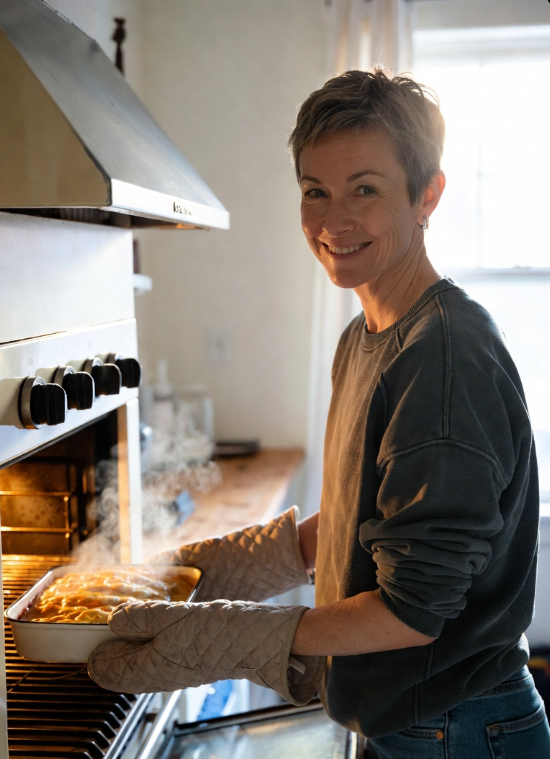
I made shepherd's pie — the late-February dish, the one that's hearty enough for winter and savory enough for the transition. Ground lamb (a rarity in this kitchen — I usually use beef, but the Ankeny butcher had lamb and I was feeling expansive), peas, carrots, corn, all simmered in gravy and topped with mashed potatoes, browned under the broiler until the peaks are golden and crispy. The first forkful is the whole dish — the meat and the vegetables and the potato and the gravy, all in one bite, the way a good casserole should work, everything together, nothing separate, a unified experience of being warm and fed and cared for by the person who stood at the stove and assembled it.
Kevin's birthday is next month. He wants the same thing he always wants: reverse-seared ribeye. The man is consistent. I am grateful for his consistency. In a world that changes — farms that sell, mothers who age, children who grow — Kevin's birthday steak is a fixed point. The steak endures. The man endures. The marriage endures. I will buy the steak and I will sear it and I will watch him eat it with his eyes closed and I will think: this is what holding on looks like. It looks like a man and a steak and a woman who knows how to cook it.
The shepherd’s pie carried us through the coldest stretch of that indecisive week, and then the next night I found myself back at the stove, Kevin’s birthday on the calendar and steak on my mind. His reverse-seared ribeye has its month, but the rest of February belongs to everyday beef — and this chopped steak, pan-seared until it’s got that dark, savory crust and finished in a simple onion gravy, is exactly the kind of meal that makes winter feel purposeful rather than just prolonged. It’s the weeknight version of the promise I make him every spring: we are fed, we are warm, and someone at this stove is paying attention.
Easy Chopped Steak
Prep Time: 10 minutes | Cook Time: 25 minutes | Total Time: 35 minutes | Servings: 4
Ingredients
- 1 1/2 lbs ground beef (80/20 blend recommended)
- 1 teaspoon garlic powder
- 1 teaspoon onion powder
- 1/2 teaspoon smoked paprika
- 1/2 teaspoon kosher salt
- 1/2 teaspoon black pepper
- 1 tablespoon Worcestershire sauce
- 1 tablespoon olive oil
- 1 medium yellow onion, thinly sliced
- 2 cloves garlic, minced
- 1 cup beef broth
- 1 tablespoon cornstarch
- 2 tablespoons cold water
- 1 tablespoon unsalted butter
- Fresh parsley, chopped, for garnish (optional)
Instructions
- Mix and shape the patties. In a large bowl, combine ground beef, garlic powder, onion powder, smoked paprika, salt, pepper, and Worcestershire sauce. Mix gently until just combined — do not overwork the meat. Form into 4 oval patties, roughly 3/4 inch thick. Press a shallow indent in the center of each with your thumb to prevent puffing.
- Sear the patties. Heat olive oil in a large cast-iron or heavy skillet over medium-high heat until shimmering. Add patties and sear without moving for 4—5 minutes per side, until a deep brown crust forms and the internal temperature reaches 160°F. Transfer to a plate and tent loosely with foil.
- Cook the onions. Reduce heat to medium. Add sliced onions to the same skillet (do not drain the drippings — they are the flavor). Cook, stirring occasionally, for 8—10 minutes until softened and beginning to caramelize. Add minced garlic and cook 1 minute more.
- Build the gravy. Pour beef broth into the skillet, scraping up any browned bits from the bottom. In a small bowl, whisk together cornstarch and cold water until smooth. Stir the slurry into the skillet and cook over medium heat, stirring, for 2—3 minutes until the gravy thickens. Stir in butter until melted and glossy.
- Return and finish. Nestle the seared patties back into the skillet, spooning gravy and onions over the top. Simmer on low for 3—4 minutes to heat through and marry the flavors. Taste and adjust seasoning. Garnish with parsley if desired and serve immediately over mashed potatoes, egg noodles, or rice.
Nutrition (per serving)
Calories: 390 | Protein: 31g | Fat: 24g | Carbs: 9g | Fiber: 1g | Sodium: 520mg