
 By
By Martin Luther King Jr. Day. In Memphis, this is not just a federal holiday — it is a reckoning, a remembrance, a wound that still bleeds. Dr. King was killed here, at the Lorraine Motel on Mulberry Street, on April 4, 1968. I was nine years old. I remember Mama crying. I remember Daddy not saying anything, which was not unusual for Daddy except that the silence was different this time — heavier, like the silence of a man who has seen something confirmed that he already knew: that this country will kill the people who try to save it.
Orange Mound holds MLK Day seriously. There was a march — a community walk from the Orange Mound Community Center to the National Civil Rights Museum at the Lorraine Motel, about four miles. I've done this walk every year since 1998, and every year I feel the weight of it — the weight of what happened on that balcony, the weight of what came before, the weight of what hasn't changed. I walked with Rosetta. Walter Jr. brought DeAndre, who is six and too young to understand the full history but old enough to walk and to see the adults around him walking with purpose and to absorb, in whatever way a child absorbs these things, that this day matters and these steps matter and the people who walked these streets before him were walking toward something that hasn't arrived yet.
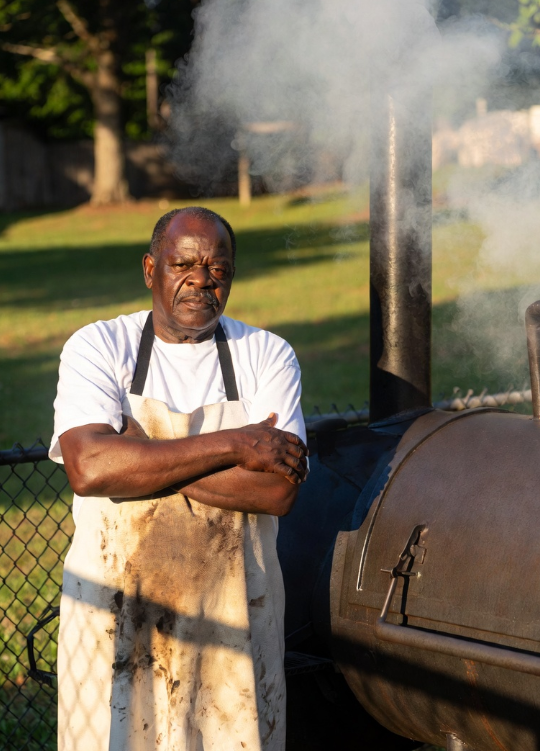
After the march, the community center hosted a meal — free, open to everyone, the way Dr. King would have wanted it. I smoked two pork shoulders for the event, because this is how I serve my community: with fire and smoke and sixteen hours of patience. The meat was pulled and served on white bread with slaw, and I stood behind the serving table and scooped portions for three hours, and every plate I served was a prayer: Let this nourish someone. Let this matter. Let the simple act of feeding people be enough, because it's what I have.
Marcus was there with his students — a group of fifteen high schoolers from Westwood who performed a spoken word piece about Memphis and memory that was so good it made grown men cry and teenage boys pretend they weren't crying, which is the same thing. Marcus teaches these kids music, but he also teaches them that art is a response to injustice, and that making beautiful things in ugly times is not escapism but resistance. I am proud of my son. I am proud in a way that goes beyond the ordinary pride of a father — I am proud of the man he chose to become, which is a man who gives away what he has to people who need it, which is the only inheritance that matters.
That evening, I sat in the living room and watched a documentary about the sanitation workers' strike of 1968 — the "I Am a Man" strike that brought Dr. King to Memphis in the first place. Black men, sanitation workers, on strike for fair wages and safe conditions, carrying signs that said I AM A MAN, which is the most powerful sentence in the English language because it should be obvious and the fact that it needed to be said on a sign is the indictment. I thought about my daddy, a factory worker. I thought about myself, a mail carrier. I thought about the men in that documentary, carrying garbage and dignity in equal measure, and I thought: We are the same. Different jobs, different decades, same fight. The fight to be seen. The fight to be valued. The fight to sit at the table.
I turned off the TV and went to the kitchen and made a pot of oxtail stew — a dish that has nothing to do with MLK Day specifically but everything to do with the day's meaning. Oxtails are a poor man's cut, the tail of the cow, tough and bony and full of connective tissue. Nobody wanted them, once upon a time. But when you braise them low and slow — four hours in a Dutch oven with red wine, tomatoes, onion, garlic, thyme, and bay leaf — the collagen melts into silk and the meat falls from the bone and the poor man's cut becomes the richest dish on the table. That's the metaphor. That's the lesson. Value is not determined by what the world thinks you're worth. Value is determined by what happens when someone takes the time to treat you right.
I made the oxtail stew that night for myself — but when I sit down to write this recipe for you, I keep coming back to the polenta I served alongside it, because polenta is the same lesson in a different form: ground corn, poor man’s grain, stirred slow with patience until it becomes something warm and rich and worthy of any table. After a day like that one — the march, the meal, the documentary, the silence of men carrying signs that should never have needed to be made — I needed food that understood what it meant to be underestimated. This polenta, finished with good cheese and paired with bitter broccoli rabe that softens under heat, is that food. It’s the metaphor made edible.
Creamy Polenta with Broccoli Rabe
Prep Time: 10 minutes | Cook Time: 35 minutes | Total Time: 45 minutes | Servings: 4
Ingredients
- 1 bunch broccoli rabe (rapini), tough stems trimmed, roughly chopped
- 3 cloves garlic, thinly sliced
- 3 tablespoons olive oil, divided
- 1/4 teaspoon crushed red pepper flakes
- Salt and black pepper, to taste
- 4 cups water or low-sodium chicken or vegetable broth
- 1 cup coarse-ground polenta (not instant)
- 2 tablespoons unsalted butter
- 1/2 cup freshly grated Parmesan or Pecorino Romano cheese
- 1/4 cup whole milk or heavy cream
Instructions
- Blanch the broccoli rabe. Bring a large pot of salted water to a boil. Add the broccoli rabe and blanch for 2 minutes to take the edge off the bitterness. Drain and set aside.
- Sauté the greens. In a wide skillet, heat 2 tablespoons of the olive oil over medium heat. Add the garlic and cook, stirring, for 1 minute until fragrant and just golden. Add the blanched broccoli rabe and red pepper flakes. Toss to coat, season with salt and black pepper, and cook for 5–7 minutes until tender and slightly caramelized at the edges. Set aside and keep warm.
- Bring the liquid to a boil. In a medium heavy-bottomed saucepan, bring the water or broth to a boil over medium-high heat. Add 1 teaspoon of salt.
- Whisk in the polenta. Reduce heat to medium-low. Slowly pour in the polenta in a thin, steady stream, whisking constantly to prevent lumps. Once all the polenta is incorporated, switch to a wooden spoon.
- Cook low and slow. Cook the polenta, stirring frequently, for 25–30 minutes until it pulls away from the sides of the pan and loses its raw, gritty texture. This step cannot be rushed — patience is what makes it silk.
- Finish with richness. Remove from heat. Stir in the butter, Parmesan, and milk or cream. Taste and adjust salt. The polenta should be loose enough to pour and settle — it will thicken as it sits.
- Plate and serve. Spoon the creamy polenta into wide shallow bowls. Top with the sautéed broccoli rabe. Drizzle with the remaining tablespoon of olive oil and a final grating of cheese if desired. Serve immediately.
Nutrition (per serving)
Calories: 310 | Protein: 9g | Fat: 16g | Carbs: 34g | Fiber: 4g | Sodium: 420mg