
 By
By The rhubarb sour launched and it's the best sour I've ever made. Tart, pink, with a brightness that tastes like spring in a glass. The taproom sold through the first keg in three days. The beer blogs are writing about it. A food magazine wants to feature it. The head brewer said, "Not bad." NOT BAD. From a man who has said approximately fourteen positive things in twelve years, "not bad" about a sour beer is a coronation.
The seasonal sour series is working. Spring: rhubarb. Summer: cherry (in production). Fall: apple (planned). Winter: cranberry (dreaming). Each one tells a story about Wisconsin, about the fruit, about the season. The sours are not just beer. They are time capsules of the place where I live, pressed into liquid form. Babcia would not have understood sour beer. She would have understood the principle: take what the land gives you and make something beautiful.
Tommy tried rhubarb. Not the beer — pureed rhubarb, sweetened slightly, served on a tiny spoon. He made a face that suggested rhubarb is the worst thing that has ever happened to him. Then he opened his mouth for more. This is the Kowalski relationship with tart food: hate it, eat it, ask for more. He's one of us.
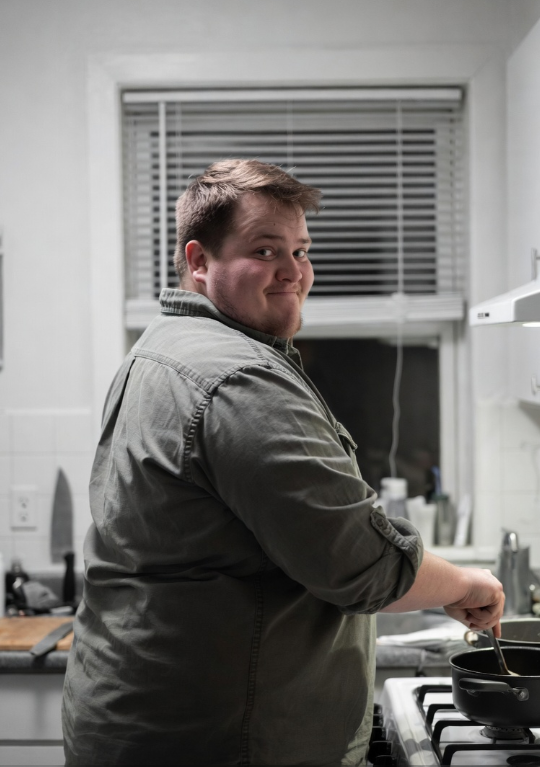
Made a grilled chicken with a rhubarb chutney — the savory application of the same fruit in the beer. The chutney is sweet-tart, pink, with ginger and orange zest. It pairs with grilled chicken the way sour beer pairs with a summer evening. Everything connects. The fruit. The beer. The food. The baby eating the fruit. All connected. All one story.
The small future-kid-conversations have begun. Megan teaches small fourth-grade at a small public school in Wauwatosa. The small adoption-vs-biological conversation is in the small early-discussion stage. The small five-year-plan includes the small kid-or-kids in some form. The small kitchen is the small place where the small future is being practiced.
The small Lakefront Brewery shift-work continues to be the small steady-paycheck. The small forty-hour-week brewery-floor job pays the small twenty-two-an-hour rate that the small Milwaukee-blue-collar-economy supports. The small benefits are the small union-decent. The small ten-year-tenure-target is the small career-anchor.
Megan is from a small Irish-Catholic Milwaukee-suburban family. The small Sunday-dinners at her small parents’ house rotate with the small Sunday-dinners at Jake’s parents’ house. The small in-laws on both sides have been the small welcoming-presence. The small two-family-network is the small extended-support the small newlywed-life rests on.
Megan and Jake married in June 2024. The small newlywed-rhythm is in its small second year. The small two-bedroom rental on the small east-side of Milwaukee continues to be the small first-home. The small thirty-year-mortgage-eventually-someday is the small five-year-goal. The small marriage is the small foundation the small life is being built on.
The small Lakefront Brewery shift-work continues to be the small steady-paycheck. The small forty-hour-week brewery-floor job pays the small twenty-two-an-hour rate that the small Milwaukee-blue-collar-economy supports. The small benefits are the small union-decent. The small ten-year-tenure-target is the small career-anchor.
The small Polish-American heritage is the small kitchen-identity. The small pierogi-recipe-cards from Babcia Helen (Jake’s grandmother who passed in 2018, who had lived two blocks from the small Bay-View family-house) is the small monthly-Saturday-tradition. The small kielbasa-and-sauerkraut. The small bigos. The small recipes that came over from the small Krakow-region in the small 1910s.
Megan is from a small Irish-Catholic Milwaukee-suburban family. The small Sunday-dinners at her small parents’ house rotate with the small Sunday-dinners at Jake’s parents’ house. The small in-laws on both sides have been the small welcoming-presence. The small two-family-network is the small extended-support the small newlywed-life rests on.
The small Milwaukee-winter is the small six-month-condition. The small cold-weather-comfort-food rotation runs October through April. The small soups, the small stews, the small braises, the small heavy-baked-goods. The small Midwestern-comfort-vocabulary is the small kitchen-language.
The small future-kid-conversations have begun. Megan teaches small fourth-grade at a small public school in Wauwatosa. The small adoption-vs-biological conversation is in the small early-discussion stage. The small five-year-plan includes the small kid-or-kids in some form. The small kitchen is the small place where the small future is being practiced.
Making that rhubarb chutney for the grilled chicken unlocked something—this realization that homemade condiments are their own kind of brewing, their own slow alchemy of fruit and acid and heat. So naturally, once the chutney was gone, I kept going. This Chunky Ketchup is what came next: the same jammy, sweet-tart logic as the chutney, built around tomatoes instead of rhubarb, thick enough to stand up to anything hot off the grill. Babcia would have understood this one completely.
Chunky Ketchup
Prep Time: 20 min | Cook Time: 1 hr 15 min | Total Time: 1 hr 35 min | Servings: 32 (about 4 cups)
Ingredients
- 4 lbs ripe roma tomatoes, cored and roughly chopped
- 1 medium yellow onion, finely diced
- 1 red bell pepper, seeded and finely diced
- 1/2 cup apple cider vinegar
- 1/3 cup packed brown sugar
- 2 tablespoons tomato paste
- 1 teaspoon kosher salt
- 1/2 teaspoon smoked paprika
- 1/2 teaspoon ground mustard
- 1/4 teaspoon ground allspice
- 1/4 teaspoon black pepper
- 1/8 teaspoon cayenne pepper
- 2 cloves garlic, minced
Instructions
- Build the base. Combine the chopped tomatoes, onion, and red bell pepper in a large heavy-bottomed saucepan or Dutch oven over medium heat. Cook, stirring occasionally, until the tomatoes begin to break down and release their liquid, about 15 minutes.
- Add flavor. Stir in the garlic, tomato paste, brown sugar, apple cider vinegar, salt, smoked paprika, ground mustard, allspice, black pepper, and cayenne. Stir well to combine everything evenly.
- Simmer low and slow. Reduce heat to medium-low and simmer uncovered, stirring every 10—15 minutes, until the mixture thickens significantly and most of the liquid has cooked off, about 55—65 minutes. The ketchup is ready when a spoon dragged across the bottom of the pan leaves a clean line that holds for a moment.
- Decide your texture. For a chunky ketchup, leave it as-is. For a slightly smoother result, use an immersion blender to pulse it 3—4 times—you want texture remaining, not a pure puree.
- Taste and adjust. Taste for salt, sugar, and acidity. Add a splash more vinegar if you want more brightness, or a pinch more brown sugar to round out the edges.
- Cool and store. Let cool to room temperature, then transfer to glass jars or an airtight container. Refrigerate for up to 3 weeks. Serve alongside grilled chicken, burgers, sausages, or anything coming off a hot grill.
Nutrition (per serving, 2 tablespoons)
Calories: 28 | Protein: 1g | Fat: 0g | Carbs: 7g | Fiber: 1g | Sodium: 78mg