
 By
By A late spring rain Tuesday afternoon. The garden grateful. Yoga Tuesday and Thursday at the studio. The classes were full. The body was the body.
Miya, 9, can shape onigiri without falling apart. She uses wet hands. She knows the order without being told. Barbara called Sunday. We talked for twenty minutes. She told me about the play she is directing. I told her about the kitchen.
Miso soup every morning this week. Fumiko's recipe. The dashi from scratch. The kombu soaked overnight. The bonito flakes added at the right moment. The white miso. The green onion. The chipped bowl.
Tomi home soon. The kitchen quiet.
Tomi watered the garden Saturday morning. The shiso was head-high. The shishito peppers were producing. The kabocha was running on the fence.
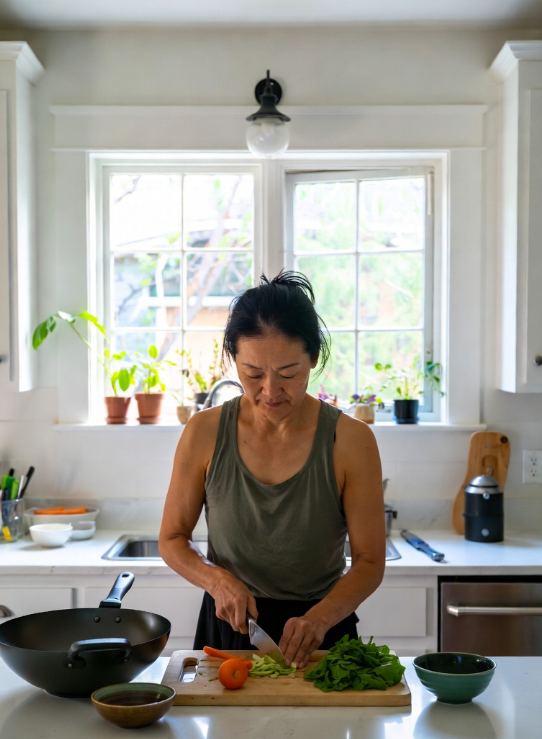
I cleaned the kitchen Sunday afternoon. Wiped the counters. Reorganized the drawer where the chopsticks live. Sharpened the knife. The reset was the reset.
I drove to Uwajimaya Wednesday. Kombu, bonito flakes, white miso, a small bag of mochiko for tomorrow's project. The store smells like home.
I read for an hour Sunday night. A book of essays by a Korean-American writer about food and grief. I underlined a paragraph that said exactly what I had been trying to say in the newsletter for months.
The rain in long sheets Tuesday afternoon. I made tea. I watched it from the porch. The cottonwoods on the next block were silver in the wet.
Coffee with a friend Saturday morning. We talked about books, about kids, about the way our forties became our fifties. The talking is the thing.
Miya's old room is now my office. The desk is by the window. The shiso outside. The newsletter in progress. The afternoons are quiet.
The newsletter went out Sunday morning. The opening line took an hour. The piece took five. The piece was what it needed to be.
Yoga Tuesday morning. The studio in Sellwood. Eight students. The class was the class.
Miya is in elementary school. The Saturday Japanese school continues. She still complains. She is still going.
I wrote at the kitchen table from six to eight. The newsletter was forming. The opening sentence was the hard sentence — they always are. I rewrote it five times. The fifth time was the right time.
Sunday farmers market in the rain. The vendors knew me. The Hood River apple stand had honeycrisps. I bought four pounds.
Therapy Tuesday. We talked about the wedding. We talked about Barbara. We talked about Fumiko. The hour passed. The work continues.
Made dashi at five-thirty AM. Ten minutes in the kitchen alone with the kombu and the bonito flakes. The day's first prayer.
A panic flicker Tuesday evening, brief, manageable. I breathed. I drank water. I went outside and walked around the block. The flicker passed. The body did its work.
I made onigiri for tomorrow's lunch. Three triangles. Salted plum in the center. Wrapped in nori. The cling wrap. The drawer where I keep them. The system.
A reader sent me a handwritten card this week. Her grandmother had cooked Japanese food in 1970s Boise. She had felt alone in it. The newsletter, she wrote, made her feel less alone. I taped the card to the wall above my desk.
I texted Miya a photo of the shiso. She texted back a heart and a single word: home.
The neighbor's dog barked at nothing for twenty minutes Sunday afternoon. The neighbor apologized. I told him I had been writing through it and the white noise was helpful. He laughed.
The cat was the cat. Mochi at fifteen sleeps most of the day. She still eats with enthusiasm. She still sits at the kitchen window watching the back garden.
The shiso was head-high and the garden was giving more than we could eat fresh — and that got me thinking about preservation, about capturing what’s abundant before the season turns. I don’t always have shiso in the pantry the way I want it, but basil is everywhere this time of year, and Fumiko’s approach to the kitchen — nothing wasted, everything honored — is exactly what this recipe asks of you. This basil jelly is a small, quiet project, the kind that fits into a Sunday afternoon between the farmers market and the newsletter, and it fills the kitchen with something green and alive.
Basil Jelly
Prep Time: 20 min | Cook Time: 15 min | Total Time: 35 min + 12 hrs setting | Servings: Makes about 5 half-pint jars (approx. 80 tablespoon servings)
Ingredients
- 2 cups fresh basil leaves, firmly packed (stems removed)
- 3 1/2 cups water
- 1/4 cup fresh lemon juice
- 1 package (1.75 oz) powdered fruit pectin
- 4 1/2 cups granulated sugar
- 3 drops green food coloring (optional)
- 1/4 tsp unsalted butter (to reduce foaming)
Instructions
- Prepare the basil infusion. Rinse basil leaves thoroughly and place them in a medium saucepan with the water. Bring to a full boil over medium-high heat, then remove from heat. Cover and steep for 15 minutes.
- Strain the liquid. Pour the basil infusion through a fine-mesh strainer lined with cheesecloth into a large measuring cup or bowl, pressing gently on the leaves to extract all the liquid. You need exactly 3 1/4 cups of liquid — add water to reach that amount if needed. Discard the spent basil.
- Prepare your jars. Sterilize 5 half-pint mason jars, lids, and bands in boiling water. Keep warm until ready to fill.
- Cook the jelly base. Pour the strained basil liquid into a large, deep saucepan. Stir in the lemon juice and powdered pectin. Add the butter. Bring the mixture to a full rolling boil over high heat, stirring constantly.
- Add the sugar. Once boiling, add all the sugar at once. Stir constantly and return to a full rolling boil that cannot be stirred down. Boil hard for exactly 1 minute. Remove from heat immediately.
- Skim and color. Skim any foam from the surface with a metal spoon. Stir in food coloring if using, just a few drops at a time until you reach a soft, translucent green.
- Fill and seal the jars. Ladle the hot jelly into the prepared jars, leaving 1/4-inch headspace. Wipe jar rims clean, apply lids and bands, and tighten to fingertip-tight.
- Process in a water bath. Place filled jars in a boiling water canner and process for 10 minutes (adjust for altitude if needed). Remove jars and set on a towel-lined counter. Do not disturb for 12 to 24 hours while the jelly sets and jars seal.
- Check the seal. After 24 hours, press the center of each lid. If it does not flex up and down, the jar is sealed. Refrigerate any unsealed jars and use within 3 weeks.
Nutrition (per serving, approx. 1 tablespoon)
Calories: 48 | Protein: 0g | Fat: 0g | Carbs: 12g | Fiber: 0g | Sodium: 1mg