
 By
By Minjun Park-Chen is born August 12, 2026, at Swedish Medical Center. 8 lbs 1 oz. James chose the Korean name — Minjun, meaning "clever and handsome." Hana, two and a half, touches Min's face in the hospital and says, "Baby." Stephanie has two children now. Two children who look l
The kimchi crock was bubbling Saturday morning when I checked. The bubbling is the right bubbling. The fermentation knew what it was doing.
David came over for Sunday dinner. He brought some tomatoes from the Bellevue garden.
A blog reader wrote about her own adoptee experience. We exchanged three emails this week.
The shiso on the south fence is fragrant and unruly. I brushed past it taking the compost out and the smell stopped me. The smell is the country. The smell is Jisoo's apartment.
I texted Jisoo a photo of the kimchi in the new onggi pot. She replied with the thumb-up emoji and a Korean-language critique. The duality is the gift.
I made coffee at seven. Hana ate cereal at seven-fifteen. Min wandered down at seven-twenty-five. James left for work at eight. The morning was the morning. The standard.
My Korean is improving. Slowly. Painfully. Conversationally adequate now. I can argue about kimchi proportions in two languages, which is a milestone in any marriage between mother and daughter.
I sat at the kitchen counter at six AM with a notebook and a cup of green tea. Writing time before the house wakes. The pre-light hour is the only writing hour I trust.
Rain on the porch all afternoon Saturday. The Wallingford rain is its own weather. I sat with a book and a tea and did not move for two hours.
Jisoo sent a photo of the dol the kids did for our visit last summer. The photo went on the fridge.
Hana left a Lego on the kitchen floor. I stepped on it at two AM. Standard.
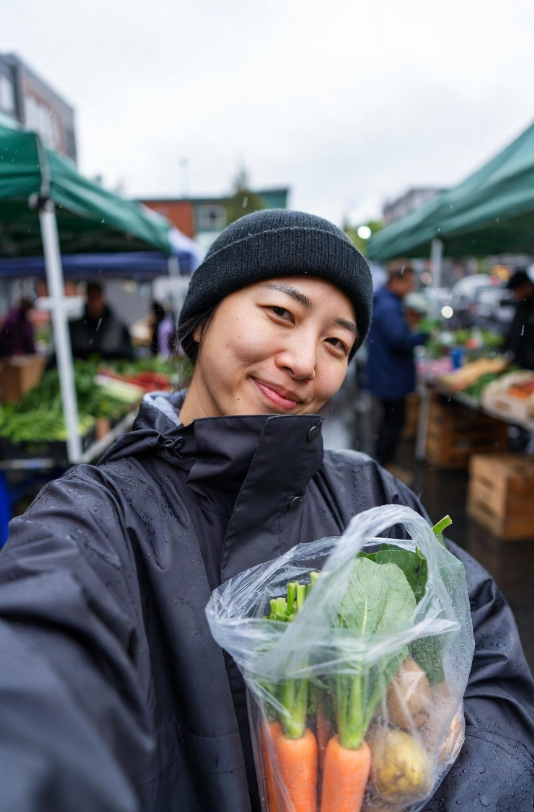
Sunday farmers market on Wallingford Avenue. The kabocha at the Asian vendor's stall. The shishito peppers. The brokered conversation. We bought too much. We always do.
The Capitol Hill apartment kitchen is small. We make it work.
I read a thread on the Korean Adoptee subreddit Saturday. Some posts brought up old anger. Most are people figuring it out in real time. We are not unique. We are a community.
Reading at night. A novel by a Korean-American writer about a family in 1990s LA. I underlined four sentences. The underlining is the marking-of-the-territory of the soul.
Yoga Tuesday morning at the studio. The forward fold released something I had been carrying in the shoulder. The mat is the mat.
Therapy Tuesday with Dr. Kim. We talked about the parents — the two sets, the one living, the one gone, the one who became real after thirty years and the one who was real my whole life and is now gone. The work is the layered work.
James and I had date night Friday. Indian restaurant on 45th. We ate too much. We sat in the car after talking about nothing for an hour. The marriage is the marriage.
Sprint review at Amazon Friday. Two hours. I could have been on a podcast.
The newsletter went out Sunday morning. The opening sentence took an hour. The piece took five. The piece was what it needed to be.
Between the farmers market haul, the kimchi crock doing its work on the counter, and a house that now holds two small people who need things at all hours, I needed a dinner that could carry its own weight without asking anything more of me. These kabobs are that dinner — the marinade borrows from the same pantry that feeds our kimchi weeknights, and the whole thing comes together fast enough that James and I could actually sit down together before someone woke up. The peppers and the soy and the char on the grill felt like a small, real thing in the middle of a week that was very large.
Asian Pepper Steak Kabobs
Prep Time: 15 min | Cook Time: 12 min | Total Time: 27 min (plus 30 min marinating) | Servings: 4
Ingredients
- 1 1/2 lbs flank steak or sirloin, cut into 1 1/2-inch cubes
- 1 large red bell pepper, cut into 1 1/2-inch pieces
- 1 large green bell pepper, cut into 1 1/2-inch pieces
- 1 medium yellow onion, cut into wedges
- 1/4 cup soy sauce
- 2 tablespoons sesame oil
- 2 tablespoons rice vinegar
- 1 tablespoon honey
- 3 cloves garlic, minced
- 1 teaspoon fresh ginger, grated
- 1/2 teaspoon crushed red pepper flakes
- 1/4 teaspoon black pepper
- 1 tablespoon toasted sesame seeds, for garnish
- 2 green onions, thinly sliced, for garnish
- Wooden or metal skewers (if wooden, soaked in water 30 minutes)
Instructions
- Make the marinade. In a bowl or zip-top bag, whisk together soy sauce, sesame oil, rice vinegar, honey, garlic, ginger, red pepper flakes, and black pepper until combined.
- Marinate the steak. Add the steak cubes to the marinade and toss to coat. Refrigerate at least 30 minutes, or up to 4 hours for deeper flavor.
- Preheat the grill. Heat an outdoor grill or grill pan to medium-high heat. Lightly oil the grates.
- Thread the skewers. Alternate steak cubes, bell pepper pieces, and onion wedges on each skewer, leaving a small gap between pieces for even cooking.
- Grill the kabobs. Cook skewers 10–12 minutes total, turning every 3–4 minutes, until steak reaches your preferred doneness and vegetables have a light char. For medium, aim for an internal temp of 145°F.
- Rest and garnish. Remove from heat and let rest 3 minutes. Sprinkle with toasted sesame seeds and sliced green onions before serving.
- Serve. Serve over steamed white rice or alongside a simple cucumber salad.
Nutrition (per serving)
Calories: 310 | Protein: 36g | Fat: 13g | Carbs: 11g | Fiber: 2g | Sodium: 780mg