
 By
By Late April. The newsletter is two months old and has four thousand subscribers. The growth curve is steeper than the blog's was at the same age — the blog took a year to reach four thousand, the newsletter did it in two months. The speed is the proof: the rawness is the thing. The rawness is what people were waiting for. The rawness was always the thing, and the blog was the approach, and the book was the step, and the newsletter is the arrival. The arrival is the three-AM kitchen with the door open and the world invited in.
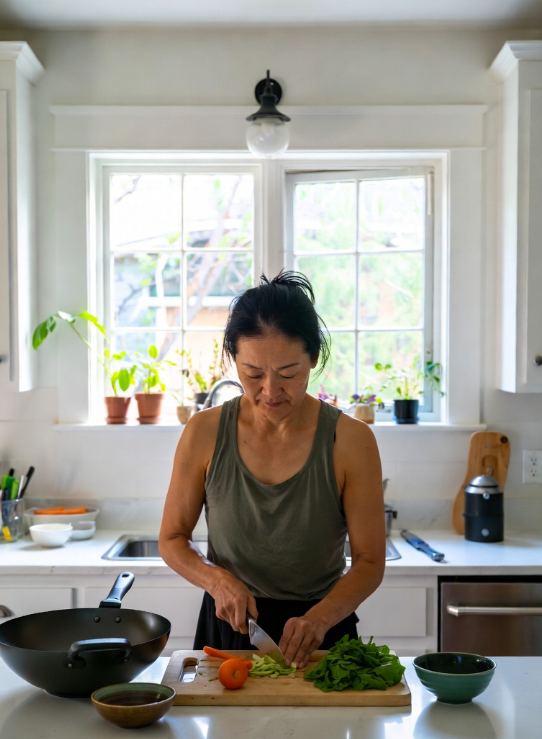
I made Fumiko's gomaae — sesame spinach, the five-minute dish, the simplicity — and the making was the contentment, the specific contentment of a woman who has, at forty, found the thing she is supposed to do and is doing it. The thing is: write honestly about food and grief. The thing is: teach cooking to strangers. The thing is: make dashi every morning. The thing is: be a mother. The thing is: carry a dead woman's recipes in living hands. The thing has always been the thing. The forty years were the finding. The finding is done. The doing is the life.
I gave the public lecture — "From Fumiko's Kitchen: Food, Identity, and the Space Between." Fifty people in a Portland event space, a Tuesday evening, raining outside (always raining, always Portland, the rain the backdrop for everything). I spoke for forty-five minutes about Fumiko and miso soup and the chipped bowl and the internment and the two kitchens and the neither-and-both. I demoed dashi. The audience watched me make dashi and I talked them through it — the same talk I give in the cooking class, the same talk I write in the blog, the same talk that is the newsletter, the same talk that is the book, the same talk that is the practice: make dashi. Pay attention. The attention is the love.
After the lecture, a line of people with copies of the first book. I signed them. Each signing was a conversation — "My grandmother made miso too." "I tried your kabocha recipe." "The newsletter changed how I think about my medication." The conversations were the lecture continued, the lecture extended into individual encounters, the practice extending one person at a time, the chain adding links.
I came home from the lecture still carrying the warmth of all those conversations — the grandmother who made miso, the reader whose newsletter changed how she thought about her medication — and I didn’t want to cook anything complicated. I wanted the same thing I always want after a night of full presence: something clean, something assembled more than cooked, something that honors the body without demanding much of it. This avocado turkey salad is that dish for me — the same spirit as the gomaae, the same five-minute logic, the same quiet proof that simplicity is not a lack of effort but the result of knowing exactly what you need.
Avocado Turkey Salad
Prep Time: 10 min | Cook Time: 0 min | Total Time: 10 min | Servings: 2
Ingredients
- 2 cups mixed salad greens or chopped romaine
- 6 oz sliced deli turkey, torn into pieces
- 1 ripe avocado, halved, pitted, and sliced
- 1/2 cup cherry tomatoes, halved
- 1/4 cup thinly sliced red onion
- 1/4 cucumber, thinly sliced
- 2 tablespoons olive oil
- 1 tablespoon fresh lemon juice
- 1/2 teaspoon Dijon mustard
- Salt and freshly ground black pepper, to taste
Instructions
- Make the dressing. In a small bowl, whisk together the olive oil, lemon juice, and Dijon mustard until emulsified. Season with salt and pepper and set aside.
- Build the base. Arrange the salad greens on two plates or in two wide bowls, spreading them into an even layer.
- Add the toppings. Distribute the turkey pieces, avocado slices, cherry tomatoes, red onion, and cucumber evenly over both plates.
- Dress and serve. Drizzle the lemon-Dijon dressing over each salad just before serving. Taste and adjust seasoning if needed. Serve immediately.
Nutrition (per serving)
Calories: 340 | Protein: 24g | Fat: 22g | Carbs: 12g | Fiber: 6g | Sodium: 520mg