Sophie texted a photo of Ingrid eating limpa bread. Ingrid is two. The bread is in both her hands. She is grinning. The line continues. The line is not metaphysical. The line is the bread, in the hands, going into the mouth, of a child whose great-great-grandmother brought the recipe across an ocean. The line is the bread.
Sophie is pregnant again. Another baby. Due next year. I will be a great-grandmother of two. The cheat sheet on the refrigerator is going to need updating. I have a small piece of graph paper taped inside the pantry door with a family tree on it. I update it after every birth, every wedding, every death. The paper is folded at the corners now and slightly yellowed at the edges. The tree has many branches. The branches keep coming.
Sophie's daughter Ingrid is walking now. She walked across the kitchen and grabbed my leg and looked up at me and said "Mor" — the Swedish for grandmother. Sophie is teaching her Swedish, or as much Swedish as Sophie remembers, which is enough for the basics. Ingrid said "Mor" with the perfect Swedish O, the rounded back-of-the-mouth O that only a child still learning sounds can pronounce. I cried. Sophie cried. The dog watched us with the patience of a saint.
I cooked Strawberry shortcake this week. Buttermilk biscuits, sliced strawberries macerated with sugar, fresh whipped cream. The first strawberries of the season, from the co-op until the local berries come in. The taste of summer arriving.
The Damiano Center: the regular Thursday. The soup is the soup. The conversations are the conversations. The week is held by the Thursday. I do not know what I would do without the Thursday. The Thursday is the structural element of the week. The structural element does not collapse if the rest of the week goes sideways. The Thursday holds.
The lake was iron gray. The kind of gray Paul loved. He used to say: "That is the gray that means weather is coming." He was always right. I miss being told. I miss being told what the lake means by a man who knew what the lake meant. I have learned to read the lake on my own. I am, at this point, an adequate reader. I am not as good as Paul was. I am better than I would have been if I had not had to learn.
It is enough. It has to be. And on a morning like this, with the lake doing what the lake does and the dog at my feet and the bread on the counter and the kitchen warm enough to live in, it is.
The phone rings less than it used to. Not because fewer people are calling, but because the people who call are mostly the family, and the family has settled into a rhythm — Peter daily, Anna twice a week, Sophie weekly, Elsa biweekly, Karin Sundays, Astrid Sundays. The phone rings predictably. I pick up predictably. The predictability is the love at this stage of life.
The lake from the kitchen window has been doing what the lake does for as long as there has been a lake. The lake has carried fish and ships and the bodies of drowned sailors and the names of Ojibwe villages and the granite-cold of melted glaciers. The lake does not notice the lives along its shore. The lives notice the lake. That is the deal. That has always been the deal.
It is enough.
I made the shortcake this week, as the story says — but it was the sherbet I kept thinking about afterward, the idea of something cold and bright to follow the warmth of biscuits and cream. With Ingrid walking now and Sophie’s news still settling in my chest like something sweet and almost too large to hold, I wanted a dessert that felt like the season turning: simple, unhurried, quietly joyful. Pineapple sherbet is exactly that. It asks very little of you, and it gives back summer.
Pineapple Sherbet
Prep Time: 15 min | Cook Time: 0 min | Total Time: 4 hr 15 min (includes freezing) | Servings: 6
Ingredients
- 1 can (20 oz) crushed pineapple, undrained
- 1 cup whole milk
- 1/2 cup granulated sugar
- 1 tablespoon fresh lemon juice
- 1/4 teaspoon vanilla extract
- Pinch of salt
Instructions
- Combine. In a large bowl, stir together the crushed pineapple (with its juice), milk, sugar, lemon juice, vanilla, and salt until the sugar is fully dissolved, about 2 minutes.
- Taste and adjust. Sample the mixture and add a touch more lemon juice if you want more brightness, or a little more sugar if the pineapple is especially tart. The flavor should be forward and clear — it will mellow slightly once frozen.
- First freeze. Pour the mixture into a shallow 9x13-inch baking dish or a large freezer-safe container. Cover tightly with plastic wrap and freeze until the edges are firm but the center is still slushy, about 1 1/2 to 2 hours.
- Break it up. Scrape the partially frozen mixture into a food processor or large bowl and beat with a hand mixer until smooth and fluffy. This step breaks up ice crystals and gives the sherbet its lighter texture.
- Second freeze. Return the mixture to the container, cover, and freeze until firm throughout, at least 2 more hours or overnight.
- Serve. Let the sherbet sit at room temperature for 5 minutes before scooping. Serve in chilled bowls or glasses, plain or with a sprig of fresh mint.
Nutrition (per serving)
Calories: 130 | Protein: 1g | Fat: 1g | Carbs: 30g | Fiber: 1g | Sodium: 35mg
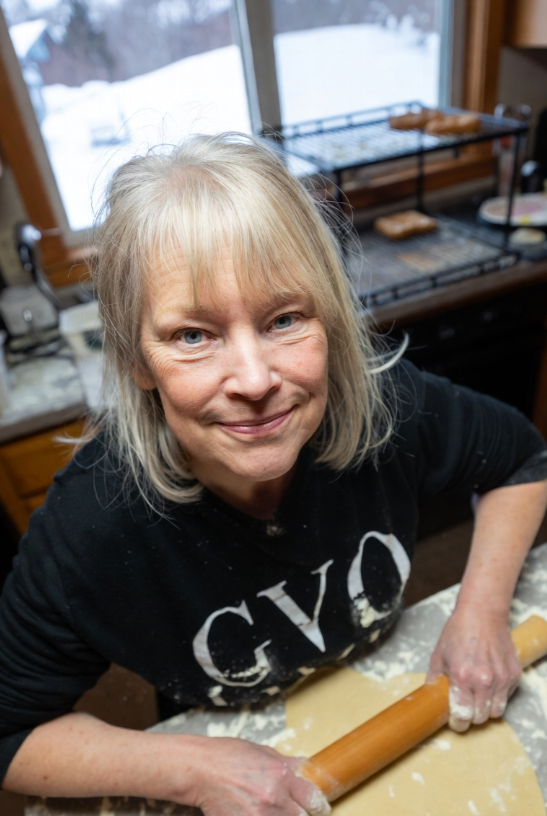
About the cook who shared this
Linda Johansson
Week 528 of Linda’s 30-year story
· Duluth, Minnesota
Linda is a sixty-three-year-old retired nurse from Duluth, Minnesota, living alone in the house where she raised her children and said goodbye to her husband. She lost Paul to ALS in 2020 after two years of watching the kindest man she'd ever known lose everything but his dignity. She cooks Scandinavian comfort food and Minnesota hotdish and the pot roast Paul loved, and she sets two places at the table out of habit because it makes her feel less alone. Every recipe she writes is a person she's loved.
