
 By
By Three weeks ago, Angela found me on the kitchen floor. I’ve told that story in pieces, in therapy, in the quiet way you disclose things when you’re still deciding how much of yourself to hand over. I haven’t told it here, not fully, because I’m not sure I’m ready to, and because this is a food blog, not a confessional, and there’s a version of healing that involves not making your suffering the centerpiece of every room you walk into.
But here’s what I will say: I’m on leave. Three months, maybe more if the therapist and I decide more is what I need. I handed my badge to my charge nurse on a Tuesday afternoon and she hugged me for a long time, which told me she’d been watching me come apart without knowing how to say so. The ER is like that. Everyone is too busy drowning to notice that the person next to them is also drowning.
The first week of leave, I slept. I don’t mean I rested — I mean I slept like something broken, fourteen, fifteen hours at a time, like my body had been running on borrowed time for so long that the debt came due all at once. I wrote about the adobo, which I made at four in the morning because four in the morning is when I’m usually awake anyway, old habits being what they are. But the adobo was a fluke, a single successful night in a stretch of days that were mostly just… gray. Not bad. Not good. Gray.
Angela has been coming by. She doesn’t announce it — she just appears, the way she always has, with the particular efficiency of a dental hygienist who has opinions about everyone’s self-care. Last Thursday she showed up with a paper bag from the Fred Meyer on DeBarr and dropped it on my counter and said, I bought you apples. Make something.
Not how are you feeling. Not do you want to talk about it. Just: make something.
Angela knows me. We’ve been sisters for twenty-five years. She knows that talking to me about my feelings is about sixty percent less effective than giving me a task that uses my hands. The therapist is for the talking. Angela is for the doing. I’m starting to understand that I need both, that they aren’t in competition, that healing is not a single-ingredient dish.
I looked at the apples for a while. There were seven of them, Fuji, the kind Lourdes always bought because they were sweet enough to eat without sugar. I stood at the counter and held one of them and thought about what I could make. Something Filipino felt like too much — too loaded, too many memories attached, too much of my father in the smell of the vinegar and the garlic. I loved making the adobo last week. I also wasn’t sure I could do it again yet without crying, and I’d cried enough for one month.
I made apple crisp.
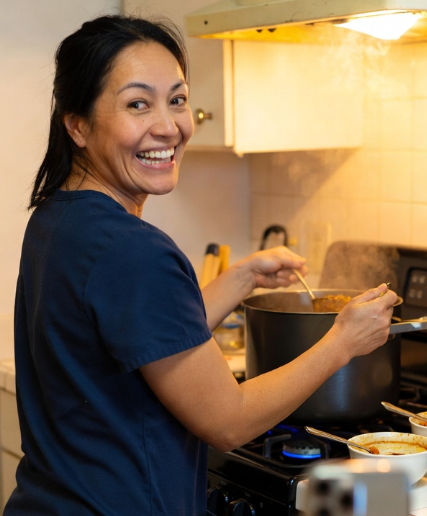
I know. It’s not adobo. It’s not lechon kawali or sinigang or anything my mother would recognize as real cooking. It’s butter and oats and brown sugar and whatever combination of spices you have in your cabinet, and it takes maybe fifteen minutes to put together and an hour to bake, and during that hour your whole apartment smells like something is being taken care of.
That last part is why I made it. I needed my apartment to smell like something was being taken care of. I needed to be the thing doing the taking care, even if the thing I was caring for was just a bowl of apples.
Here is what I know about apple crisp that I didn’t learn from Lourdes: it is almost impossible to make badly. You can peel the apples unevenly. You can forget to add lemon juice. You can use old oats that have been in your cabinet since February. You can be distracted, or sad, or both, and the crisp will still come out of the oven bubbling and golden-brown and smelling like the kind of kitchen you wanted to grow up in. It is a recipe that forgives you. After three weeks of feeling like I had nothing left to give, I needed something that forgave me.
Angela stayed while it baked. We didn’t talk much — we sat at my kitchen table and she looked at her phone and I stared at the oven window and we existed in the same space in that comfortable way you can only do with people who have known you long enough to not need to fill the silence. Her kids are with her husband on Thursdays. She’d made time.
I thought about my father while the apples cooked. Reynaldo Santos loved sweet things the way Filipino men often do — quietly, a little guiltily, because he was diabetic and sweets were not supposed to be his. Lourdes would catch him eating halo-halo at Filipino parties and give him a look that communicated an entire conversation without a word. He’d shrug and eat it anyway because he was a man who had crossed an ocean to build a life and he was not going to let diabetes take halo-halo from him too. He would have liked apple crisp. He would have added a scoop of ice cream and not told Lourdes.
When I pulled the crisp out of the oven, Angela looked up from her phone and said, That smells incredible.
I said, It’s just apples and oats.
She said, You always say ‘just’ like that’s a bad thing.
I stood there with the oven mitt still on my hand and I thought: she’s right. I do that. I diminish things. I diminish the cooking, the caring, the holding — all the things I do that keep people alive and I call it “just.” Just an apple crisp. Just a nurse. Just someone who shows up. But showing up is not just anything. Showing up is the whole job. The only job, really, when you get down to it.
We ate the crisp warm, with no ice cream because I didn’t have any, and it was very good. Angela ate two bowls. I ate one and then, after she left, I ate another standing at the counter in the dark, and I thought: okay. There is still this. There is still the smell of cinnamon and the sound of something bubbling and the warmth of an oven that has been doing its patient work while I do mine.
I have therapy again on Friday. I have a follow-up with my doctor on Monday. I am rebuilding something, though I can’t tell you yet what the finished shape looks like. But I made apple crisp this week, and I’m writing about it, and both of those things feel like evidence of something I haven’t lost.
Start with the apples. The rest will follow.
The recipe I’m sharing is the one I made that night—the one that got me off the kitchen floor and back to something like myself. I chose apple crisp because it’s forgiving in the way I needed something to be forgiving: no precision required, no way to really get it wrong, just apples and warmth and time. Here’s how I made it.
The Apple Crisp That Got Me Off the Kitchen Floor
Prep Time: 20 minutes | Cook Time: 45 minutes | Total Time: 1 hour 5 minutes | Servings: 8Ingredients
For the apple filling:- 7 medium Fuji or Honeycrisp apples (about 3 lbs), peeled, cored, and sliced 1/4-inch thick
- 2 tablespoons granulated sugar
- 1 tablespoon fresh lemon juice
- 1 teaspoon ground cinnamon
- 1/4 teaspoon ground nutmeg
- 1/4 teaspoon fine salt
- 1 tablespoon all-purpose flour
- 1 cup old-fashioned rolled oats (not quick oats)
- 3/4 cup all-purpose flour
- 3/4 cup packed light brown sugar
- 1/2 teaspoon ground cinnamon
- 1/4 teaspoon fine salt
- 8 tablespoons (1 stick) cold unsalted butter, cut into 1/2-inch cubes
Instructions
- Heat the oven. Preheat to 350°F. Lightly butter a 9x13-inch baking dish or equivalent oven-safe dish. You don’t need to be precise about this.
- Prepare the apples. Peel, core, and slice the apples. They don’t need to be perfect — uneven slices just mean some pieces get a little more caramelized. Toss them in a large bowl with the sugar, lemon juice, cinnamon, nutmeg, salt, and flour until everything is evenly coated. The flour helps the filling thicken as it bakes. Pour into the prepared baking dish and spread into an even layer.
- Make the crumble topping. In the same bowl (no need to wash it), combine the oats, flour, brown sugar, cinnamon, and salt. Add the cold butter cubes. Use your fingertips to work the butter into the dry ingredients, pressing and pinching until the mixture looks like coarse, damp sand with some pea-sized clumps throughout. The cold butter is important — it’s what makes the topping crisp rather than dense. Work quickly so the butter doesn’t soften too much.
- Assemble and bake. Scatter the crumble topping evenly over the apples. It should cover the fruit completely. Bake for 40 to 50 minutes, until the topping is deep golden brown and the filling is bubbling at the edges. If the topping starts to brown too quickly, tent it loosely with foil and keep baking. You want those bubbles at the edges — that’s how you know the filling has cooked through.
- Rest before serving. Let the crisp sit for at least 10 minutes before you serve it. This is the hardest instruction in the recipe and also the most important. The filling needs time to set. So do you. Ten minutes of just standing there, letting things settle, is not wasted time.
- Serve. Spoon into bowls, warm. Vanilla ice cream if you have it. Whipped cream if you’re feeling ambitious. Nothing at all if the bowl and the warmth and the smell is already enough, which most days it is.