
 By
By First summer weekend in Grinnell. The whole family loaded up Saturday morning and made the hour drive, the kids in the back seat arguing about radio stations and whether Ohio is a real state (it is, but I stayed out of the debate). Dad was in his garden when we pulled up. He was wearing his seed corn cap and his overalls and kneeling between the tomato rows, his hands in the dirt, and for a moment — just a moment — he looked like the man I grew up with, the farmer, the one who bent to the soil like he was praying to it.
Jack went straight to the garden. Didn't say hello to anyone first, just beelined for the corn patch and started examining Dad's Bodacious rows. Dad followed him. They stood together between the stalks — Roger's corn is chest-high already, because Grinnell soil is farm soil and farm soil knows things — and Jack touched the leaves with that absent reverence that Dad has, the one that isn't taught but inherited, and I watched from the porch with Mom and neither of us said anything because some things you just witness.
Noah found a lawn mower engine in Dad's garage, which was like finding the Holy Grail in a shed. He spent three hours disassembling it while Dad gave commentary from his lawn chair. "That's the carburetor." "Don't lose that bolt." "Your grandmother is going to kill you if you get grease on that shirt." Marlene did not kill him. Marlene brought him lemonade and a rag and told him to be careful with the fuel line.
Emma organized Dad's bookshelf. Nobody asked her to. Emma organizes things the way other people breathe — automatically, compulsively, and with commentary. "Grandpa, you have four copies of the Farmer's Almanac." "I keep them." "From 1998." "It was a good year."
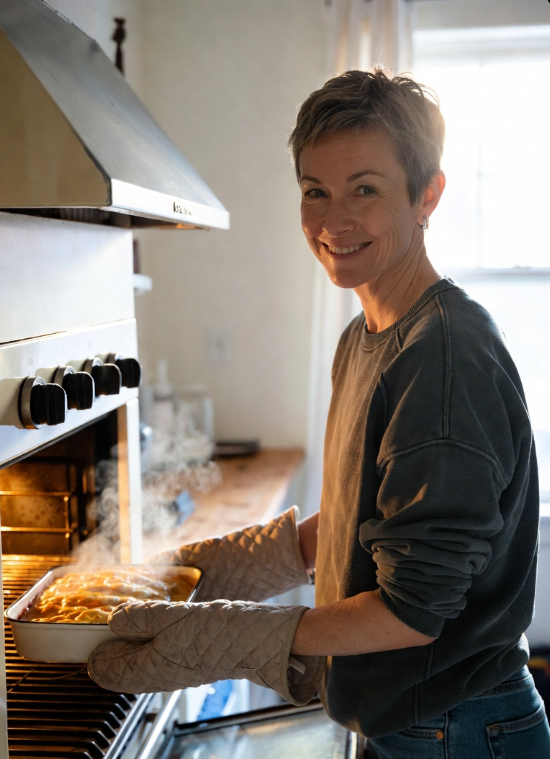
Mom and I cooked dinner together. Roast chicken — her roast chicken, the Sunday chicken, butter and salt, no thermometer. She let me prep the bird. She supervised with the quiet intensity of a woman watching someone handle her heritage. "More butter under the skin." "Yes, Mom." "And salt. Real salt." "Yes, Mom." We ate at Dad's kitchen table, all seven of us, elbows bumping, the chicken golden and the kitchen warm and the sunflowers swaying outside the window. Marlene grew those sunflowers. She always has. They're her mark on the land that isn't theirs anymore. They bloom anyway.
Mom’s version will always be the original — butter under the skin, real salt, no thermometer, done when it’s done — and I’m not trying to improve on it. But when I got home from Grinnell that Sunday night and the weekend was still warm inside me, I found myself wanting to make a bird of my own, something that carried that same quiet confidence, that same smell of a kitchen that means something. This za’atar roast chicken is what I made: earthy, lemony, golden-skinned, and completely forgiving — the kind of recipe that lets you be present at your own table the way Dad is present in his garden, unhurried and certain.
Za’atar Roast Chicken
Prep Time: 15 minutes | Cook Time: 1 hour 15 minutes | Total Time: 1 hour 30 minutes | Servings: 4–6
Ingredients
- 1 whole chicken (3 1/2 to 4 1/2 lbs), patted dry
- 3 tablespoons za’atar spice blend
- 3 tablespoons olive oil
- 4 tablespoons unsalted butter, softened and divided
- 1 1/2 teaspoons kosher salt, plus more to taste
- 1/2 teaspoon freshly ground black pepper
- 1 lemon, halved
- 1 head of garlic, halved crosswise
- 4 sprigs fresh thyme
- 1 medium yellow onion, quartered
Instructions
- Bring the chicken to room temperature. Remove the chicken from the refrigerator 30 to 45 minutes before roasting. Pat it thoroughly dry with paper towels — a dry bird is a crispy bird.
- Preheat and prep the pan. Preheat your oven to 425°F. Scatter the onion quarters and halved garlic head in the bottom of a cast iron skillet or roasting pan. This becomes your roasting rack and builds flavor in the drippings.
- Make the za’atar butter. In a small bowl, combine 3 tablespoons of the softened butter with the za’atar, 1/2 teaspoon of the salt, and a few grinds of black pepper. Mix until well combined.
- Season the chicken. Using your fingers, gently loosen the skin over the breast and thighs without tearing it. Spread the za’atar butter directly under the skin, pressing from outside to distribute it evenly. Rub the outside of the bird with olive oil and the remaining 1 tablespoon of plain butter, then season generously all over with the remaining salt and pepper.
- Stuff the cavity. Squeeze half of the lemon over the outside of the bird. Tuck the squeezed lemon half, the thyme sprigs, and the remaining lemon half inside the cavity. Tie the legs together loosely with kitchen twine if desired.
- Roast the chicken. Place the chicken breast-side up on top of the onion and garlic in the pan. Roast at 425°F for 20 minutes to set the skin, then reduce heat to 375°F and continue roasting for 50 to 60 minutes, until the juices run clear when you pierce the thigh and the skin is deep golden brown.
- Rest before carving. Remove the chicken from the oven and let it rest, loosely tented with foil, for at least 10 to 15 minutes. Do not skip this step — it is where the bird becomes itself. Carve and serve with the roasted pan drippings spooned over the top.
Nutrition (per serving)
Calories: 410 | Protein: 38g | Fat: 27g | Carbs: 4g | Fiber: 1g | Sodium: 520mg