
 By
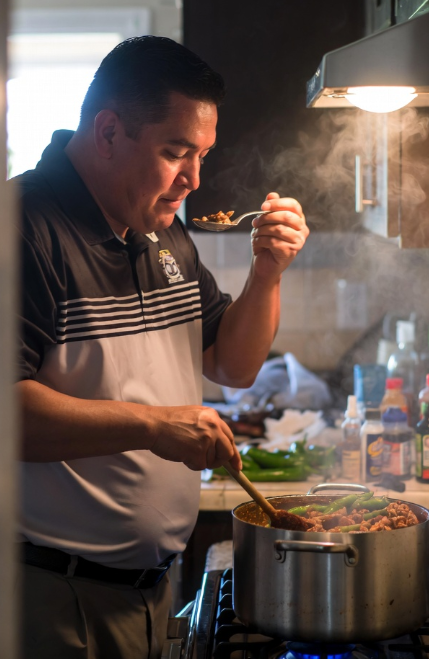
By December in Denver is a specific kind of cold — not the wet, bone-deep cold of the Midwest, but a dry, bright cold that fools you into thinking it's not that bad until you're standing on your patio at six AM in a hoodie and your fingers stop working. I was out there Tuesday morning, scraping ice off the flat-top griddle, because I had decided — for reasons that Lisa would call irrational and I would call principled — that I was making breakfast burritos on the grill. Green chile, scrambled eggs, crumbled chorizo, shredded cheese, all of it wrapped in a flour tortilla the size of a hubcap. Diego ate his in the car on the way to school. Sofia ate hers at the table with a napkin in her lap like a civilized person. The twins ate approximately thirty percent of theirs and wore the rest. This is the math of feeding young children: multiply the portion by three, expect a two-thirds loss rate, and accept that the dog will handle cleanup.
The first week without football is the hard one. The second week is when you start to breathe again. I cleaned out my office at the school — filed the game film, packed the playbooks, washed the coaching polos that had been in a gym bag since September and had developed their own ecosystem. I met with the boosters on Wednesday. They're happy. 10-1 and a playoff appearance. They want to talk about fundraising for a new weight room. I want to talk about the contain issue that Valor Christian exploited, but boosters don't want to hear about schematic failures. They want to write checks and feel good. I let them feel good. The weight room would be nice.
Lisa worked three twelve-hour shifts this week — Tuesday, Thursday, Saturday. ER in December is brutal. Flu season, ice-related injuries, the particular sadness that the holidays bring into emergency rooms. She came home Saturday night looking like she'd been through a war and I had a bowl of posole waiting. Pork, hominy, red chile broth, shredded cabbage and radish and lime on the side. It's the soup that fixes things. Not everything. Not the big things. But it warms you from the inside and reminds your body that someone cared enough to simmer something for three hours, and sometimes that's all you need.
Called Gloria on Sunday. She's already planning the Christmas tamale production with the intensity of a general planning an invasion. I told her we'd be there the weekend before Christmas. She said, "Bring green chile. I'm running low." She is not running low. She has a freezer full. But Medina women speak in code, and "bring green chile" means "I miss you, come home."
Feed your people. The game is won at the table.
That Saturday night with Elena reminded me how much a bowl of something slow-cooked can say what words can’t—and it got me thinking about the kind of soup that doesn’t demand anything from you, just gives. Posole is the Medina family medicine, but this time of year I also keep coming back to minestrone, that Italian answer to the same question: how do you feed someone who’s been through it? It’s humble, it’s generous, and like all the best things, it gets better the longer you let it go. Here’s how I make it when the weeks feel like December.
Winter Minestrone Soup with Garlic Bruschetta
Prep Time: 20 minutes | Cook Time: 55 minutes | Total Time: 1 hour 15 minutes | Servings: 6
Ingredients
- 2 tablespoons olive oil
- 1 medium yellow onion, diced
- 3 cloves garlic, minced
- 2 medium carrots, peeled and sliced into coins
- 2 stalks celery, sliced
- 1 medium zucchini, diced
- 1 can (14.5 oz) diced fire-roasted tomatoes
- 1 can (15 oz) cannellini beans, drained and rinsed
- 1 can (15 oz) kidney beans, drained and rinsed
- 6 cups low-sodium chicken or vegetable broth
- 1 cup small pasta (ditalini or elbow macaroni)
- 2 cups chopped kale or roughly torn spinach
- 1 teaspoon dried oregano
- 1/2 teaspoon dried thyme
- 1/2 teaspoon smoked paprika
- 1 bay leaf
- Salt and black pepper to taste
- Parmesan rind (optional, adds depth)
- Fresh parsley, chopped, for serving
- Grated Parmesan, for serving
- For the Garlic Bruschetta:
- 1 baguette, sliced 3/4-inch thick
- 4 tablespoons unsalted butter, softened
- 3 cloves garlic, minced or pressed
- 2 tablespoons fresh parsley, finely chopped
- Pinch of flaky sea salt
Instructions
- Build the base. Heat olive oil in a large heavy-bottomed pot or Dutch oven over medium heat. Add the onion and cook until softened and translucent, about 5 minutes. Add the garlic, carrots, and celery and cook another 4–5 minutes, stirring occasionally.
- Add aromatics and tomatoes. Stir in the oregano, thyme, smoked paprika, and a generous pinch of salt and pepper. Pour in the fire-roasted tomatoes and stir to combine, scraping up any fond from the bottom of the pot.
- Simmer the soup. Add the broth, both cans of beans, the zucchini, bay leaf, and Parmesan rind if using. Bring to a boil, then reduce heat to a low simmer. Cook uncovered for 25–30 minutes until the vegetables are tender and the broth is deeply flavored.
- Cook the pasta separately. While the soup simmers, cook the pasta in salted boiling water until just shy of al dente. Drain and set aside. (Cooking it separately prevents it from absorbing all the broth if you have leftovers.)
- Finish the soup. Stir the kale or spinach into the simmering soup and cook 3–4 minutes until wilted. Remove the bay leaf and Parmesan rind. Add the cooked pasta and stir to combine. Taste and adjust salt and pepper.
- Make the garlic bruschetta. Preheat your oven broiler to high. Mix the softened butter with the minced garlic and parsley until combined. Spread generously onto each baguette slice and arrange on a baking sheet. Broil 2–3 minutes until golden and the edges are just starting to crisp. Sprinkle with flaky salt.
- Serve. Ladle the soup into bowls, top with fresh parsley and grated Parmesan, and set the garlic bruschetta alongside. This soup holds well and tastes even better the next day.
Nutrition (per serving)
Calories: 390 | Protein: 15g | Fat: 11g | Carbs: 58g | Fiber: 10g | Sodium: 620mg