
 By
By MLK Day. The drive to Scotlandville. Daddy's story. This year it was not a story — it was a silence. Daddy sat at the table and did not speak for a long time and then he said, "I don't have a story this year. I have a question." He asked: "What are you building?" Not what are you studying. Not what are you cooking. What are you building. The question sat in the room like a guest who had been expected but arrived early.
I said, "A medical practice in north Baton Rouge." He nodded. He said, "That's what I thought. Build it right. Your grandfather built the pulpit and it's still standing. Build your thing to last." Then he was done. The conversation lasted ninety seconds. It contained more direction than a four-year degree program.
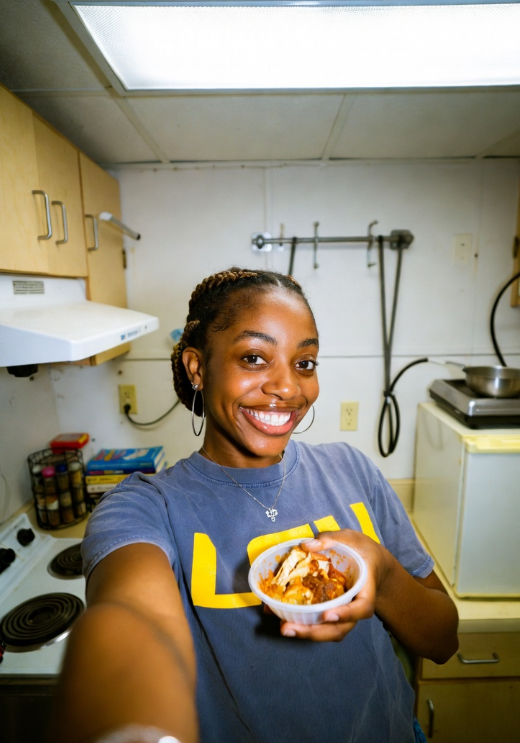
I made smothered chicken afterward. The ritual. But this time, while the chicken simmered in the onion gravy, I thought about the question differently than I have thought about my future before. Not "what am I going to do" but "what am I building." Building implies permanence. Building implies architecture. Building implies that the thing I am making — the practice, the community service, the life — will outlast me the way the pulpit outlasts Grandpa Charles. I am building a pulpit. The pulpit is made of medicine and food and the stubborn refusal to leave the neighborhood that made me.
MawMaw Shirley called after dinner. I told her about Daddy's question. She said, "Good question." I said, "What are you building?" She said, "I built my building. It is standing in your kitchen right now." She meant the pot. She meant the recipes. She meant me. She built me. I am the building. The realization was quiet and enormous and I sat with it for a long time after the phone call ended, alone in my parents' kitchen, the chicken cold in the pan, the understanding warm in my chest.
After I hung up with MawMaw Shirley, I stayed at that table for a while — the chicken cold, the question still warm — and then I did what I always do when something is too large to hold in my head: I baked. This cranberry bundt cake is hers, passed down the way she passes everything down, without ceremony and without explanation, as if it were simply obvious that you would need it someday. The tart snap of the cranberries against the soft crumb felt exactly right for a night that had been both sharp and tender, and the glaze dripping down the sides of the pan looked, to me, exactly like something built to last.
Winning Cranberry Bundt Cake
Prep Time: 20 minutes | Cook Time: 58 minutes | Total Time: 1 hour 18 minutes | Servings: 12
Ingredients
- 3 cups all-purpose flour
- 1 tsp baking soda
- 1/2 tsp fine salt
- 1 cup (2 sticks) unsalted butter, softened
- 1 1/2 cups granulated sugar
- 3 large eggs, room temperature
- 1 1/2 tsp pure vanilla extract
- 1 cup full-fat sour cream
- 2 cups fresh or frozen cranberries, coarsely chopped
- 1/2 cup chopped pecans (optional)
- 1 cup powdered sugar, sifted
- 3 tbsp fresh orange juice
- 1 tsp orange zest
Instructions
- Preheat and prep the pan. Heat oven to 350°F. Generously grease a 10- to 12-cup Bundt pan with butter or nonstick spray, then dust lightly with flour, tapping out any excess. Set aside.
- Whisk the dry ingredients. In a medium bowl, whisk together flour, baking soda, and salt until evenly combined. Set aside.
- Cream butter and sugar. In a large bowl using a hand mixer or stand mixer fitted with the paddle attachment, beat softened butter and granulated sugar on medium-high speed until pale and fluffy, about 4 minutes. Scrape down the sides of the bowl as needed.
- Add eggs and vanilla. Beat in eggs one at a time, mixing well after each addition. Add vanilla extract and mix to combine. The batter may look slightly curdled — that is normal.
- Alternate flour and sour cream. Reduce mixer speed to low. Add the flour mixture in three additions, alternating with the sour cream in two additions, beginning and ending with the flour. Mix just until no streaks of flour remain — do not overmix.
- Fold in cranberries and pecans. Using a rubber spatula, gently fold in the chopped cranberries and pecans (if using) until evenly distributed through the batter.
- Fill and bake. Spoon batter evenly into the prepared Bundt pan and smooth the top. Bake on the center rack for 55–60 minutes, until a wooden skewer inserted into the thickest part of the cake comes out clean and the top is deep golden brown.
- Cool in pan. Let the cake rest in the pan on a wire rack for exactly 15 minutes — no longer or it may stick. Run a thin spatula around the center tube and outer edges, then invert confidently onto the rack. Allow to cool completely, at least 45 minutes.
- Make the orange glaze. In a small bowl, whisk together powdered sugar, fresh orange juice, and orange zest until smooth and pourable. If too thick, add orange juice 1 teaspoon at a time. If too thin, add a little more powdered sugar.
- Glaze and serve. Drizzle the glaze over the fully cooled cake, letting it run naturally down the ridges. Allow the glaze to set for 10 minutes before slicing. Serve at room temperature.
Nutrition (per serving)
Calories: 418 | Protein: 5g | Fat: 19g | Carbs: 58g | Fiber: 2g | Sodium: 204mg