
 By
By Carmen sat me down this week and said what I already knew but did not want to hear: "She's not getting better, Maria Elena." Carmen had spoken to Beatriz, who had spoken to the doctor in Juárez, who said the diabetes is advanced, the kidneys are failing, the fall weakened her in ways that the body at sixty-two cannot repair. The doctor said months. Maybe less. Carmen said this in my kitchen on a Tuesday afternoon while Camila played in the next room and the house smelled like the beans I had left simmering on the stove, and the normalcy of the scene — beans and a child playing and a kitchen — made the words worse, because dying should not happen in a kitchen that smells like beans. Dying should happen somewhere dramatic and far away, not in the same room where your four-year-old is singing to herself about a butterfly.
I cried. I cried the way you cry when you have been holding it for months — ugly crying, animal crying, the kind that comes from the gut and not the eyes. Carmen held me. She said, "We knew this was coming." And she is right. We did. Rosa has been sick for years and getting sicker and we have all known, in the way families know things they do not say, that this was the direction. But knowing something is coming and feeling it arrive are two different species of pain, and the arrival is worse, always worse, because it makes the knowing retroactively naive. You thought you were prepared. You were not prepared. You will never be prepared.
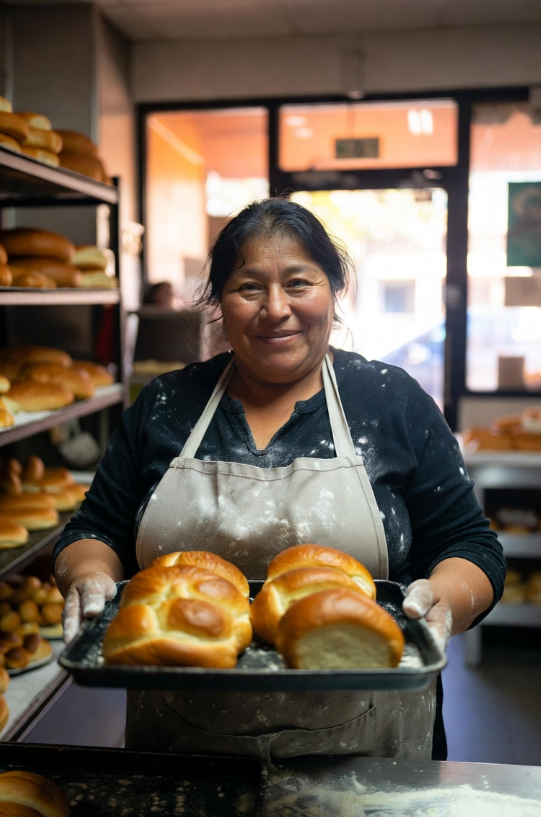
I went to the bakery the next morning at 3 AM. I made conchas. I made them slowly, deliberately, rolling each one with the care of someone who is trying to keep their hands busy so their mind will stop. Each concha is Rosa's recipe. Each one carries her fingerprint in the ingredient list, in the technique, in the particular way the sugar topping cracks when you bite into it. I made two hundred that morning. Slow. Careful. Each one a prayer.
Luis Jr. knows something is wrong. He doesn't ask — he is fifteen and fifteen-year-old boys don't ask — but he watches me. He watches the way I move, the way I pause in the kitchen, the way my eyes go somewhere else in the middle of a sentence. He brought me coffee on Wednesday morning without being asked. Just set it on the counter and walked away. That is how Gutierrez men say I love you. They set coffee on counters and walk away and hope you understand.
Isabella asked me directly: "Is Abuela dying?" She is thirteen and she does not do the indirect approach. She walked into the kitchen on Thursday and said the words and stood there waiting for the truth, and I gave it to her because Isabella has earned the truth — she earns everything, through intelligence and directness and the particular courage of a girl who would rather be hurt by honesty than comforted by lies. I said: "Yes, mija. Abuela is very sick." And Isabella nodded and her eyes filled but she didn't cry, not in front of me, and I thought: she will be a wonderful nurse. The best. Because she can hold truth and tears at the same time without spilling either one.
I made frijoles charros this week — cowboy beans, the hearty kind with bacon and onion and tomato and jalapeño and a splash of beer, cooked slow until the beans are creamy and the broth is thick and the whole pot smells like a campfire. Rosa made these for every family gathering, every holiday, every baptism and quinceañera and Tuesday-that-felt-like-it-needed-beans. I made them because the house needed comfort and beans are comfort and because when you are losing your mother you make your mother's food, compulsively, obsessively, as if the recipes are spells that can keep her here.
I pray harder now. Not differently — the same prayers, the same rosary, the same candles at St. Patrick's. But harder. With more of myself behind the words. I kneel on the stone floor and I don't ask God to fix it — I know He won't, or can't, or the distinction doesn't matter — I ask Him to hold Rosa when I can't. I ask Him to be the hands that I cannot reach across the bridge to be. And I ask Him — selfishly, desperately, with the raw need of a daughter — to let her live long enough to know that her recipes are safe. That I have them. That I am keeping them. That they will not die.
I have been living in Rosa’s recipes this week — frijoles charros, conchas, anything that puts her hands and mine in the same place at the same time. When I finally had to feed the family something beyond beans and grief, I turned to carnitas, because slow-cooked pork is the same kind of medicine: patient, fragrant, warm all the way through. This pulled pork carnitas recipe is the one I reach for when the house needs something that feels like it came from somewhere deep and sure, and right now that is exactly what we need.
Whole30 Pulled Pork Carnitas
Prep Time: 15 minutes | Cook Time: 8 hours | Total Time: 8 hours 15 minutes | Servings: 8
Ingredients
- 3 to 4 pounds boneless pork shoulder, trimmed of excess fat
- 1 tablespoon kosher salt
- 1 teaspoon black pepper
- 1 teaspoon cumin
- 1 teaspoon chili powder
- 1 teaspoon smoked paprika
- 1/2 teaspoon garlic powder
- 1/2 teaspoon onion powder
- 1/4 teaspoon dried oregano
- 1 medium white onion, roughly chopped
- 4 cloves garlic, smashed
- 1 jalapeño, halved (seeds removed for less heat)
- Juice of 2 oranges (about 1/2 cup)
- Juice of 1 lime
- 1/2 cup chicken broth (Whole30-compliant)
- 2 tablespoons avocado oil or olive oil
Instructions
- Season the pork. Pat the pork shoulder dry with paper towels. In a small bowl, combine the salt, pepper, cumin, chili powder, smoked paprika, garlic powder, onion powder, and oregano. Rub the spice mixture all over the pork, pressing it into every surface.
- Sear for flavor. Heat the avocado oil in a large skillet or Dutch oven over medium-high heat. Sear the pork shoulder on all sides until deeply browned, about 3 to 4 minutes per side. This step builds the fond that makes the final dish rich and complex.
- Load the slow cooker. Transfer the seared pork to a slow cooker. Scatter the chopped onion, smashed garlic, and jalapeño around and under the pork.
- Add the braising liquid. Pour the orange juice, lime juice, and chicken broth over the pork. The liquid should come about one-third of the way up the side of the meat.
- Cook low and slow. Cover and cook on LOW for 8 hours, or on HIGH for 4 to 5 hours, until the pork is completely tender and pulls apart easily with two forks.
- Pull the pork. Remove the pork from the slow cooker and place it on a large cutting board or rimmed baking sheet. Use two forks to shred the meat into large, uneven pieces. Discard the jalapeño.
- Crisp the carnitas (optional but recommended). Spread the pulled pork on a foil-lined baking sheet and ladle 1/4 cup of the reserved braising liquid over the top. Broil on high for 5 to 7 minutes until the edges are caramelized and slightly crisp. Watch carefully.
- Serve. Serve the carnitas over cauliflower rice, in lettuce cups, or alongside roasted vegetables with fresh salsa, sliced avocado, and lime wedges.
Nutrition (per serving)
Calories: 310 | Protein: 34g | Fat: 16g | Carbs: 5g | Fiber: 1g | Sodium: 480mg