
 By
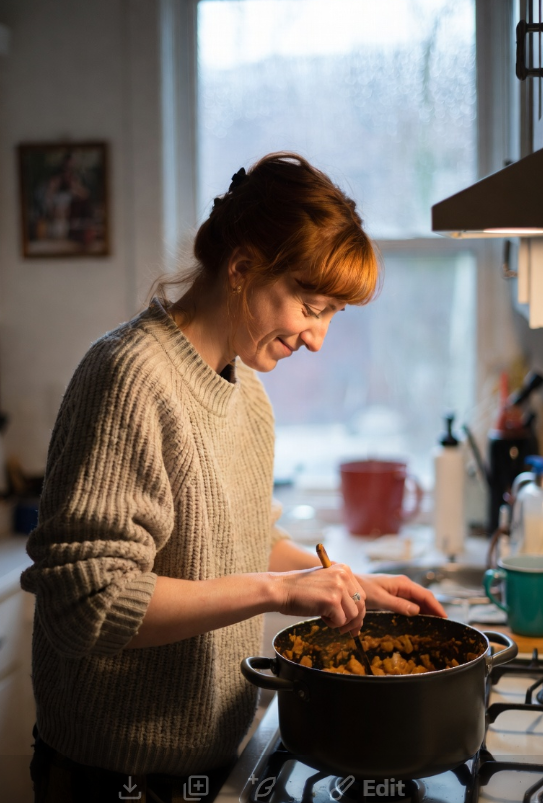
The day after a birthday is usually the best day. Nothing expected of you, but the leftovers are good and the cards are still on the counter. I made corned beef hash Sunday morning from the brisket my mother sent home in a Tupperware — cubed potatoes in the cast iron, onions gone golden, the beef chopped fine, an egg each for Sean and Liam and half for Nora. The apartment smelled like a diner and I liked it. Sean ate standing at the counter because he cannot sit down when hash is available. This is a long-standing fact of our marriage.
Colleen is still pregnant. Forty-one weeks and six days. The induction was pushed a third time, which at this point is comical in a way that is not funny. Patrick called me Monday night sounding like a person who has accepted his new identity as a man whose wife will never deliver the baby. I reminded him that was not possible, medically. He said "Kate, she looked at me tonight and told me to stop hovering or she'd have the baby out of spite just to get rid of me." I said "that's the Colleen I know." He laughed. The induction is Wednesday. We shall see.
Liam asked about dying this week. Out of nowhere. He was eating grapes at the counter and said "does everybody die." I said yes, everyone dies, but most people live for a very long time first. He said "do I die." I said you will live a very, very long life, Buddy. He said "does Daddy die." I said Daddy will live a very long life too. He said "okay." He ate another grape. He moved on. The question was over. I stood at the counter and kept slicing the onion I was working on and I did not let my face do what my face wanted to do. Three-year-olds ask the questions. You answer them plainly. You cry about it later, if you need to. I did not cry. I told Sean that night. He listened. He said "it's the age." I said "yes." It is the age. It is the age when they learn that everything ends. It is the age when you have to do the plainness on demand.
Nora said "Daddy" Thursday. She had "Mommy" since two. "Daddy" had been resisting her. I do not know why. Some words come in order that is not the order of priority; some words come when the person has decided the word is now necessary. Thursday evening Sean came home from school and walked in the door and Nora looked up from the floor and said, clearly, with precision, "Daddy." Sean stopped in the entryway. He put his bag down. He said "hi Nora." She said "Daddy." He cried, briefly, in the hallway, in his coat. He tried to hide it. I saw it. I did not mention it. This is the marriage. You let your husband have the quiet cry about the baby saying his name. You save it up for the long-form telling later, at some other year's dinner, when it is no longer raw.
Back to work Tuesday. The clinic was normal. The commute, now a longer and more varied commute, is becoming habit. The house is becoming habit. Routines are forming in the new environment. Human beings are adaptive. I know this from my patients. I know it from myself.
We didn’t have enough brisket left for a second round of hash, but the Sunday morning feeling was still there — the cast iron on the burner, Sean circling the kitchen, the kids not fully awake yet. These whole wheat chive waffles with a poached egg on top are what I make when I want that same diner warmth without the leftovers to work from. The chives bring the savory, the egg brings the richness, and the whole wheat keeps it honest. It is the kind of breakfast that makes a Sunday feel like it was planned, even when it wasn’t.
Whole Wheat Chive Waffles with Poached Egg
Prep Time: 10 minutes | Cook Time: 20 minutes | Total Time: 30 minutes | Servings: 4
Ingredients
- 1 cup whole wheat flour
- 1 teaspoon baking powder
- 1/2 teaspoon baking soda
- 1/4 teaspoon salt
- 1/4 teaspoon black pepper
- 1 cup buttermilk
- 2 large eggs, separated
- 2 tablespoons unsalted butter, melted
- 3 tablespoons fresh chives, finely chopped
- 1 tablespoon white vinegar (for poaching)
- 4 large eggs (for poaching)
- Flaky sea salt, for finishing
Instructions
- Preheat the waffle iron. Heat your waffle iron according to manufacturer instructions and lightly grease with cooking spray or butter.
- Mix the dry ingredients. In a large bowl, whisk together the whole wheat flour, baking powder, baking soda, salt, and black pepper.
- Combine the wet ingredients. In a separate bowl, whisk together the buttermilk, egg yolks, and melted butter until smooth. Pour the wet ingredients into the dry and stir until just combined — do not overmix. Fold in the chives.
- Whip the egg whites. In a clean bowl, beat the egg whites with a hand mixer or whisk until soft peaks form. Gently fold the egg whites into the batter in two additions to keep the waffles light.
- Cook the waffles. Pour enough batter to fill your waffle iron (about 3/4 cup per waffle). Cook until golden and crisp, 4 to 5 minutes. Keep finished waffles warm in a 200°F oven on a wire rack while you cook the remaining batter.
- Poach the eggs. Fill a wide saucepan with about 3 inches of water and bring to a gentle simmer. Add the white vinegar. Crack each egg into a small cup. Create a gentle swirl in the water and slide the egg in. Poach for 3 to 4 minutes, until the whites are set and the yolk is still soft. Remove with a slotted spoon and blot dry on a paper towel.
- Assemble and serve. Place a warm chive waffle on each plate. Top with a poached egg. Finish with a pinch of flaky sea salt and additional chopped chives if desired. Serve immediately.
Nutrition (per serving)
Calories: 310 | Protein: 15g | Fat: 13g | Carbs: 34g | Fiber: 4g | Sodium: 420mg