Sophie texted a photo of Ingrid eating limpa bread. Ingrid is two. The bread is in both her hands. She is grinning. The line continues. The line is not metaphysical. The line is the bread, in the hands, going into the mouth, of a child whose great-great-grandmother brought the recipe across an ocean. The line is the bread.
Sophie is pregnant again. Another baby. Due next year. I will be a great-grandmother of two. The cheat sheet on the refrigerator is going to need updating. I have a small piece of graph paper taped inside the pantry door with a family tree on it. I update it after every birth, every wedding, every death. The paper is folded at the corners now and slightly yellowed at the edges. The tree has many branches. The branches keep coming.
Sophie's daughter Ingrid is walking now. She walked across the kitchen and grabbed my leg and looked up at me and said "Mor" — the Swedish for grandmother. Sophie is teaching her Swedish, or as much Swedish as Sophie remembers, which is enough for the basics. Ingrid said "Mor" with the perfect Swedish O, the rounded back-of-the-mouth O that only a child still learning sounds can pronounce. I cried. Sophie cried. The dog watched us with the patience of a saint.
I drove to Chicago this week. Third trip. I sat in Peter's apartment. I gave him the ultimatum about meatballs. I said: "I watched your grandfather drink himself into silence after Lars died, and I will not watch you do the same thing. You will get help or I will move into this apartment and make you meatballs until you do." He looked at me for a long minute. He said, "Mom." I said, "I mean it." He checked into a treatment program the following week. He has been sober since. The streak began on March 12, 2026.
I cooked Beef stew (kalops) this week. The Swedish stew, ancient and patient. Beef chuck cut in cubes, browned in butter, simmered with onion, allspice (the secret), bay leaf, salt, beef stock, for two and a half hours, until the meat surrenders. Served with boiled potatoes and pickled beets. The kitchen smells like every Swedish grandmother who has ever cooked in a cold place.
Damiano Thursday. A teenage boy came in alone. He was hungry. He did not want to make eye contact. I served him soup. I did not make small talk. He ate two bowls. He left. The not-asking was the gift. The not-asking is sometimes the right form of attention. The teenagers know.
The kitchen is the reliquary. I have used this word in the blog before. I am using it again because it is the right word. A reliquary is the container that holds the bones of the saints. The kitchen holds the bones of my saints — Pappa, Lars, Mamma, Paul, Erik, the first Sven, the second Sven. The bones are not literal bones. The bones are the marble slab and the bread pans and the glasses on the shelf and the wooden spoon worn smooth by Mamma's hand. The kitchen holds them. The kitchen is what holds them.
It is enough. It has to be. And on a morning like this, with the lake doing what the lake does and the dog at my feet and the bread on the counter and the kitchen warm enough to live in, it is. It is enough.
The kalops always comes with potatoes — that is not optional, that is the rule, the same rule Mamma kept and her mother kept before her. This week, with the stew simmering and the kitchen smelling like every cold Nordic winter I have ever loved, I made these mashed potatoes the way I make them when I want the table to feel full: white potatoes and sweet together, buttered until they are almost embarrassingly rich, warm enough to hold against the kind of relief that makes you cry in your own kitchen. Peter is sober. Ingrid said “Mor.” The potatoes go on the left side of the bowl, next to the beets. Some things do not need to change.
White ‘n’ Sweet Mashed Potatoes
Prep Time: 15 min | Cook Time: 25 min | Total Time: 40 min | Servings: 6
Ingredients
- 2 lbs russet potatoes, peeled and cut into 1-inch cubes
- 1 lb sweet potatoes, peeled and cut into 1-inch cubes
- 4 tablespoons unsalted butter, cut into pieces
- 1/2 cup whole milk or half-and-half, warmed
- 1/2 teaspoon salt, plus more for boiling water
- 1/4 teaspoon white pepper
- Pinch of ground nutmeg
- Fresh chives or parsley, chopped, for garnish (optional)
Instructions
- Boil the potatoes. Place the cubed russet and sweet potatoes in a large pot. Cover with cold salted water by at least one inch. Bring to a boil over high heat, then reduce to a steady simmer. Cook 18—22 minutes, until both potato varieties are completely tender and yield easily to a fork.
- Drain and dry. Drain the potatoes thoroughly in a colander. Return the empty pot to the burner over low heat for 1—2 minutes, then add the drained potatoes back in. Stir gently for about 30 seconds to allow any remaining moisture to steam off — this keeps the mash from turning watery.
- Mash and butter. Remove the pot from heat. Add the butter pieces and mash with a potato masher until the butter is fully incorporated and the mixture is smooth. Work quickly while the potatoes are hot.
- Add the milk. Pour in the warmed milk gradually, stirring and mashing between additions, until you reach your preferred consistency — silky but still with a little body. Do not overwork; stop mashing as soon as the lumps are gone.
- Season and serve. Stir in the salt, white pepper, and nutmeg. Taste and adjust seasoning. Transfer to a warm serving bowl and garnish with chopped chives or parsley if desired. Serve immediately alongside kalops and pickled beets.
Nutrition (per serving)
Calories: 225 | Protein: 4g | Fat: 8g | Carbs: 36g | Fiber: 3g | Sodium: 290mg
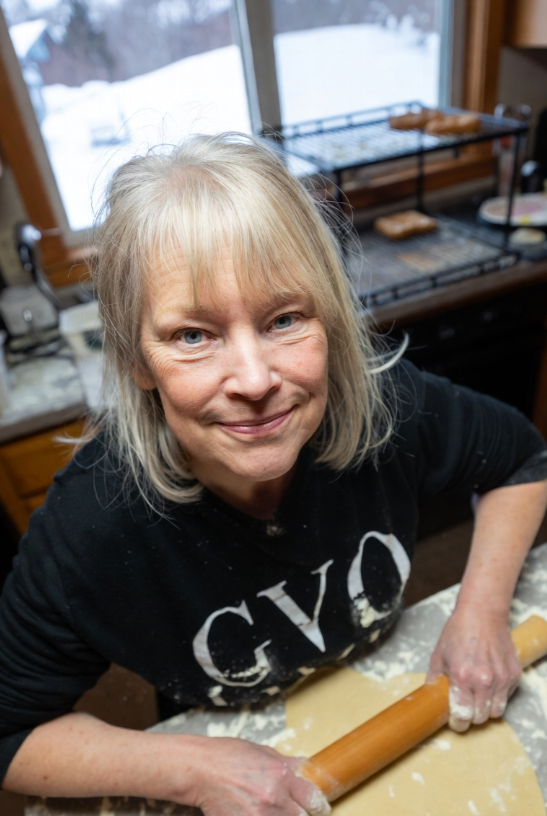
About the cook who shared this
Linda Johansson
Week 518 of Linda’s 30-year story
· Duluth, Minnesota
Linda is a sixty-three-year-old retired nurse from Duluth, Minnesota, living alone in the house where she raised her children and said goodbye to her husband. She lost Paul to ALS in 2020 after two years of watching the kindest man she'd ever known lose everything but his dignity. She cooks Scandinavian comfort food and Minnesota hotdish and the pot roast Paul loved, and she sets two places at the table out of habit because it makes her feel less alone. Every recipe she writes is a person she's loved.
