
 By
By Jason said something this week that I can't stop thinking about. We were in my kitchen — where everything important happens — and he was telling me about a fire call, a house fire, a family that got out safely, and he said, "I love my job but it's taking pieces of me." He said it the way I would say it — calmly, factually, the observation of a person who has learned to monitor their own erosion. And I recognized the words because they're my words, the words I said to Dr. Reeves three years ago, before the floor, before I knew what erosion looked like from the inside.
I didn't panic. I didn't project my own breakdown onto his statement. I said, "What do you need?" and he said, "I don't know yet," and that answer was honest and I respected it because I remember not knowing. I remember the not-knowing that preceded the floor, the period where the erosion was visible to everyone except the person being eroded, and the fact that Jason can see it, can name it, can say "it's taking pieces" — that's better than where I was. That's ahead of where I was.
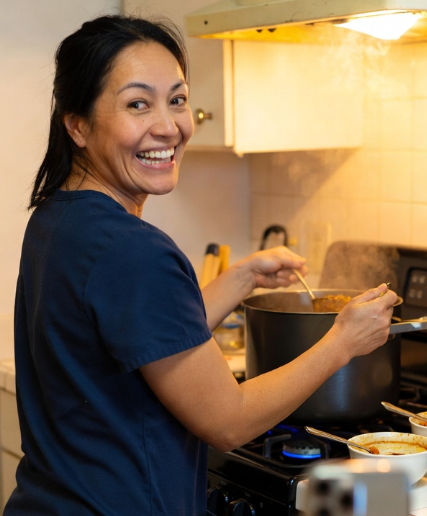
I made sinigang that night. Not for me — for him. His version, the one I taught him, but made by my hands because his hands were tired and the gesture of making someone else's recipe for them is a particular kind of love that doesn't have a name but should. The sour broth steamed. The tamarind did its work. I added one more squeeze. Reynaldo's rule. My inheritance. Jason's medicine now too.
He ate two bowls. We sat on the couch and were quiet and the quiet was the kind I've learned to trust — the kind that says everything it needs to without syllables, the kind that two people who work in emergencies create between them like a demilitarized zone, a space where nothing is urgent and the breathing is enough.
I thought about calling Dr. Reeves. Not for me — for Jason. But that's not how it works. You can't therapy someone by proxy. You can't cook someone out of a crisis. You can feed them. You can be present. You can say "what do you need" and accept "I don't know" as a full answer. You can make sinigang and add one more squeeze and hope the tamarind reaches the places your words can't. The kitchen does what it does. The rest is patience.
Sinigang is mine and Jason’s, and some recipes belong to the people who taught them to you — they’re not for the blog, not yet. But the impulse behind that bowl of sour broth, the need to make something warm and sustaining for a person whose hands were tired and whose heart was working too hard, that impulse translates. This white bean and kale soup lives in the same register: simple, deeply savory, the kind of thing that steams gently on the stove and fills a kitchen with the particular smell of something good being made for someone who matters. It’s what I reach for when I can’t fix anything but I can still feed someone. That night, that’s all I needed it to do.
White Bean and Kale Soup
Prep Time: 15 minutes | Cook Time: 30 minutes | Total Time: 45 minutes | Servings: 6
Ingredients
- 2 tablespoons olive oil
- 1 medium yellow onion, diced
- 4 cloves garlic, minced
- 2 medium carrots, peeled and sliced into rounds
- 2 stalks celery, sliced
- 2 cans (15 oz each) white beans (cannellini or Great Northern), drained and rinsed
- 4 cups low-sodium vegetable broth
- 1 can (14.5 oz) diced tomatoes, with juices
- 4 cups kale, stems removed, leaves roughly chopped
- 1 teaspoon dried thyme
- 1/2 teaspoon dried rosemary
- 1/2 teaspoon smoked paprika
- Juice of 1/2 lemon
- Salt and black pepper to taste
- Red pepper flakes, optional
- Crusty bread, for serving
Instructions
- Build your base. Heat olive oil in a large heavy-bottomed pot over medium heat. Add the onion and cook, stirring occasionally, until softened and translucent, about 5 minutes. Add garlic and cook 1 minute more, until fragrant.
- Add the vegetables. Stir in the carrots and celery. Cook for 3 to 4 minutes, until they begin to soften slightly at the edges.
- Add beans and broth. Pour in the white beans, vegetable broth, and diced tomatoes with their juices. Stir to combine. Bring the pot to a gentle boil over medium-high heat, then reduce heat to medium-low.
- Season and simmer. Add thyme, rosemary, and smoked paprika. Simmer uncovered for 15 minutes, stirring occasionally, until the carrots are tender and the broth has deepened in color.
- Add the kale. Stir in the chopped kale, pressing it down into the broth. Simmer for 5 to 7 minutes until kale is wilted and tender but still a deep, rich green.
- Finish and adjust. Squeeze in the lemon juice. Taste and season generously with salt, black pepper, and red pepper flakes if desired. The lemon brightens everything — don’t skip it.
- Serve. Ladle into wide bowls. Serve hot with crusty bread alongside. This soup holds well — the second bowl is often better than the first.
Nutrition (per serving)
Calories: 215 | Protein: 11g | Fat: 5g | Carbs: 34g | Fiber: 9g | Sodium: 460mg