
 By
By The week between Christmas and New Year's — that liminal space I love, when time loses its grip and the calendar becomes a suggestion rather than a mandate. I spent it cooking osechi, the traditional New Year's foods, each dish a meditation on patience and precision and the belief that how you start the year determines how the year will go.
The kuromame are ready — glossy, black, perfect. Three days of simmering, the nail in the pot, the slow conversion of hard beans to soft sweetness. I packed them in a small container and they glistened like dark jewels. Fumiko called to check on them. "Did they wrinkle?" she asked. "No," I said. "Good," she said. The entire conversation was about bean texture. It was, I think, the most emotionally satisfying conversation we have had all year.
I made datemaki — the sweet rolled omelet that represents scholarship and learning in the osechi tradition. It is made by blending eggs with fish paste and sugar and cooking the mixture in a sheet, then rolling it while hot into a log and slicing it into pinwheels. The process is difficult and the result is beautiful — golden spirals that look like tiny scrolls. My first attempt was too loose. My second was too tight. My third was right. Three attempts. Fumiko would say this is too many. Fumiko has been making datemaki since she was twenty. I have been making it since I was thirty. We are on different timelines.
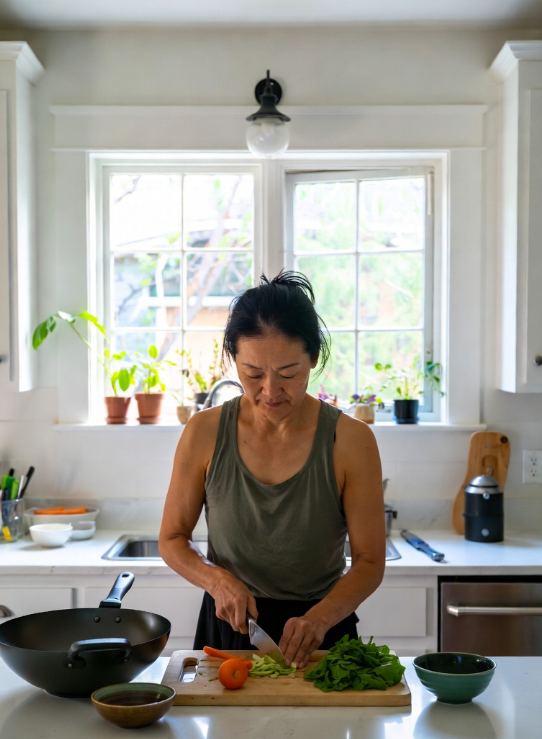
Brian watched me cook the osechi with the expression of a man observing a religious ceremony he does not practice but respects. He offered to help. I said no, then yes, then handed him the daikon peeler. He peeled. We worked in companionable silence, and the silence was the comfortable kind, the kind that does not need to be filled, and I thought: maybe the bridge is here. In the peeling. In the shared kitchen at the end of the year, the last week, the quiet space between one year and the next where anything feels possible, even us.
Miya is twenty months old and she helped with the osechi by eating half the kuromame out of the container when I turned my back. I choose to view this as her participating in the tradition rather than stealing my food. Fumiko, when informed, said, "At least she has good taste." Nakamura approval, one black bean at a time.
After a week of osechi — of kuromame that required three days and a nail, of datemaki that required three attempts and my pride — I wanted to carry that same patience into something Brian could cook with me, something that didn’t require a decade of muscle memory or a grandmother on the phone asking about bean texture. Velvet chicken is that dish. The technique is Chinese, not Japanese, but the principle is the same as everything I made that week: you slow down, you trust the process, you treat the ingredient with respect, and it rewards you. The velveting — soaking the chicken in egg white and cornstarch before cooking — is the kind of step that feels unnecessary until the moment you taste the result, and then you understand why you never skip it. It’s the kind of cooking that suits the in-between week, the quiet kitchen, the year that hasn’t quite started yet.
Velvet Chicken with Vegetables
Prep Time: 20 min (plus 30 min marinating) | Cook Time: 15 min | Total Time: 1 hr 5 min | Servings: 4
Ingredients
- 1 1/2 lbs boneless, skinless chicken breast, sliced thin against the grain (about 1/4-inch slices)
- 2 egg whites
- 2 tablespoons cornstarch, divided
- 1 tablespoon Shaoxing rice wine (or dry sherry)
- 1 teaspoon sesame oil
- 1/2 teaspoon kosher salt
- 3 tablespoons neutral oil (avocado or vegetable), divided
- 3 cloves garlic, minced
- 1 tablespoon fresh ginger, grated
- 1 medium red bell pepper, sliced into thin strips
- 1 cup snap peas, strings removed
- 1 cup broccoli florets, cut small
- 1 medium carrot, peeled and cut into matchsticks
- 3 tablespoons low-sodium soy sauce
- 1 tablespoon oyster sauce
- 1 teaspoon rice vinegar
- 1/2 teaspoon white pepper
- 1/3 cup low-sodium chicken broth
- 1 teaspoon cornstarch (for sauce slurry), mixed with 1 tablespoon cold water
- Sliced scallions and sesame seeds, to finish
Instructions
- Velvet the chicken. In a medium bowl, whisk together the egg whites, 2 tablespoons cornstarch, Shaoxing wine, sesame oil, and salt until smooth. Add the sliced chicken and toss until every piece is coated. Cover and refrigerate for at least 30 minutes, or up to 2 hours. Do not skip this step — it is the entire point.
- Make the sauce. Whisk together the soy sauce, oyster sauce, rice vinegar, white pepper, and chicken broth in a small bowl. Set aside along with your cornstarch slurry.
- Par-cook the chicken. Bring a medium saucepan of water to a gentle simmer (not a boil — you want about 170°F). Slide the marinated chicken pieces in and stir gently, separating any that stick together. Cook for 60–90 seconds just until the exterior turns white and opaque. They will not be cooked through; that is correct. Remove with a slotted spoon and drain on a paper-towel-lined plate.
- Stir-fry the aromatics and vegetables. Heat a wok or large skillet over high heat until it just begins to smoke. Add 2 tablespoons of neutral oil, then add the garlic and ginger. Stir constantly for 30 seconds. Add the carrots and broccoli first and cook for 2 minutes, tossing frequently. Add the bell pepper and snap peas and cook for another 2 minutes, until everything is just barely tender and still bright.
- Combine and finish. Push the vegetables to the edges of the wok. Add the remaining 1 tablespoon oil to the center and add the par-cooked chicken. Let it sit undisturbed for 30 seconds to get a little color, then toss everything together. Pour the sauce over the top and stir to coat. Add the cornstarch slurry, stir, and cook for another 60 seconds until the sauce thickens and clings to the chicken and vegetables like it belongs there.
- Plate and serve. Transfer to a serving platter or directly over steamed rice. Scatter sliced scallions and sesame seeds over the top. Serve immediately — velvet chicken waits for no one.
Nutrition (per serving)
Calories: 310 | Protein: 38g | Fat: 11g | Carbs: 14g | Fiber: 3g | Sodium: 620mg