
 By
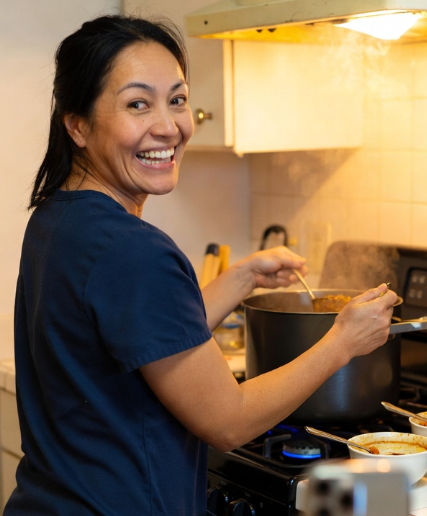
By Waiting for the publisher's response. The waiting is a specific kind of cooking — you've put the ingredients in the pot and closed the lid and now you wait for the flavors to develop and the development requires time and the time requires patience and the patience requires something to do with your hands while the pot simmers. My hands' solution: cook more. Clean the apartment. Rearrange the spice shelf. The spice shelf has been rearranged three times this week. The turmeric has been in four different locations. The Datu Puti has not moved. The Datu Puti never moves. The Datu Puti is the fixed point.
Mia is two months old and has discovered her hands. Angela reports this with the philosophical wonder of a new mother — Mia staring at her own fingers as if they contain the secrets of the universe, which, for a two-month-old, they do. The hands will learn the things: how to hold a spoon, how to wrap lumpia, how to chop garlic, how to hold the hand of someone dying in an ER and then let go and then pick up a spatula and then cook adobo and then keep going. The hands will learn. All Santos hands learn.
I made ginataang kalabasa — squash in coconut milk, the gentle dish. The squash softened. The coconut milk thickened. The shrimp sweetened. I brought it to Angela's house and watched Mia discover her hands while Angela ate one-handed and the scene was domestic and mundane and the mundane was the miracle — the miracle of babies and squash and the ordinary Tuesday that contains everything.
The ginataang kalabasa I brought to Angela’s that Tuesday was just squash and coconut milk, gentle and unhurried — the kind of food that asks nothing of you except to sit down and eat. These Veggie-Stuffed Tomatoes carry the same quiet energy: vegetables softened by heat, flavors deepened by patience, something wholesome enough to set in front of a new mother eating one-handed while a baby stares at her own fingers. It’s the food I reach for when my hands need a task and someone I love needs a meal.
Veggie-Stuffed Tomatoes
Prep Time: 20 min | Cook Time: 25 min | Total Time: 45 min | Servings: 4
Ingredients
- 4 large beefsteak tomatoes
- 1 cup cooked brown rice
- 1/2 cup diced zucchini
- 1/2 cup diced red bell pepper
- 1/4 cup finely diced yellow onion
- 2 cloves garlic, minced
- 1/2 cup shredded mozzarella, divided
- 2 tablespoons olive oil
- 1 teaspoon dried basil
- 1/2 teaspoon dried oregano
- 1/4 teaspoon crushed red pepper flakes (optional)
- Salt and black pepper to taste
- Fresh flat-leaf parsley, chopped, for garnish
Instructions
- Preheat and prep. Preheat oven to 375°F. Slice the tops off the tomatoes and use a small spoon to scoop out the pulp and seeds into a bowl, leaving a 1/4-inch shell. Roughly chop the reserved pulp and set aside. Place hollowed tomatoes cut-side up in a baking dish.
- Sauté the vegetables. Heat olive oil in a skillet over medium heat. Add onion and cook 3 minutes until softened. Add garlic, zucchini, and bell pepper and cook 4–5 minutes, stirring occasionally, until just tender.
- Build the filling. Stir in the reserved tomato pulp, cooked rice, basil, oregano, and red pepper flakes if using. Season generously with salt and pepper. Cook 2 minutes until any excess moisture cooks off. Remove from heat and stir in half the mozzarella.
- Stuff and top. Spoon the filling evenly into each tomato shell, pressing gently to pack. Top each with the remaining mozzarella.
- Bake. Bake uncovered for 20–25 minutes, until the tomatoes are tender and the cheese is melted and lightly golden at the edges.
- Serve. Let rest 5 minutes before serving. Garnish with fresh parsley.
Nutrition (per serving)
Calories: 195 | Protein: 7g | Fat: 9g | Carbs: 23g | Fiber: 4g | Sodium: 310mg