
 By
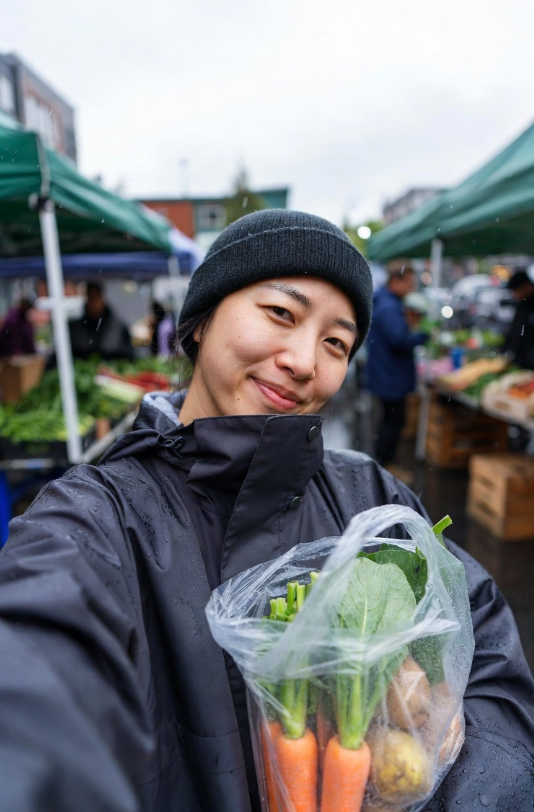
Martin Luther King Jr. Day. A day about justice and equality and the ongoing American project of becoming what it promises to be. I took the day off and went to the International District — the ID, Seattle's historic Asian neighborhood — alone, deliberately, with the intention of just being there. Not shopping, not eating (though I did both), but being. Walking through the streets where Korean and Chinese and Japanese and Vietnamese businesses stand side by side, where the signs are in multiple Asian languages, where the faces on the street look like mine.
I walked into Uwajimaya, the huge Asian grocery store, and spent two hours wandering. I didn't have a list. I just walked the aisles, looking at everything — the produce section with vegetables I'm still learning to name, the sauces and pastes from a dozen countries, the seafood counter with whole fish and live crabs, the housewares section with Korean pottery and Japanese rice bowls and Chinese tea sets. I bought a set of Korean soup bowls — the kind with the lids, used for jjigae — and a pair of Korean metal chopsticks. Korean chopsticks are metal, flat, and harder to use than wooden or bamboo ones. They require more precision, more grip strength. I've been using wooden chopsticks at home and am decent with them, but metal is the Korean standard, and if I'm going to eat Korean food, I should eat it with Korean utensils. Another mirror. Another piece of the identity I'm building.
Lunch in the ID: I went to a tiny Korean place — six tables, hand-lettered menu, a halmeoni (grandmother) running the kitchen alone. I ordered doenjang jjigae. It came in a stone bowl with seven banchan and a bowl of rice, and the jjigae was — transcendent. The best I've ever tasted. The halmeoni's doenjang jjigae had a depth and complexity that mine doesn't have yet, because she's been making it for forty or fifty years and I've been making it for nine months, and the difference between forty years and nine months is everything. But eating her jjigae wasn't discouraging. It was inspiring. It showed me where I'm going. The target is a moving target — by the time I reach her level, she'll have advanced further — and the pursuit is the point. The pursuit is always the point.
The halmeoni brought extra banchan without being asked. She watched me eat with the metal chopsticks (awkwardly but determinedly) and said something in Korean that I caught one word of: 맛있어? (mashisseo? — is it delicious?). I said, "Ne, mashisseoyo" — yes, it's delicious — in my terrible accent, and her face broke into a grin and she patted my shoulder, and the pat was warm and firm and grandmotherly, and for a moment I was just a Korean girl eating her grandmother's food, and the moment was fiction — she's not my grandmother, I'm not just anything — but it was also true, in the way that food can make a fiction feel true for the duration of a meal.
I came home with the new soup bowls and chopsticks and a bag of groceries from H Mart (inside Uwajimaya: more gochugaru, a tub of gochujang, perilla seeds, dried anchovies). I made doenjang jjigae, trying to replicate the halmeoni's version. Mine was good. Hers was better. The gap is the distance between knowledge and wisdom, between nine months and fifty years, between someone who learned from YouTube and someone who learned from her mother who learned from her mother. I can close that gap. It'll take years. I have years. I'm twenty-three. I have decades of doenjang jjigae ahead of me. The thought is comforting. The thought is, in fact, one of the most comforting thoughts I've had in years: there is time. There is time to learn this. There is time to become this. I am not too late.
I couldn’t replicate the halmeoni’s doenjang jjigae that night — not yet — but I still needed to cook something, to keep my hands busy and stay inside the warmth of what the day had given me. This vegetarian lasagna is what I make when I need a dish that rewards the same thing the halmeoni’s kitchen reminded me of: patience, layering, and the slow accumulation of flavor that only comes from showing up and doing it again. It isn’t Korean, and it doesn’t pretend to be — but like any dish worth mastering, it gets better every single time you make it.
Vegetarian Lasagna with Ricotta
Prep Time: 30 minutes | Cook Time: 55 minutes | Total Time: 1 hour 25 minutes | Servings: 8
Ingredients
- 12 lasagna noodles
- 1 tablespoon olive oil
- 3 cloves garlic, minced
- 1 medium zucchini, diced
- 1 red bell pepper, diced
- 8 oz cremini mushrooms, sliced
- 1 teaspoon dried oregano
- 1 teaspoon dried basil
- Salt and black pepper to taste
- 2 cups whole-milk ricotta cheese
- 1 large egg
- 1/2 cup grated Parmesan cheese, divided
- 2 1/2 cups shredded mozzarella cheese, divided
- 1 jar (24 oz) marinara sauce
- Fresh basil leaves, for garnish
Instructions
- Preheat and prep. Preheat your oven to 375°F. Bring a large pot of salted water to a boil and cook the lasagna noodles according to package directions until just al dente. Drain and lay flat on a lightly oiled baking sheet to prevent sticking.
- Saute the vegetables. Heat olive oil in a large skillet over medium heat. Add garlic and cook 30 seconds until fragrant. Add zucchini, bell pepper, and mushrooms. Cook 6–8 minutes, stirring occasionally, until softened and any liquid has evaporated. Season with oregano, basil, salt, and pepper. Remove from heat.
- Mix the ricotta filling. In a medium bowl, stir together the ricotta, egg, 1/4 cup Parmesan, and 1/2 cup mozzarella until well combined. Season lightly with salt and pepper.
- Assemble the lasagna. Spread 1/2 cup marinara sauce across the bottom of a 9x13-inch baking dish. Lay 3 noodles in a single layer. Spread one-third of the ricotta mixture over the noodles, followed by one-third of the sauteed vegetables, then a generous spoonful of marinara. Repeat the layers two more times (noodles, ricotta, vegetables, marinara). Top with the final 3 noodles, the remaining marinara, 2 cups mozzarella, and the remaining 1/4 cup Parmesan.
- Bake covered. Cover the dish tightly with aluminum foil and bake for 35 minutes.
- Bake uncovered. Remove the foil and bake an additional 15–20 minutes, until the cheese is melted, bubbling, and golden at the edges.
- Rest and serve. Let the lasagna rest for 10 minutes before slicing — this helps the layers hold together. Garnish with fresh basil and serve warm.
Nutrition (per serving)
Calories: 390 | Protein: 22g | Fat: 17g | Carbs: 39g | Fiber: 3g | Sodium: 640mg