
 By
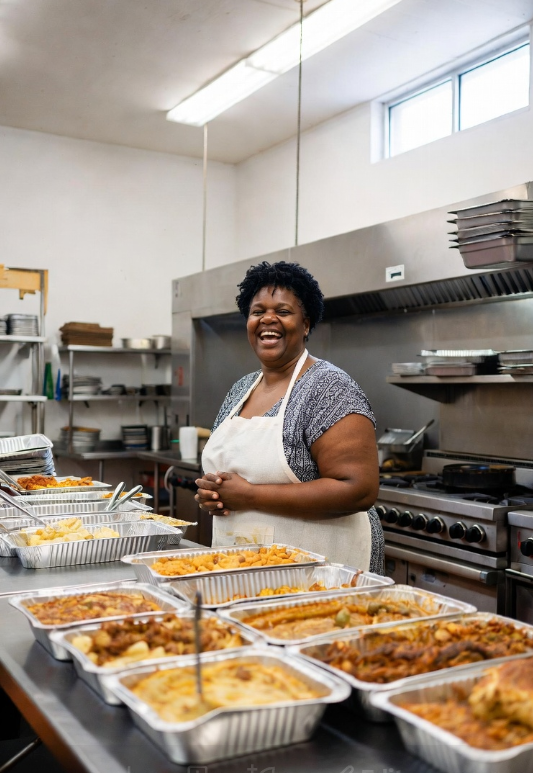
By I have been thinking about what the cooking class is, beneath its surface. On the surface it is eleven women learning to cook on Saturday mornings, which is useful and good and worth the time it takes. But underneath it, it is something older and more necessary: the transmission of knowledge that was never written down, that has never been in a cookbook because the women who knew it didn't write cookbooks, that lives only in the hands of the women who have it and dies when they do if they don't pass it forward. I am a link in a chain that goes back to Bernice, and back through Bernice to her mother, and back through that woman to hers, through the kitchens of Alabama and Georgia and Mississippi and further back than that to wherever the knowledge began. If I don't teach it, the chain breaks. And if the chain breaks, something goes out of the world that cannot be retrieved from a library or a YouTube video. It has to come from a person standing beside you with a wooden spoon.
So I teach. Tuesdays I feed the hungry. Saturdays I teach. Sundays I feed my family and the God who made me and the memory of Marcus and the future that includes Destiny's children and CJ's children who don't exist yet but will. All of it is the same work. All of it is the kitchen, the chain, the wooden spoon passing forward.
This week in class we made bread. Basic white bread—yeast bread, the kind that requires attention but not expertise, the kind that rises twice and goes in the oven and comes out golden and smelling of the most fundamental human satisfaction. Bread-baking is humbling because it requires you to partner with something living—the yeast—that has its own schedule and its own needs and will not be rushed. The bread is done when the bread is done. This is true. This is also everything.
This is the bread we made in class — not exactly, but close enough that it carries the same lesson. Focaccia is forgiving for beginners, but it does not lie to you: the yeast rises on its own schedule, the dough tells you when it’s ready, and no amount of impatience will move it faster. I chose this recipe to share here because it adds vegetables and cheese, which gives you something to do with your hands while the bread does its slow, honest work — and because when it came out of my oven golden and fragrant, it felt exactly like what I had been trying to explain all morning to those eleven women: that some things cannot be rushed, and that is not a limitation but a gift.
Vegetable & Cheese Focaccia
Prep Time: 30 min | Cook Time: 25 min | Total Time: 1 hr 45 min (includes rise time) | Servings: 12
Ingredients
- 1 package (1/4 oz) active dry yeast
- 1 cup warm water (110° to 115°F)
- 1 teaspoon sugar
- 2 1/2 cups all-purpose flour, divided
- 1/4 cup plus 3 tablespoons olive oil, divided
- 3/4 teaspoon salt
- 1/2 cup diced green bell pepper
- 1/2 cup diced red bell pepper
- 1/2 cup thinly sliced red onion
- 1 cup sliced fresh mushrooms
- 2 garlic cloves, minced
- 1/2 teaspoon dried rosemary, crushed
- 1/2 teaspoon dried oregano
- 1/2 teaspoon black pepper
- 1 cup shredded part-skim mozzarella cheese
- 1/4 cup grated Parmesan cheese
Instructions
- Proof the yeast. In a large bowl, dissolve the yeast and sugar in warm water. Let stand for 5–10 minutes until foamy. This is your sign the yeast is alive and ready to work.
- Mix the dough. Stir in 1 cup of flour, 1/4 cup olive oil, and the salt until smooth. Gradually add the remaining flour, mixing until a soft dough forms. It should pull away from the sides of the bowl but still feel slightly tacky.
- Knead and rise. Turn dough onto a lightly floured surface and knead for 6–8 minutes, until smooth and elastic. Place in a greased bowl, turning once to coat the top. Cover with a clean towel and let rise in a warm place for 1 hour, or until doubled in size. Do not rush this step — the bread is done when it’s done.
- Prepare the vegetables. While the dough rises, heat 2 tablespoons of olive oil in a skillet over medium heat. Add the bell peppers, onion, and mushrooms. Cook, stirring occasionally, for 5–7 minutes until softened. Add the garlic and cook 1 minute more. Remove from heat and set aside.
- Shape the focaccia. Punch down the risen dough. Press it into a greased 13x9-inch baking pan, stretching it gently to the edges. Brush the surface with the remaining 1 tablespoon of olive oil. Use your fingertips to dimple the dough all over — this is one of the more satisfying moments in bread-making.
- Top and season. Spread the sautéed vegetables evenly over the dough. Sprinkle with rosemary, oregano, and black pepper. Top with mozzarella and Parmesan cheeses.
- Bake. Bake at 400°F for 22–25 minutes, until the edges are golden and the cheese is lightly browned and bubbling. Let cool in the pan for 5 minutes before slicing.
Nutrition (per serving)
Calories: 210 | Protein: 7g | Fat: 9g | Carbs: 26g | Fiber: 2g | Sodium: 230mg