
 By
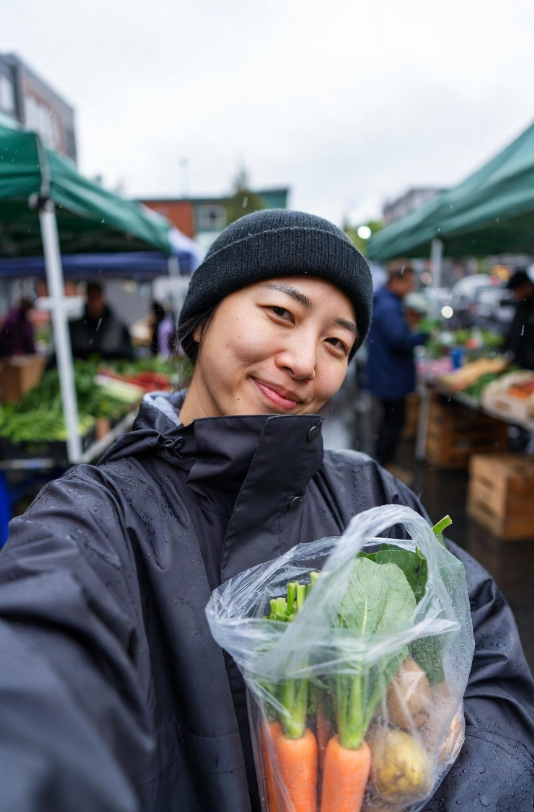
By I have developed what I can only call a Korean grocery store routine. Every Saturday, before or after Bellevue, I stop at H Mart. I have a list — always a list, because I'm the kind of person who makes grocery lists organized by aisle, which Kevin says is "psychopathic" and I say is "efficient." The list this week: gochugaru (I'm going through it faster than I expected, because I put it on everything now, rice, eggs, avocado toast, things that do not traditionally require Korean chili flakes but are improved by them), a fresh block of tofu for jjigae, bean sprouts (which I'm going to attempt namul — Korean seasoned vegetables — for the first time), and perilla leaves, which I've been curious about since I saw Maangchi use them in a wrap with grilled meat.
The perilla leaves were a revelation. They're large, green, slightly fuzzy, with a flavor that sits somewhere between mint and basil but is neither — it's its own thing, distinctly Korean, and when I wrapped a piece of leftover bulgogi in a perilla leaf with a dab of ssamjang, the combination of flavors was so perfect, so obviously designed to be together, that I felt again that strange cellular recognition: my body knows this. My tongue knows this. Whatever part of me was formed in Korea before I was carried across an ocean — that part recognizes perilla leaves the way my American palate recognizes Karen's apple pie.
I know this sounds unscientific. I am a scientist. I know that taste preferences are largely learned, not inherited, and that my affinity for Korean food is probably cultural longing manifesting as flavor preference rather than some mystical genetic memory. But knowing that doesn't change the feeling, and I'm learning — slowly, reluctantly, with the resistance of a person trained in empiricism — that not everything needs to be explained to be real. Some things are just felt. The perilla leaf tastes like home to a woman who has never been home. That's not logical. It's true.
At work, I've been assigned to a new project: a fraud detection system for Amazon Fresh orders. The technical challenge is interesting — identifying anomalous patterns in order data using statistical models — and it requires the kind of focused, deep work that I love: hours of concentration, building something complex from first principles. I worked late three nights this week, not because I had to but because I wanted to, because the code was flowing and the system was taking shape and there's a particular joy in building something from nothing that I don't get anywhere else. Except, now, in the kitchen. The parallels between coding and cooking are getting hard to ignore: both involve following a recipe (or writing one), managing multiple simultaneous processes, timing, precision, and the eventual surrender to chaos — because no system works perfectly on the first try, and no dish comes out exactly like the recipe says, and the gap between plan and reality is where the learning happens.
The bean sprout namul was my first attempt at banchan — the small side dishes served with every Korean meal, the supporting cast that makes rice and a main dish into a feast. The recipe is absurdly simple: blanch bean sprouts, season with sesame oil, garlic, salt, sesame seeds. That's it. Five ingredients. Three minutes of active cooking. And the result is — well, it's bean sprouts, but they're transformed by the sesame oil into something nutty and clean and exactly the kind of thing I want beside a bowl of rice and kimchi at 7 PM on a Tuesday in my Capitol Hill kitchen. I made a batch and ate it all week, and the act of having banchan in my refrigerator — a Korean side dish, ready to eat, waiting for me — made my kitchen feel more Korean than any single dish I've made so far. It's the accumulation that matters. The kimchi plus the banchan plus the rice cooker plus the gochugaru on the shelf. Each thing alone is just an ingredient. Together, they're a kitchen. My kitchen. A Korean-American kitchen. Getting there.
Saturday dinner in Bellevue was Karen's meatloaf, which is comfort food of the highest American order — ground beef with breadcrumbs and ketchup glaze, served with mashed potatoes. I ate two helpings and loved every bite and did not feel conflicted about it, which feels like progress. The Korean food doesn't erase the American food. The bibimbap doesn't cancel the meatloaf. I am learning to hold both, to love both, to be both. It's harder than it sounds. But the bean sprout namul is in my fridge and Karen's meatloaf is in my stomach and I am twenty-two years old and I contain multitudes, and Walt Whitman said that and he wasn't even Korean.
The bean sprout namul taught me something I wasn’t expecting: that simplicity, done with intention, is its own kind of sophistication. Five ingredients, three minutes, and suddenly my refrigerator felt Korean. So when I wanted to carry that same banchan energy into a full weeknight dinner — something vegetable-forward, sesame-scented, and ready before the rice cooker finishes — this vegan stir fry became the obvious next step. It’s not traditional banchan, but it lives in the same spirit: humble produce, a short list of pantry staples, and that particular alchemy of sesame oil and garlic that makes everything taste like it was always supposed to be this way.
Vegan Stir Fry
Prep Time: 15 minutes | Cook Time: 15 minutes | Total Time: 30 minutes | Servings: 4
Ingredients
- 1 block (14 oz) firm tofu, pressed and cut into 3/4-inch cubes
- 2 cups broccoli florets
- 1 red bell pepper, thinly sliced
- 1 cup snap peas, trimmed
- 2 medium carrots, julienned or thinly sliced on the diagonal
- 3 cloves garlic, minced
- 1 tablespoon fresh ginger, grated
- 3 tablespoons low-sodium soy sauce
- 1 tablespoon sesame oil
- 1 tablespoon rice vinegar
- 1 teaspoon cornstarch
- 2 tablespoons vegetable oil, divided
- 1 teaspoon sesame seeds, for garnish
- 2 green onions, thinly sliced, for garnish
- Cooked white or brown rice, for serving
Instructions
- Press the tofu. Wrap the tofu block in a clean kitchen towel or paper towels and place a heavy skillet on top for at least 10 minutes to remove excess moisture. Cut into 3/4-inch cubes and pat dry.
- Make the sauce. In a small bowl, whisk together the soy sauce, sesame oil, rice vinegar, and cornstarch until the cornstarch is fully dissolved. Set aside.
- Brown the tofu. Heat 1 tablespoon of vegetable oil in a large skillet or wok over medium-high heat. Add the tofu cubes in a single layer and cook undisturbed for 3 to 4 minutes until golden on the bottom. Flip and cook another 2 to 3 minutes until golden on the second side. Transfer to a plate.
- Stir fry the vegetables. Add the remaining 1 tablespoon of vegetable oil to the same skillet over high heat. Add the carrots and broccoli first and cook, stirring frequently, for 2 minutes. Add the bell pepper and snap peas and continue stir frying for another 2 minutes, until the vegetables are tender-crisp and lightly charred at the edges.
- Add aromatics. Push the vegetables to the sides of the pan and add the garlic and ginger to the center. Cook for 30 seconds, stirring constantly, until fragrant, then toss everything together.
- Finish with sauce and tofu. Return the tofu to the pan. Give the sauce a quick stir and pour it over everything. Toss to coat and cook for 1 to 2 minutes, until the sauce thickens and clings to the vegetables and tofu.
- Serve. Spoon over steamed rice and garnish with sesame seeds and sliced green onions. Serve immediately.
Nutrition (per serving)
Calories: 230 | Protein: 13g | Fat: 13g | Carbs: 17g | Fiber: 4g | Sodium: 560mg