
 By
By School started. The new rhythm is official now — the four-child morning, the four-child evening, the four-child table that has a gap where Luis Jr. sat. Isabella is a sophomore, sixteen in October, in AP classes and HOSA and the trajectory of a girl who doesn't swerve. Sofia starts eighth grade — her last year of middle school, her last year before high school, her last year before the world asks her what she wants to be and she says "a baker" and the world says "is that all?" and she says "that is everything."
Diego starts fifth grade. His new teacher, Mr. Kaplan, sent home a note on the first day: "Diego asked me if we could build a trebuchet for the physics unit. I said we'd discuss it. He said he already has the design. I believe him." Mr. Kaplan is going to have an interesting year. I almost feel sorry for him. Almost.
Camila starts first grade. She marched into the classroom the way she marches into every room — leading, not following, the small general in the pink backpack who announces her name and her mother's bakery and her singing ability before she sits down. Her new teacher, Mrs. Lopez, called me after the first day: "Camila is... extraordinary." The pause before "extraordinary" was the sound of a teacher searching for a word that means "wonderful and impossible" at the same time.
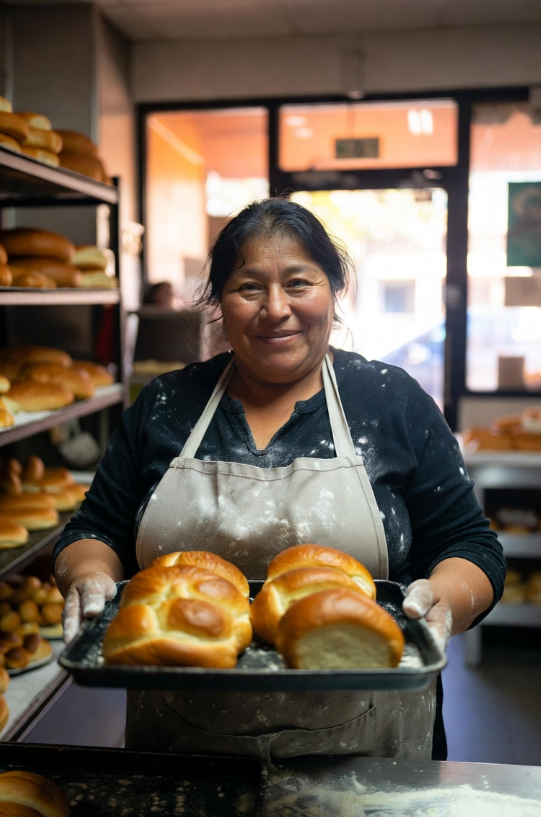
I made a special batch of conchas for the first day of school — one per child, with their initials in the sugar topping. I: Isabella. S: Sofia. D: Diego. C: Camila. I made a fifth one — LJ: Luis Jr. — and I mailed it to Fort Sill in a padded envelope, knowing it would arrive stale and crushed and completely inedible, and not caring, because the concha is not food. The concha is a letter. The concha says: your initial is still in the dough. You are still in the family. You are still fed, even when the feeding crosses state lines.
I made a pot of frijoles negros this week — black beans, slow-cooked with epazote and onion and garlic, the kind of beans that simmer for four hours and fill the house with the smell of earth and patience. Rosa didn't make black beans — she made pinto, always pinto, because Chihuahua is pinto country. But I make black beans because I learned them from Doña Pilar (Puebla) and Doña Mercedes (Yucatán) and the collected wisdom of every Mexican woman who has ever stood at a pot and stirred slowly and known that the stirring is the cooking and the cooking is the life.
The frijoles negros I described — the ones that take four hours and fill the house with the smell of earth and patience — are the reason I keep coming back to baked beans in every form they take. This vegan baked beans recipe is the version I reach for when I want that same slow magic but need something a little more pantry-friendly for a school-night table of four hungry kids. Doña Pilar would approve, I think — it’s still the stirring, still the waiting, still the faith that the pot knows what it’s doing if you just leave it alone long enough.
Vegan Baked Beans
Prep Time: 15 min | Cook Time: 1 hr 45 min | Total Time: 2 hrs | Servings: 6
Ingredients
- 2 cans (15 oz each) black beans or navy beans, drained and rinsed
- 1 medium yellow onion, finely diced
- 4 cloves garlic, minced
- 1/2 cup tomato sauce
- 3 tablespoons molasses
- 2 tablespoons brown sugar, packed
- 1 tablespoon apple cider vinegar
- 1 tablespoon Dijon mustard
- 1 teaspoon smoked paprika
- 1/2 teaspoon ground cumin
- 1/4 teaspoon black pepper
- 3/4 teaspoon kosher salt, plus more to taste
- 1 cup low-sodium vegetable broth
- 1 tablespoon olive oil
Instructions
- Preheat and prep. Preheat your oven to 325°F. In an oven-safe Dutch oven or deep baking dish, warm the olive oil over medium heat on the stovetop.
- Soften the aromatics. Add the diced onion to the pot and cook, stirring occasionally, for 6–8 minutes until softened and translucent. Add the garlic and cook 1 minute more until fragrant.
- Build the sauce. Stir in the tomato sauce, molasses, brown sugar, apple cider vinegar, Dijon mustard, smoked paprika, cumin, salt, and black pepper. Mix until fully combined.
- Add the beans and broth. Fold in the drained beans and pour in the vegetable broth. Stir gently so the beans are coated. Bring the mixture to a low simmer on the stovetop, about 3–4 minutes.
- Bake low and slow. Cover the pot tightly with a lid or foil and transfer to the oven. Bake for 1 hour 15 minutes. Remove the cover, stir gently, and bake uncovered for an additional 25–30 minutes until the sauce has thickened and the top edges are just beginning to caramelize.
- Rest and adjust. Remove from the oven and let the beans rest for 10 minutes before serving — they will continue to thicken as they cool. Taste and adjust salt as needed. Serve warm, straight from the pot.
Nutrition (per serving)
Calories: 210 | Protein: 9g | Fat: 3g | Carbs: 38g | Fiber: 9g | Sodium: 390mg