
 By
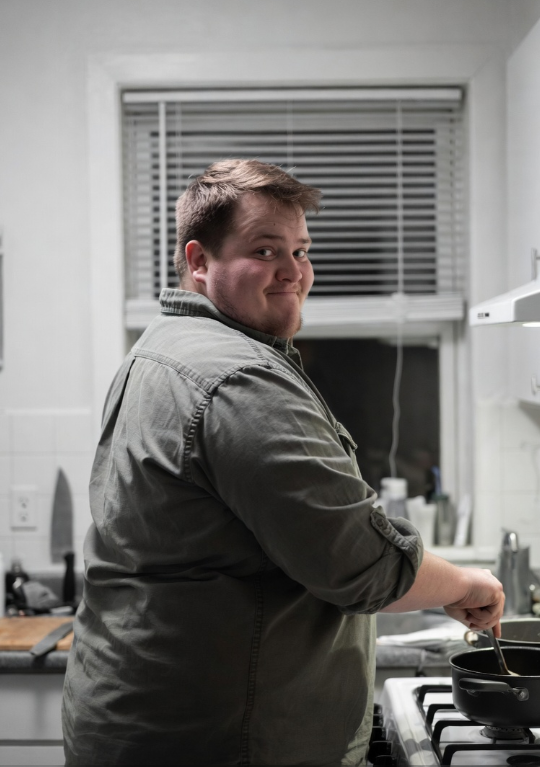
By Babcia's birthday — ninety-six. Tom's birthday — fifty-eight. The November birthdays that anchor my fall calendar. I made the mushroom soup for Babcia and the full Polish dinner for Tom, same as every year. The tradition doesn't need embellishment. It doesn't need reinvention. It needs showing up. It needs dough and filling and a stove and hands that remember.
Tom sat at the table and ate everything and at the end he said, "Jake." I said, "Yeah?" He said, "When are you going to open that shop?" I said, "What shop?" He said, "The pierogi shop. Helen's." I put down my fork. I said, "Who told you about that?" He said, "Nobody told me. I'm your father. I know you." He said, "You've been building toward it for years. Every pierogi you make, every recipe you write, every conversation about food. You're building Helen's. You just haven't signed the lease yet."
I was quiet for a long time. Tom was right. Tom is always right about the things that matter, and he expresses his rightness in ten words or fewer, which makes it more devastating. He knows about Helen's. He's known all along. He's been watching me build it one pierogi at a time.
He said, "When you're ready, I'll help with the wiring." That's it. That's Tom. When you're ready. I'll help with the wiring. The whole future in two sentences.
Megan squeezed my hand under the table. She knew about Helen's because I told her. Tom knew because he's my father. The dream has been seen by the people who matter. It's not a secret anymore. It's a plan. A someday plan. But a plan.
Tom’s words stayed with me long after the plates were cleared — you’ve been building Helen’s one pierogi at a time — and I kept thinking about how much of what I know about dough and filling and shape I learned not from a class but from repetition, from November after November at that same stove. Pierogi are pasta. They are dough with intention. So I keep coming back to this guide on pasta types and how to use them, because understanding the full family of dough-based shapes — the folds, the cuts, the thickness, the purpose — is exactly the kind of foundation you need when you’re building something that’s meant to last.
Types of Pasta — How To Use Them
Prep Time: 20 min | Cook Time: 10 min | Total Time: 30 min | Servings: 4
Ingredients
- 2 cups all-purpose flour, plus more for dusting
- 2 large eggs
- 1/2 teaspoon salt
- 2–3 tablespoons water, as needed
- 1 tablespoon olive oil
- 4 quarts water (for boiling)
- 1 tablespoon kosher salt (for boiling water)
- Sauce or filling of choice (see notes below for pairing guide)
Instructions
- Make the dough. Mound the flour on a clean work surface and create a well in the center. Crack the eggs into the well, add the salt and olive oil, and beat lightly with a fork. Gradually incorporate the flour from the inner walls of the well until a shaggy dough forms.
- Knead. Knead the dough by hand for 8–10 minutes until smooth and elastic, adding water one tablespoon at a time if the dough feels too stiff. Wrap in plastic and rest for 30 minutes at room temperature.
- Roll and cut. Divide dough into four portions. Working with one portion at a time on a lightly floured surface, roll to your desired thickness — thin (1/16 inch) for delicate shapes like angel hair or tagliatelle, thicker (1/8 inch) for pappardelle, stuffed pastas, or dumpling-style shapes.
- Shape by type. For long cuts: fold dough loosely and slice to width. For stuffed shapes (ravioli, pierogi-style): cut into rounds or squares, add filling, seal edges firmly with a fork or pinch. For short cuts (penne-style): roll dough into a log and cut on the diagonal.
- Boil. Bring 4 quarts of water to a rolling boil. Add kosher salt until the water tastes like the sea. Cook fresh pasta 2–4 minutes for thin cuts, 4–6 minutes for stuffed or thicker shapes. Pasta is done when it floats and is tender but still has a slight resistance.
- Pair intentionally. Light, delicate shapes (angel hair, capellini) carry light oil-based or cream sauces. Wide flat noodles (pappardelle, tagliatelle) hold up to bold meat ragus. Tubular shapes (penne, rigatoni) trap chunky vegetable sauces. Stuffed shapes stand alone with only butter, a drizzle of olive oil, or a light pan sauce that doesn’t compete with the filling.
- Finish and serve. Reserve 1/2 cup pasta cooking water before draining. Toss cooked pasta directly in your sauce pan over medium heat for 60 seconds, adding pasta water a splash at a time to achieve a glossy, cohesive sauce. Serve immediately.
Nutrition (per serving)
Calories: 310 | Protein: 10g | Fat: 6g | Carbs: 52g | Fiber: 2g | Sodium: 480mg