
 By
By Lumpia production week. Lourdes, Angela, and I — masked, hands washed, the pandemic precautions observed with the seriousness of a surgical team and the warmth of three women who have been wrapping lumpia together since two of them were old enough to hold a wrapper. Three hundred lumpia. The full count. The wedding count. The number that says: Lourdes Santos attended her son's wedding, even if Lourdes Santos was in Anchorage and the wedding was in San Diego.
We wrapped for six hours. The kitchen was a factory — Lourdes on filling (her portioning is precise; she can measure a tablespoon of filling by sight), Angela on rolling (her technique is tighter than mine; she'll deny this), me on sealing (the egg wash, the careful pressing, the closure that keeps the lumpia intact during frying). The production line was efficient and imperfect and loud — Lourdes directing, Angela arguing, me mediating, the three of us performing the roles we've played since childhood. The eldest mediates. The middle argues. The mother directs. The lumpia gets made.
Three hundred lumpia, wrapped and frozen and packed in dry ice in a Styrofoam cooler. The cooler was shipped via overnight freight to San Diego, where Mark and Carmen would receive it two days before the wedding and fry them for the reception — the small reception, the COVID reception, just close friends and family, but the lumpia would be there, three hundred of them, shipped from a kitchen in Mountain View, Anchorage, Alaska, to a courthouse in San Diego, California, by a seventy-year-old Filipino woman who believes that food is presence and presence is love and love is lumpia.
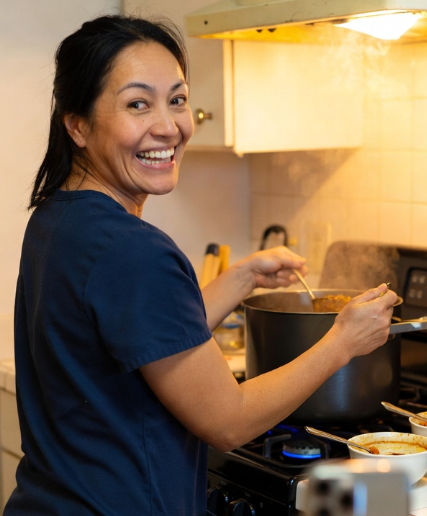
I made mechado after the wrapping marathon — a simple, warm stew to feed the three women who had just spent six hours making food for someone else. The mechado was rich and the kitchen was warm and Angela fell asleep on Lourdes's couch and Lourdes covered her with a blanket and looked at me and said, "My children." Two words. The whole world. My children. We are her children. Even in a pandemic. Especially in a pandemic. The children who wrap and ship and eat and stand in her kitchen and fall asleep on her couch and are covered with blankets. My children.
After six hours on the production line and three hundred lumpia sealed, frozen, and packed for shipping, none of us had eaten a real meal — we’d been too focused on feeding everyone else. I wanted something warm and deeply savory that required almost no precision, no portioning by sight, no technique to argue over — just a pot, two kinds of meat, tomatoes, and time. This two-meat sauce was that meal: rich enough to feel like an occasion, simple enough to make while Angela was already half-asleep on the couch, and generous enough that Lourdes and I could sit together quietly and eat without talking, which after six hours of directing and arguing and mediating, was exactly what we needed.
Two-Meat Spaghetti Sauce
Prep Time: 15 minutes | Cook Time: 50 minutes | Total Time: 1 hour 5 minutes | Servings: 8
Ingredients
- 1 lb ground beef (80/20)
- 1 lb mild Italian sausage, casings removed
- 1 medium yellow onion, finely diced
- 1 green bell pepper, finely diced
- 4 cloves garlic, minced
- 2 tablespoons olive oil
- 1 can (28 oz) crushed tomatoes
- 1 can (15 oz) tomato sauce
- 1 can (6 oz) tomato paste
- 1/2 cup water or dry red wine
- 1 1/2 teaspoons dried Italian seasoning
- 1 teaspoon dried basil
- 1/2 teaspoon dried oregano
- 1/2 teaspoon sugar
- 1/2 teaspoon crushed red pepper flakes (optional)
- Salt and black pepper to taste
- Cooked spaghetti, for serving
- Freshly grated Parmesan, for serving
Instructions
- Brown the meats. Heat olive oil in a large, heavy-bottomed pot or Dutch oven over medium-high heat. Add the ground beef and Italian sausage, breaking them up with a wooden spoon. Cook until browned and no pink remains, 8–10 minutes. Drain excess fat, leaving about 1 tablespoon in the pot.
- Soften the aromatics. Reduce heat to medium. Add the diced onion and bell pepper to the pot and cook, stirring occasionally, until softened, about 5 minutes. Add the minced garlic and cook 1 minute more, until fragrant.
- Build the sauce. Stir in the tomato paste and cook for 2 minutes, stirring constantly, to caramelize slightly. Pour in the crushed tomatoes, tomato sauce, and water or wine. Stir to combine, scraping up any browned bits from the bottom of the pot.
- Season and simmer. Add the Italian seasoning, dried basil, oregano, sugar, red pepper flakes if using, and a generous pinch of salt and black pepper. Stir well. Bring the sauce to a gentle boil, then reduce heat to low.
- Cook low and slow. Simmer uncovered for 30–35 minutes, stirring occasionally, until the sauce is thick, deeply colored, and fragrant. Taste and adjust salt, pepper, and sugar as needed.
- Serve. Ladle generously over cooked spaghetti and finish with freshly grated Parmesan. The sauce keeps refrigerated for up to 5 days and freezes beautifully for up to 3 months.
Nutrition (per serving, sauce only)
Calories: 310 | Protein: 23g | Fat: 18g | Carbs: 13g | Fiber: 3g | Sodium: 620mg