
 By
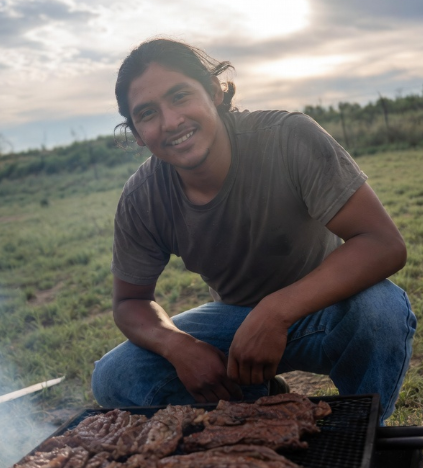
By Mid-November. The deer rut is full on now. I'm hunting most weekends and a couple of evenings during the week if I can get out. Took a doe Saturday morning — clean shot at thirty yards from the north stand. Processed her with Caleb in the afternoon. He's gotten faster at it, his hands sure. He says he's been thinking about doing his own hunt next year. I told him I'd teach him. He said: you taught Kai. I said: I taught everybody who let me. He said: I'll let you. I said: good.
The freezer is in good shape. We're stocked through to summer. With the doe and the six-point and the elk meat I traded a welding job for in September, plus the catfish from the lake earlier this fall, the protein side of the year is set. That's a kind of security I never had as a kid and that I still don't take for granted as an adult. Empty freezers in childhood are a memory that doesn't go away. Full freezers in adulthood are a kind of ongoing answer.
The food forest is in fall mode. The pawpaws are leafless. The persimmons are dropping their last fruit. The pecans are being raked daily by squirrels and by Hannah and me — what we get to before the squirrels do. We collected about twenty pounds of pecans in the last two weeks, half-cracked already by squirrel teeth and finished by my hands at the porch table in the evenings. The pecans go in the freezer in jars. They'll be the foundation of pies for Thanksgiving and Christmas, and of pralines for January when Hannah teaches a workshop on Cherokee-Mexican food and the pralines bridge both sides.
Wednesday the cohort had a problem. Two students got into a yelling match in the bay over a project — long story, partly personal, partly that one was tired and the other hadn't slept. I broke it up. Sent them both home for the day. Called them in separately Thursday morning, talked to them, told them what I needed. By Thursday afternoon they were back in the bay working on opposite ends. The conflict cost a half-day of class time. The repair cost an hour of one-on-one. The cohort needs to be a unit. I needed them to remember that. They will.
Caleb Saturday after the doe. We finished her, cleaned the workshop, sat on the porch in the cool sun. He said: I'm going to be sober eleven years next March. I said: I know. He said: I never thought I'd see eleven. I said: I never stopped thinking you would. He said: that's a lie. I said: it's a useful lie. He laughed. I laughed. We sat. The cottonwood was bare. The wind was cold. The land went on doing what it does in November, which is preparing to go silent for a while.
After Caleb left Saturday, I sat on that porch a while longer than I needed to. The cottonwood was bare, the wind had teeth, and the land was doing its November thing — going quiet. I didn’t want anything complicated for dinner. I wanted something that let me stand at the stove and stir and not think too hard, something that used what I had and tasted like it meant something. This turkey thyme risotto is that dish. It’s slow enough to be meditative, warm enough to be an answer to cold air, and simple enough that you can make it while you’re still sitting with a good day.
Turkey Thyme Risotto
Prep Time: 10 min | Cook Time: 35 min | Total Time: 45 min | Servings: 4
Ingredients
- 1 lb ground turkey
- 1 1/2 cups arborio rice
- 5 cups low-sodium chicken broth, warmed
- 1 medium yellow onion, finely diced
- 3 cloves garlic, minced
- 1/2 cup dry white wine (or additional broth)
- 1/2 cup freshly grated Parmesan cheese
- 2 tablespoons unsalted butter
- 2 tablespoons olive oil
- 1 1/2 teaspoons fresh thyme leaves (or 1/2 teaspoon dried thyme)
- 1/2 teaspoon salt, plus more to taste
- 1/4 teaspoon black pepper
- 1 tablespoon fresh flat-leaf parsley, chopped (optional, for serving)
Instructions
- Warm the broth. Pour the chicken broth into a small saucepan and heat over low heat. Keep it warm throughout cooking — adding cold broth stalls the risotto.
- Brown the turkey. Heat 1 tablespoon of the olive oil in a wide, heavy-bottomed pan or Dutch oven over medium-high heat. Add the ground turkey, season with salt and pepper, and cook, breaking it up with a spoon, until cooked through and lightly browned, about 6–8 minutes. Transfer to a bowl and set aside.
- Soften the aromatics. Reduce heat to medium. Add the remaining tablespoon of olive oil and the butter to the same pan. Once the butter melts, add the onion and cook, stirring, until softened and translucent, about 4–5 minutes. Add the garlic and thyme and cook 1 minute more until fragrant.
- Toast the rice. Add the arborio rice to the pan and stir to coat in the butter and oil. Toast for 1–2 minutes, stirring constantly, until the edges of the rice look slightly translucent.
- Deglaze with wine. Pour in the white wine and stir until fully absorbed, about 1–2 minutes.
- Add broth gradually. Add the warm broth one ladleful (about 1/2 cup) at a time, stirring frequently and waiting until each addition is absorbed before adding the next. Continue this process for 22–26 minutes, until the rice is creamy and cooked through with just a slight bite at the center.
- Finish the risotto. Stir the cooked turkey back into the pan. Remove from heat and stir in the Parmesan. Taste and adjust salt and pepper. The risotto should be loose and creamy — add a final splash of warm broth if it tightens up before you’re ready to serve.
- Serve. Spoon into bowls, scatter parsley over the top if using, and finish with a light grating of extra Parmesan. Eat while it’s warm.
Nutrition (per serving)
Calories: 520 | Protein: 34g | Fat: 18g | Carbs: 52g | Fiber: 2g | Sodium: 610mg