
 By
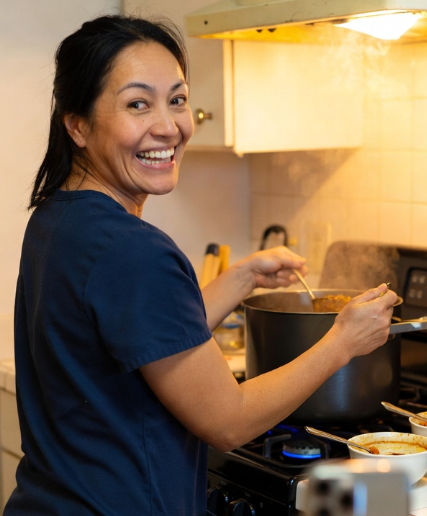
By Jason came to dinner. At my apartment. My food, my kitchen, my territory. This is significant in ways I need to explain: cooking for someone is, for me, the most intimate thing I do. More intimate than conversation, more revealing than confession. When I cook for someone, I'm showing them who I am — the garlic I use (too much), the vinegar I pour (too generously), the way I stand at the stove and stir and talk and let the food speak for the parts of me that words can't reach. Cooking for Jason was inviting him into the room where I'm most myself. No one has been in that room for a long time.
I made chicken adobo. Of course. The first recipe, the foundational dish, the test. If he can eat my adobo and understand what it means — not just the flavor but the weight behind it — then he can be here. This is not a fair test. No one walks into a bowl of chicken adobo and understands that it represents a mother's love and a father's death and a daughter's recovery and thirty-five years of immigration and the particular stubbornness of a woman who feeds people because feeding is the only language she fully trusts. But Jason doesn't need to understand all of that. He just needs to eat it and mean the eating.
He ate two bowls. He asked for the recipe. I said, "It's my mother's." He said, "It's the best thing I've ever eaten." I said, "You should try her lumpia." He said, "I will." Something about the "will" — the certainty, the future tense, the assumption that there would be more meals, more recipes, more time — made my chest do something that wasn't pain and wasn't exactly joy but was the space between them, the space where hope lives when it's been cautious for too long.
After dinner, we sat on the couch and he told me about his worst call — a car accident on the Seward Highway, a family, winter. He told it the way we tell these things — factual, spare, the emotion underneath the words like a river under ice. I listened. I didn't flinch. When he finished, I said, "I understand." He said, "I know." And then we were quiet and the quiet was not empty, it was the fullest quiet I've experienced since the floor.
He left at ten. I washed the dishes slowly and thought about the meal we'd shared and the stories we'd traded and the way two people who hold other people's emergencies for a living had, for one evening, held each other's instead. The dishes were clean. The apartment smelled like vinegar and garlic. The evening was good. Not more. Not yet. But good.
The adobo belongs to my mother — I’ll always cook it when the stakes feel highest, when I need to say something I don’t have words for. But in the days after Jason left and the apartment still smelled like vinegar and garlic, I kept cooking, kept reaching for dishes that carry that same quality: bold and unapologetic, warm in a way that has nothing to do with temperature. This Thai red curry has become one of those dishes for me — fragrant and generous, the kind of thing that fills a kitchen and makes a person feel, without quite knowing why, that they are being taken care of.
Thai Red Curry with Vegetables
Prep Time: 10 minutes | Cook Time: 25 minutes | Total Time: 35 minutes | Servings: 4
Ingredients
- 1 tablespoon coconut oil or neutral oil
- 3 tablespoons Thai red curry paste
- 1 can (13.5 oz) full-fat coconut milk
- 1 cup vegetable broth
- 1 tablespoon fish sauce (or soy sauce for vegan)
- 1 tablespoon brown sugar or coconut sugar
- 1 tablespoon fresh lime juice
- 1 red bell pepper, sliced thin
- 1 zucchini, sliced into half-moons
- 1 cup broccoli florets
- 1 cup snap peas, trimmed
- 1/2 cup canned bamboo shoots, drained
- 3 cloves garlic, minced
- 1 tablespoon fresh ginger, grated
- 4 fresh kaffir lime leaves (optional)
- Fresh Thai basil and sliced red chili, for garnish
- Cooked jasmine rice, for serving
Instructions
- Bloom the paste. Heat oil in a large skillet or wok over medium heat. Add the red curry paste, garlic, and ginger. Stir and cook for 1—2 minutes until fragrant, letting the paste sizzle and deepen in the oil.
- Build the sauce. Pour in the coconut milk and vegetable broth, stirring to combine with the paste. Add fish sauce (or soy sauce), brown sugar, and kaffir lime leaves if using. Bring to a gentle simmer over medium heat.
- Add the vegetables. Add bell pepper, broccoli, zucchini, and bamboo shoots. Stir to coat in the sauce. Simmer uncovered for 10—12 minutes, stirring occasionally, until the vegetables are just tender but still have some bite.
- Finish with snap peas. Add the snap peas in the last 3 minutes of cooking so they stay bright and crisp. Stir in the lime juice and taste, adjusting fish sauce or sugar as needed.
- Serve. Remove kaffir lime leaves. Ladle over steamed jasmine rice and top with fresh Thai basil and sliced red chili.
Nutrition (per serving, without rice)
Calories: 280 | Protein: 5g | Fat: 22g | Carbs: 18g | Fiber: 4g | Sodium: 620mg