
 By
By The days are absurdly long now. This is Alaska in late May — sunset at eleven PM, sunrise at five AM, and in between, a blue-gold light that makes everything look like it's being photographed by someone who oversaturated the color settings. I went for a walk at ten PM tonight and it was bright enough to read by. If you've never experienced an Alaskan summer, you don't understand how the endless light can feel like a second chance. After months of four-hour days and darkness that presses on you like a physical weight, the light arrives and the world opens up and your body doesn't know what to do with all this brightness except try to match it.
I'm trying to match it. Seven weeks of leave, fourteen therapy sessions, and something is shifting. Not dramatically — I don't trust dramatic shifts anymore, because the ER taught me that the patients who look suddenly better are sometimes the ones about to crash. But steadily. I slept five hours last night without a nightmare. Five consecutive hours. I texted Angela: "Five hours." She texted back a single heart emoji. She understood.
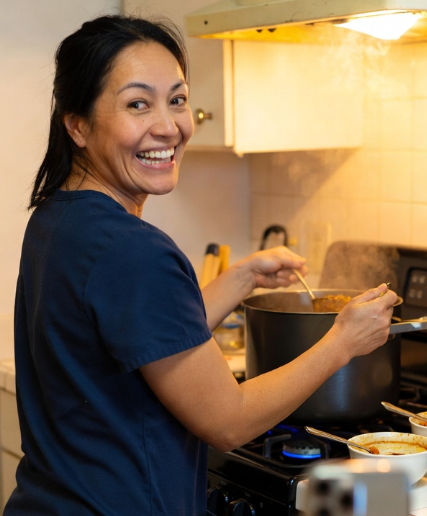
I spent the afternoon making kare-kare — Filipino oxtail stew in peanut sauce. It's one of the more labor-intensive Filipino dishes, which is exactly why I chose it. The oxtails need to simmer for hours until the collagen breaks down and the meat slides off the bone. You toast the peanuts and grind them into sauce. You add eggplant, string beans, banana blossom if you can find it (I couldn't — this is Anchorage, not Manila). And you serve it with bagoong — fermented shrimp paste, the salty-funky counterpoint to the rich peanut sauce, the contrast that makes the whole dish work.
The cooking took four hours. Four hours of chopping, toasting, simmering, stirring. Four hours of my hands doing something purposeful and precise, the same hands that start IVs and perform compressions and hold the hands of dying people. In the ER, these hands save lives. In the kitchen, they save mine. Dr. Reeves would say I'm using cooking as a grounding technique. Lourdes would say I'm finally learning to cook properly. They're both right.
I packaged portions for Lourdes and Angela and dropped them off. Lourdes tasted it, paused, and said, "More peanuts next time, but good." From Lourdes, "but good" is a standing ovation. I drove home in the ten PM sunshine and the light was everywhere and I let it in. All of it. Even the parts that made me squint.
The kare-kare I made that night — the full recipe, the four-hour version — wasn’t something I could share here, if only because bagoong is its own universe and the dish is a project, not a weeknight. But the peanut sauce? That’s the heart of it, and that’s something I can give you. I kept coming back to it in the days after: that moment when the sauce comes together and the kitchen smells like something ancient and right, and your hands are just doing what hands do. Here’s the version I’ve refined down to something fast enough for a Tuesday, rich enough to feel like it matters.
Thai Chili Peanut Sauce
Prep Time: 10 minutes | Cook Time: 10 minutes | Total Time: 20 minutes | Servings: 8 (about 1 cup total)
Ingredients
- 3/4 cup dry-roasted peanuts (unsalted), plus more to taste
- 2 tablespoons natural peanut butter (smooth)
- 3 cloves garlic, minced
- 1 tablespoon fresh ginger, grated
- 2 tablespoons soy sauce (or tamari for gluten-free)
- 1 tablespoon fish sauce (optional, adds depth)
- 1 tablespoon rice vinegar
- 1 tablespoon brown sugar or palm sugar
- 1–2 teaspoons sambal oelek or Thai chili paste, to taste
- 1/2 cup coconut milk (full-fat)
- 2–3 tablespoons warm water, to thin
- 1 teaspoon sesame oil
- Juice of 1/2 lime
Instructions
- Toast the peanuts. In a dry skillet over medium heat, toast the peanuts for 3–4 minutes, stirring frequently, until fragrant and lightly golden. Watch carefully — they go from toasted to burned quickly. Remove from heat and let cool for 2 minutes.
- Grind the peanuts. Transfer the toasted peanuts to a food processor or blender and pulse until finely ground, about 30 seconds. You want a coarse meal, not a paste. Set aside.
- Build the base. In a small saucepan over medium-low heat, combine the peanut butter, garlic, and ginger. Stir for 1 minute until fragrant.
- Add the liquids. Pour in the coconut milk, soy sauce, fish sauce (if using), rice vinegar, brown sugar, and sambal oelek. Whisk to combine and bring to a gentle simmer.
- Incorporate the ground peanuts. Stir in the ground toasted peanuts and simmer for 3–4 minutes, stirring often, until the sauce thickens and turns a deep, warm amber. Add warm water one tablespoon at a time to reach your desired consistency — it should coat a spoon but still pour slowly.
- Finish and balance. Remove from heat. Stir in sesame oil and lime juice. Taste and adjust: more sambal for heat, more sugar for sweetness, more soy sauce for salt. Lourdes’s note applies here — when in doubt, more peanuts.
- Serve. Use warm as a dipping sauce, drizzle over noodles or rice, spoon over steamed vegetables, or use as the base for a full kare-kare–style braise. Keeps refrigerated for up to 5 days; reheat gently with a splash of water to loosen.
Nutrition (per serving)
Calories: 138 | Protein: 5g | Fat: 11g | Carbs: 7g | Fiber: 1g | Sodium: 320mg