
 By
By Late January. The rain has been constant for three weeks and the apartment feels like the inside of a submarine — sealed, damp, the windows fogged with the breath of three people living in too-small a space with too-large feelings. I open the windows every morning for ten minutes, regardless of the rain, because the air inside needs to move and the movement is a metaphor I am too tired to articulate but too compelled to ignore.
I made Fumiko's gyudon — the beef bowl, thinly sliced beef simmered with onions in a sweet soy-dashi sauce, served over rice. It is the ultimate quick comfort food, a one-bowl meal that takes twenty minutes and tastes like someone cares about you. Fumiko made gyudon on weeknights when she was tired, when the full kaiseki-style cooking she preferred was beyond the day's energy. She called it "apologetic cooking" — the meal you make when you cannot make the meal you want to make. I have stopped apologizing for the gyudon. Gyudon is honest. Gyudon says: I am tired and I am feeding you anyway, and the feeding is the love, and the love does not require an elaborate presentation.
Brian and I had a fight. A real one — the first real fight in months, because we have been avoiding real fights the way you avoid a room in your house where the floor is rotting: you know it's there, you walk around it, you pretend the house is fine. The fight was about dishes. It is always about dishes when it is never about dishes. I said he doesn't help. He said I don't ask. I said I shouldn't have to ask. He said he's not a mind reader. The argument is ancient, older than our marriage, older than us — every couple in history has had this fight, and every couple in history has been arguing about something else. We were arguing about attention. About the fact that I am here, in this kitchen, every day, making food and making art and making a life, and he walks through it without seeing it. The dishes are the symptom. The disease is invisibility.
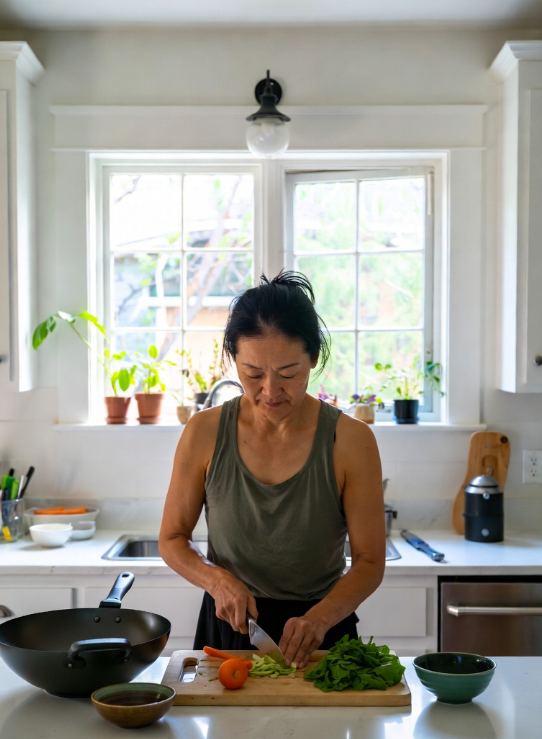
After the fight, after Miya was in bed, after the silence had settled into the apartment like sediment in a bottle, I sat at the kitchen table and opened my laptop and began writing the book. Not the outline. Not the notes. The actual book. Chapter one. Fumiko's kitchen. The smell of soy sauce. The cast iron tamagoyaki pan. The ceramic bowls from a country she never returned to. I wrote for two hours. The words came the way dashi comes after the kombu has soaked all night: clear, concentrated, full of everything that was invisible before the heat was applied. The heat has been applied. The book is starting. The marriage is ending. Both are happening at the same time, in the same kitchen, and the simultaneity is not a coincidence. It is the architecture of a life that is making room.
Fumiko’s gyudon is her recipe, her bowl, her ghost in my kitchen — and some nights it belongs only to her memory. On the nights I need something of my own, something with heat and momentum that matches the particular exhaustion of a fight half-resolved and a book newly begun, I reach for this Szechuan-style chicken stir fry. It has the same logic as the gyudon: protein, aromatics, a sauce that does the work, rice underneath to hold everything together. It takes about thirty minutes, which is exactly the amount of time I need to let the sediment settle before I can eat in something that resembles peace.
Szechuan-Style Chicken Stir Fry
Prep Time: 15 min | Cook Time: 15 min | Total Time: 30 min | Servings: 4
Ingredients
- 1 1/2 lbs boneless, skinless chicken breasts, thinly sliced against the grain
- 2 tablespoons cornstarch
- 3 tablespoons soy sauce, divided
- 2 tablespoons vegetable oil, divided
- 1 red bell pepper, thinly sliced
- 1 cup broccoli florets
- 3 cloves garlic, minced
- 1 teaspoon fresh ginger, grated
- 2 tablespoons hoisin sauce
- 1 tablespoon rice vinegar
- 1 teaspoon sesame oil
- 1/2 teaspoon crushed red pepper flakes (or more to taste)
- 1/4 cup low-sodium chicken broth
- 3 green onions, sliced
- 1 teaspoon sesame seeds, for garnish
- Cooked white rice, for serving
Instructions
- Marinate the chicken. Toss sliced chicken with cornstarch and 1 tablespoon of the soy sauce in a bowl. Let sit for 10 minutes while you prep the vegetables.
- Make the sauce. Whisk together the remaining 2 tablespoons soy sauce, hoisin sauce, rice vinegar, sesame oil, red pepper flakes, and chicken broth in a small bowl. Set aside.
- Sear the chicken. Heat 1 tablespoon vegetable oil in a large skillet or wok over high heat until shimmering. Add the chicken in a single layer and cook undisturbed for 2—3 minutes until golden. Stir and cook another 1—2 minutes until cooked through. Transfer to a plate.
- Cook the vegetables. Add the remaining tablespoon of oil to the pan. Add broccoli and bell pepper and stir fry over high heat for 3—4 minutes until just tender-crisp. Add garlic and ginger and cook for 30 seconds until fragrant.
- Combine and sauce. Return the chicken to the pan. Pour the sauce over everything and toss to coat. Cook for 1—2 minutes until the sauce thickens and clings to the chicken and vegetables.
- Serve. Spoon over steamed white rice. Top with sliced green onions and sesame seeds.
Nutrition (per serving)
Calories: 310 | Protein: 38g | Fat: 10g | Carbs: 16g | Fiber: 2g | Sodium: 780mg