Ten weeks. Into the double digits. The baby is now the size of a kumquat, which is a fruit I've never cooked with but which Raj insists we buy every week from the Indian grocery store so he can hold it up to my stomach and say, "Hello, kumquat."
He talks to the baby. Every night, before bed, he puts his face near my stomach and talks. About his day, about his patients, about the weather. He tells the baby about cricket, which I've told him is premature and also boring, and he tells the baby about our wedding and about the time he almost set a curtain on fire lighting diyas.
I pretend to find this ridiculous. It is the most tender thing I've ever witnessed.
The twelve-week mark is approaching — the traditional "safe to tell" milestone. Raj wants to tell our families then. I'm not sure I'll ever feel safe enough to tell anyone, but twelve weeks is the number, so twelve weeks it will be.
At work, the MTM program continues to grow. I've been asked to mentor a new pharmacist — Jessica, twenty-six, fresh out of Rutgers, eager and terrified in equal measure. She reminds me of myself five years ago, before the program, before the confidence. I'm trying to teach her the thing no pharmacy school teaches: how to listen. How to hear what the patient isn't saying. How to read the pause between "I take my medication" and "most of the time."
I made idiyappam tonight — string hoppers, the South Indian rice noodle nests that you steam and serve with coconut milk or curry. They're delicate work — you press the dough through a special mold to create thin noodles, then coil them into flat discs on banana leaves or muslin, then steam them. The texture should be soft but not mushy, the noodles distinct but not stiff.
Amma makes idiyappam for special occasions — festivals, birthdays, the first day of Tamil months. I'm making them on a Tuesday because I want to, because the careful, repetitive work of pressing noodles through a mold is meditative, because my hands need something to do while my mind worries about twenty-six out of thirty and kumquat-sized hopes.
The idiyappam came out well. Not perfect — some nests were too thick, some fell apart during steaming — but the ones that worked were beautiful: white, lacy, steaming. I served them with Amma's vegetable stew (coconut milk, potatoes, carrots, green peas, curry leaves) and the combination was comfort in bowl form.
Raj ate his and talked to the kumquat about stew.
The vegetable stew I made alongside the idiyappam that Tuesday night — Amma’s version, the one I’ve been watching her make since I was small enough to stand on a stool at the stove — is the kind of recipe that lives in your hands more than your head. Coconut milk, potatoes, carrots, green peas, curry leaves: it is not complicated, but it asks for attention, and that night attention was exactly what I needed to give something other than the number twelve. This soup is the closest I can write it down: a sweet potato lentil stew that borrows those same warm, coconut-bright flavors and comes together in one pot on an ordinary weeknight, for anyone whose hands need something steady to do.
Sweet Potato Lentil Soup with Coconut Milk & Curry Leaves
Prep Time: 15 minutes | Cook Time: 35 minutes | Total Time: 50 minutes | Servings: 4
Ingredients
- 1 tablespoon coconut oil or neutral oil
- 1 teaspoon black mustard seeds
- 10–12 fresh curry leaves (or 1/2 teaspoon dried)
- 1 medium yellow onion, diced
- 3 garlic cloves, minced
- 1 teaspoon fresh ginger, grated
- 1 teaspoon ground coriander
- 1/2 teaspoon ground turmeric
- 1/2 teaspoon ground cumin
- 1/4 teaspoon cayenne pepper (adjust to taste)
- 2 medium sweet potatoes (about 1 lb), peeled and cut into 3/4-inch cubes
- 2 medium carrots, peeled and sliced into rounds
- 3/4 cup red lentils, rinsed and drained
- 1 can (13.5 oz) full-fat coconut milk
- 2 1/2 cups vegetable broth
- 3/4 cup frozen green peas
- 1 teaspoon kosher salt, plus more to taste
- Juice of 1/2 lime
- Fresh cilantro, for serving
Instructions
- Bloom the aromatics. Heat the coconut oil in a large heavy-bottomed pot over medium heat. Add the mustard seeds and let them pop, about 30 seconds. Add the curry leaves carefully (they will sputter) and stir for 15 seconds until fragrant.
- Build the base. Add the diced onion and cook, stirring occasionally, until softened and translucent, about 6 minutes. Add the garlic and ginger and cook 1 minute more.
- Add the spices. Stir in the coriander, turmeric, cumin, and cayenne. Cook for 30 seconds, stirring constantly, until the spices are fragrant and toasted.
- Add vegetables and lentils. Add the sweet potatoes, carrots, and red lentils to the pot. Stir to coat everything in the spiced base.
- Add liquid and simmer. Pour in the coconut milk and vegetable broth. Add the salt and stir to combine. Bring to a gentle boil, then reduce the heat to low, cover partially, and simmer for 25 minutes, until the sweet potatoes are tender and the lentils have dissolved into the broth, thickening it.
- Add peas and finish. Stir in the frozen peas and cook 3 minutes more. Remove from heat, squeeze in the lime juice, and taste for salt. The stew should be thick, creamy, and gently spiced.
- Serve. Ladle into bowls and top with fresh cilantro. Serve on its own, over steamed rice, or alongside idiyappam, naan, or crusty bread.
Nutrition (per serving)
Calories: 380 | Protein: 14g | Fat: 16g | Carbs: 49g | Fiber: 11g | Sodium: 620mg
About the cook who shared this
Priya Krishnamurthy
Week 81 of Priya’s 30-year story
· Edison, New Jersey
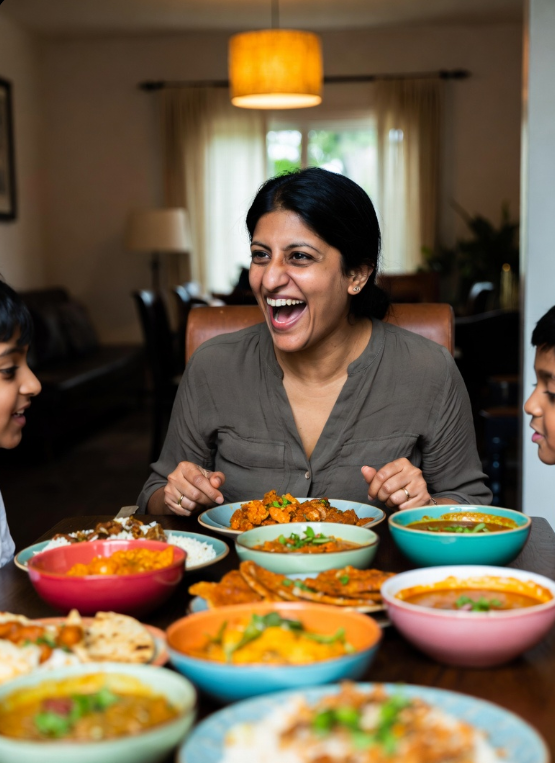
Priya is a pharmacist, wife, and mom of two in Edison, New Jersey — the town she grew up in, surrounded by the sights and smells of her mother's South Indian kitchen. These days, she splits her time between the hospital pharmacy, school pickups, and her own kitchen, where she cooks nearly every night. Her style is a blend of the Tamil recipes her mother taught her and the American comfort food her kids actually want to eat. She writes about the beautiful mess of balancing two cultures on one plate — and she wants you to know that ordering pizza is also an act of love.
