
 By
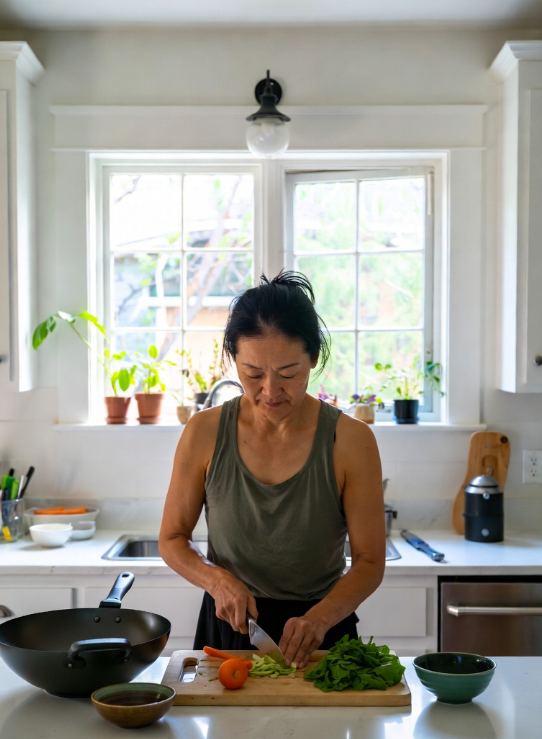
By Mid-July. I visited Ken in Sacramento. Bimonthly. He is seventy-four and the Parkinson's is progressing — the word-finding is harder now, the sentences shorter, the pauses between words longer. But the garden is still producing and Marco is still tending and Ken is still directing from his chair on the patio and the directing is the gardening and the gardening is the living and the living continues. I cooked all weekend. Fumiko's dishes. The memorial menu. The food as conversation with a man whose conversational range is narrowing but whose appetite is not.
I gave Ken the advance copy of Two Kitchens. He held it in both trembling hands and looked at the cover and said: "Two kitchens." The repetition of the title was the review. The review was: yes. Two kitchens. Exactly. The two kitchens that Ken has known his whole life — his mother's kitchen and his wife's kitchen — are now a book, written by his daughter, and the book is an explanation of the thing that Ken has lived but never articulated, because Ken does not articulate, Ken endures, and the enduring is the articulation.
I cooked Fumiko's hayashi rice for Ken — the beef stew over rice, the yoshoku comfort food, the dish that bridges Western and Japanese in a single pot. Ken ate it slowly, the Parkinson's making the eating deliberate, each bite a negotiation between the body and the fork, the fork and the mouth, the tremor and the will. The will wins. The will always wins. Nakamuras endure. The fork reaches the mouth. The stew is eaten. The eating is the enduring.
On the drive home, I did not cry. Not because the visit was not sad — the visits are always sad now, the sadness of watching your father be slowly disassembled by a disease that does not negotiate — but because the sadness has become a component of the visit, the way dashi is a component of miso soup: present, essential, the flavor that holds everything else. The sadness holds the visit. The visit holds the love. The love holds me.
The hayashi rice I cooked for Ken that weekend was Fumiko’s — it will always be Fumiko’s — but the impulse behind it was something I return to every time I cook for him: make something that requires the body to slow down and be present with the food. This stuffed walleye carries that same intention. It is a patient dish, one that asks the cook to be deliberate and the eater to take their time, and right now, deliberate and unhurried is exactly the kind of meal I want to put in front of the people I love most.
Stuffed Walleye
Prep Time: 20 min | Cook Time: 30 min | Total Time: 50 min | Servings: 4
Ingredients
- 4 walleye fillets (about 6 oz each), skin on
- 2 tablespoons unsalted butter, plus more for the pan
- 1/2 cup finely diced yellow onion
- 1/3 cup finely diced celery (about 2 stalks)
- 2 cloves garlic, minced
- 1 cup seasoned breadcrumbs
- 2 tablespoons fresh flat-leaf parsley, chopped
- 1 teaspoon fresh thyme leaves
- 1/4 teaspoon black pepper
- 1/2 teaspoon kosher salt, divided
- 3 tablespoons chicken broth or dry white wine
- 1 lemon, half juiced and half sliced into rounds for serving
- 1 tablespoon olive oil
Instructions
- Preheat and prep the pan. Preheat your oven to 375°F. Lightly butter a 9x13-inch baking dish and set aside.
- Make the stuffing. In a skillet over medium heat, melt the butter. Add the onion and celery and cook, stirring occasionally, until softened, about 5 minutes. Add the garlic and cook 1 minute more. Remove from heat. Stir in the breadcrumbs, parsley, thyme, 1/4 teaspoon salt, and black pepper. Add the chicken broth one tablespoon at a time until the stuffing just holds together when pressed — it should be moist but not wet.
- Stuff the fillets. Lay two fillets skin-side down in the prepared baking dish. Divide the stuffing evenly between them, mounding it gently in the center of each fillet. Lay the remaining two fillets on top, skin-side up, to form two sandwiched packets. Press gently to hold.
- Season and dress. Brush the tops of the fish with olive oil. Sprinkle with the remaining 1/4 teaspoon salt. Squeeze the lemon juice evenly over both packets. Arrange lemon rounds around the fish in the dish.
- Bake. Bake uncovered for 25–30 minutes, until the fish is opaque throughout and flakes easily with a fork. The stuffing should be golden at the edges. If the top is browning too quickly, tent loosely with foil for the last 10 minutes.
- Rest and serve. Let the fish rest 5 minutes before plating. Serve each stuffed packet whole with the roasted lemon rounds and a simple green salad or steamed rice alongside.
Nutrition (per serving)
Calories: 370 | Protein: 36g | Fat: 14g | Carbs: 18g | Fiber: 1g | Sodium: 510mg