
 By
By The Lowcountry boil. September 2027. Two hundred and fifty-one people. A new record. Again. The boil doesn't plateau. The boil climbs. The boil is an oak tree that adds a ring every year, and every ring is wider than the last, and the tree doesn't ask if there's room — the tree just grows.
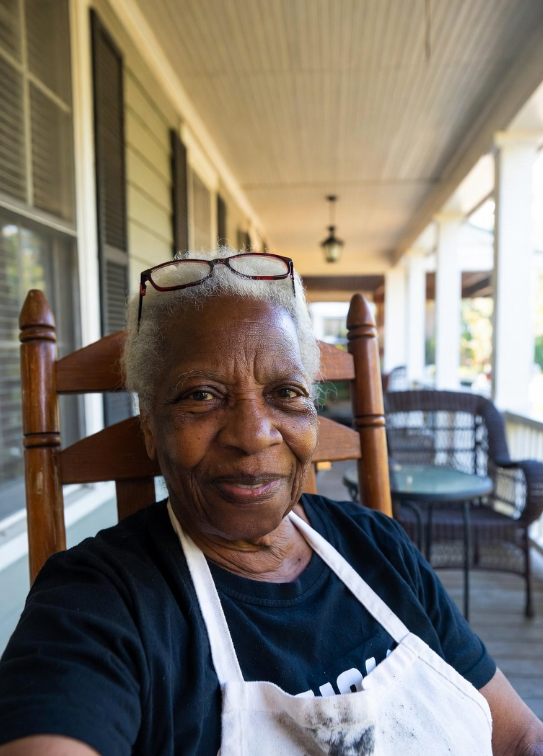
Miss Vernelle sent thirty-five pounds of creek shrimp. She is eighty-nine years old. She pulls crabs and shrimp from the marsh behind her house on Wilmington Island, and she has been doing this since before the Civil Rights Act and she will be doing this after the sun burns out because Miss Vernelle is powered by something that is not dependent on time. Miss Vernelle is powered by the marsh. I said, "Miss Vernelle, you sent five more pounds this year." She said, "You're feeding five more people." She knows the math. The boil grows. The shrimp grow with it.
Gladys brought her cobbler. The annual entry. I tasted it when she wasn't looking (she was arguing with Deacon Johnson about the tablecloth arrangement). The cobbler was... good. Very good. Eight-point-five. Gladys is approaching nine. I am concerned. Not seriously concerned — my cobbler is a ten and will always be a ten — but Gladys at eight-point-five is a different Gladys than Gladys at seven, and the gap is closing, and the closing is the motivation, and the motivation is what keeps both of us baking every September.
Michael was there. Twenty-one months old. He sat in a tiny chair that Denise brought, at the end of the serving table, and he ate corn on the cob that Devon held for him, and he bit into it with his twenty teeth and the corn went everywhere and his face was covered in butter and Old Bay and the joy of a boy eating corn at a church event surrounded by two hundred and fifty-one people who are all eating the same food at the same time, which is the definition of community: eating together. That is all community is. That is all it has ever been.
I brought the watermelon. Third generation. I sliced it at the dessert table and people ate it and said, "Dot, did you grow this?" and I said, "I grew this and its mother and its grandmother." They laughed. I didn't. I meant it literally. The watermelon has a family tree. The watermelon is a Henderson.
Now go on and feed somebody.
The watermelon gets all the attention — and it should, it’s a Henderson, it has earned it — but the dessert table at a two-hundred-and-fifty-one-person boil needs reinforcements. I started making this sorbet three years ago because I needed something I could prepare two days ahead and carry in a cooler without worrying, something that would hold up in the heat while Gladys’s cobbler and my watermelon did their thing. Strawberry and mango together taste like July looks, which is exactly right for a September boil in coastal Georgia when you’re still sweating through your church clothes at six in the evening.
Strawberry Mango Sorbet
Prep Time: 20 minutes | Cook Time: 0 minutes | Total Time: 4 hours 20 minutes (includes freezing) | Servings: 8
Ingredients
- 2 cups fresh strawberries, hulled and halved
- 2 cups fresh mango, peeled and cubed (about 2 medium mangoes)
- 3/4 cup granulated sugar
- 3/4 cup water
- 2 tablespoons fresh lemon juice
- 1 tablespoon fresh lime juice
- Pinch of fine sea salt
Instructions
- Make the simple syrup. Combine sugar and water in a small saucepan over medium heat. Stir until sugar fully dissolves, about 3–4 minutes. Remove from heat and let cool completely to room temperature.
- Blend the fruit. Add the strawberries, mango, lemon juice, lime juice, and salt to a blender. Pour in the cooled simple syrup. Blend on high until completely smooth, about 60 seconds.
- Strain. Pour the blended mixture through a fine-mesh strainer into a large bowl, pressing with a spatula to extract as much liquid as possible. Discard solids. This step gives the sorbet its clean, smooth texture.
- Chill the base. Cover the bowl and refrigerate the strained mixture for at least 1 hour, or until thoroughly cold. A cold base freezes more evenly.
- Churn or freeze. If using an ice cream maker, churn according to manufacturer’s instructions, usually 20–25 minutes, until the sorbet reaches a soft-serve consistency. If churning without a machine, pour the base into a shallow freezer-safe dish, freeze for 45 minutes, then scrape and stir vigorously with a fork. Repeat every 45 minutes for 3–4 hours until frozen and scoopable.
- Final freeze. Transfer churned sorbet to a lidded freezer container and freeze for at least 2 hours until firm enough to scoop cleanly.
- Serve. Let the sorbet sit at room temperature for 5 minutes before scooping. Serve in cups or bowls. Garnish with a fresh strawberry slice or a wedge of mango if you want to be fancy. You don’t have to be fancy.
Nutrition (per serving)
Calories: 118 | Protein: 1g | Fat: 0g | Carbs: 30g | Fiber: 2g | Sodium: 18mg