Anaya's nine-month checkup. The pediatrician: everything on track. Weight, height, developmental milestones, motor skills. She's crawling with intent now — not just exploring but pursuing specific targets (the cat toy she found under the couch, the electrical cords I've baby-proofed seventeen times, and Raj's shoes, which she finds hilarious for reasons known only to her).
The pediatrician asked about language. "How many words?"
"Amma, Dada, ba, and something that might be 'no' but could be a sneeze."
"That's great for nine months."
She said Dada last week. Raj celebrated as if she'd been accepted to medical school. He called his parents. He texted his sister. He may have mentioned it to patients, though he denies this. The man waited three months for Dada and he is LIVING.
At work, the research paper is taking shape. Dr. Okafor and I have co-authored a draft about the MTM program outcomes — medication adherence improvements, adverse event reduction, readmission rate decreases. It's dry reading unless you're a pharmacist or a cardiologist, but it matters. It proves that what I built works.
I'm building things. The program. The blog. The recipe collection. The future. I'm building as fast as I can because building is the opposite of losing, and losing is what I watch Amma do in increments so small nobody notices unless they're counting.
I'm counting.
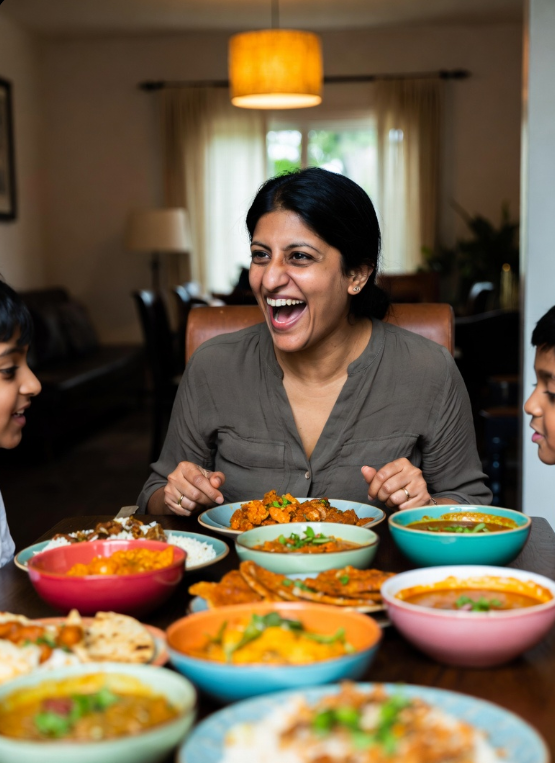
I made Amma's thengai paal kozhukattai — steamed rice dumplings in coconut milk gravy. It's a festival dish, technically, but I made it on a Tuesday because the recipe is in my notebook and I wanted to test it against my memory. The dumplings were round and smooth (Amma's hands know the right pressure — mine are still learning). The coconut milk gravy was sweet and peppery.
Anaya crawled to the kitchen while I cooked and pulled herself up on the cabinet and stood, holding the handle, for approximately four seconds before falling on her padded bottom.
She stood. Four seconds. In my kitchen. While I made Amma's dumplings.
Four seconds of standing. A lifetime of watching. The kitchen is where we learn to stand.
Amma’s dumplings are still in my notebook, and I’ll keep making them until my hands know the right pressure the way hers do. But the instinct behind that Tuesday cooking session — reaching for something warm, fragrant, and built from scratch when you need to feel grounded — is what led me to this soup. A pot of spring vegetables simmered until yielding, finished with a spoonful of bright pistou pounded by hand: it’s the same gesture in a different language. You make something that takes patience. You stir it while a baby pulls herself up on a cabinet handle four feet away. You eat it and it tastes like proof that you are still building.
TRANSITION_START
Spring Essence Soup with Pistou
Prep Time: 20 min | Cook Time: 35 min | Total Time: 55 min | Servings: 6
Ingredients
- 2 tablespoons olive oil
- 1 medium yellow onion, diced
- 3 cloves garlic, minced
- 2 medium carrots, sliced into thin rounds
- 2 stalks celery, sliced
- 1 medium zucchini, diced
- 1 cup green beans, trimmed and cut into 1-inch pieces
- 1 can (14.5 oz) diced tomatoes, with juices
- 1 can (15 oz) cannellini beans, drained and rinsed
- 6 cups low-sodium vegetable broth
- 1 teaspoon kosher salt, plus more to taste
- 1/2 teaspoon black pepper
- 1/2 teaspoon dried thyme
- For the pistou:
- 2 cups fresh basil leaves, packed
- 3 cloves garlic
- 1/3 cup grated Parmesan cheese
- 1/4 cup olive oil
- Pinch of salt
Instructions
- Build the base. Heat olive oil in a large heavy-bottomed pot over medium heat. Add onion and celery; cook, stirring occasionally, until softened, about 5 minutes. Add garlic and cook 1 minute more until fragrant.
- Add the vegetables. Stir in carrots, zucchini, and green beans. Cook 3–4 minutes, letting the vegetables begin to soften and pick up a little color from the pot.
- Simmer the soup. Pour in the diced tomatoes with their juices and the vegetable broth. Add cannellini beans, thyme, salt, and pepper. Bring to a boil, then reduce heat to a gentle simmer. Cook uncovered for 20–25 minutes, until all vegetables are fully tender and the broth has deepened in flavor.
- Make the pistou. While the soup simmers, combine basil leaves, garlic, and a pinch of salt in a food processor (or use a mortar and pestle for a more textured result). Pulse until finely chopped. Add Parmesan and pulse again. With the motor running, drizzle in olive oil until the pistou is thick and cohesive. Taste and adjust salt.
- Finish and serve. Ladle soup into bowls. Drop a generous spoonful of pistou directly into each bowl — do not stir it in fully; let it swirl and melt at the edges so each bite carries a burst of fresh herb. Serve with crusty bread if desired.
Nutrition (per serving)
Calories: 218 | Protein: 8g | Fat: 11g | Carbs: 24g | Fiber: 6g | Sodium: 480mg
About the cook who shared this
Priya Krishnamurthy
Week 155 of Priya’s 30-year story
· Edison, New Jersey
Priya is a pharmacist, wife, and mom of two in Edison, New Jersey — the town she grew up in, surrounded by the sights and smells of her mother's South Indian kitchen. These days, she splits her time between the hospital pharmacy, school pickups, and her own kitchen, where she cooks nearly every night. Her style is a blend of the Tamil recipes her mother taught her and the American comfort food her kids actually want to eat. She writes about the beautiful mess of balancing two cultures on one plate — and she wants you to know that ordering pizza is also an act of love.
