
 By
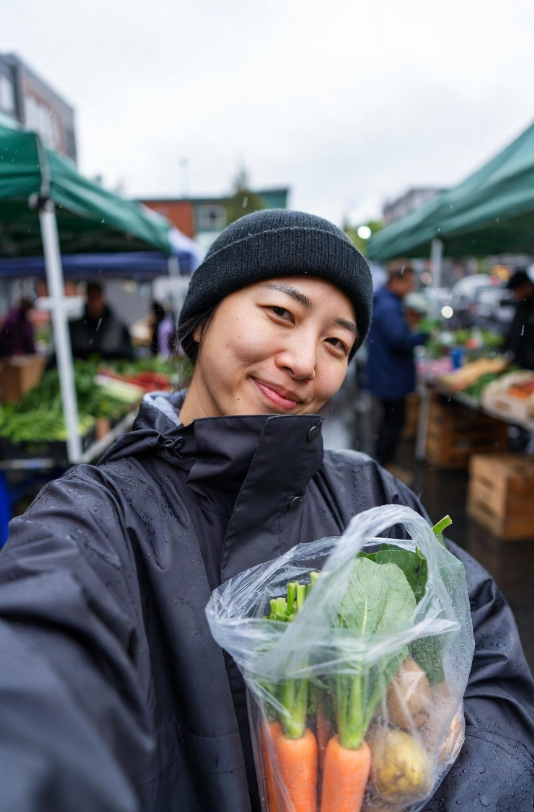
By James and I went to H Mart together. His first time. I know this sounds like a minor event — a grocery store trip — but for me, H Mart is a sacred space, the Korean cathedral where my identity work began, the place where I bought my first gochugaru and first kimchi and stood in the produce section holding Korean pears and feeling the floor shift beneath me. Taking James to H Mart is introducing him to the foundation. The origin story. The place where Stephanie Park became a Korean cook.
James walked through H Mart with the wide-eyed curiosity of a food person in a new grocery store, which is its own form of tourism. He knew the Japanese ingredients (soy sauce, miso, kombu) and the Taiwanese ones (five-spice, star anise, Shaoxing wine) but the Korean-specific items were new: gochugaru, doenjang, the varieties of kimchi, the specific cuts of meat for Korean BBQ. I walked him through the aisles like a museum guide: "This is gochugaru — red pepper flakes, the backbone of Korean cooking. This is doenjang — fermented soybean paste, the soul of the cuisine. This is perilla — the herb that tastes like nothing else on earth." James listened with the attention he brings to everything: total, present, respectful. He tasted gochujang from the sample station and said, "This is like the Taiwanese chili bean paste but sweeter." Cross-cultural tasting notes. Two cuisines, compared through a man's palate at a sample station in H Mart. The comparative cuisine continues.
We bought ingredients for the week: Korean and Taiwanese, side by side in the cart. Gochugaru and five-spice. Tofu for jjigae and tofu for ma po. Short ribs for galbi and pork belly for lu rou fan. Two cuisines in one cart, two identities in one relationship, the hyphen between Korean-American and Taiwanese-American replaced by a grocery cart containing both.
At work, the ACM paper was submitted. Derek reviewed the draft and said, "This is publication-quality." The paper maps food preference networks and predicts cross-cuisine exploration using collaborative filtering. The abstract doesn't mention kimchi or identity or love. But the data is my data, in the sense that the phenomenon the paper describes — people who discover one cuisine exploring its neighbors — is the phenomenon I've lived. Korean food led me to James. James's Taiwanese food led me to a wider Asian culinary world. The paper quantifies what the kitchen already knows: food is a bridge, and bridges connect.
Saturday: Bellevue. I brought the H Mart haul — we cooked at Karen's house. James made three-cup chicken (Taiwanese, a soy-sauce-sesame-oil-basil-braised chicken), and I made doenjang jjigae. Two Asian dishes on the Park table, neither American, both delicious. David ate the three-cup chicken and said, "This is different from what Stephanie usually makes but it's very good." David is developing a vocabulary for non-Korean Asian food, which is progress — from "all Asian food is the same" (which he never said but might have thought) to "this is different" (which he says now with genuine interest). The distinction is the point. Korean is not Taiwanese is not Chinese is not Japanese. The specificity matters. James's three-cup chicken is not my kimchi jjigae and both are Asian and neither is reducible to the other, and David's acknowledgment of that — his "this is different" — is a triumph of the Bellevue education, four years in.
James tasted gochujang at the sample station and immediately started comparing it to Taiwanese chili bean paste — sweeter, he said, rounder — and that moment stuck with me all the way home. We had already cooked the three-cup chicken and the doenjang jjigae, but I kept thinking about that sample station conversation, about gochujang as a first impression, and I wanted to give it a dish where it could be the undisputed star. These noodles are exactly that: the paste center stage, sesame holding it up, heat you can feel in your chest — the kind of bowl that explains, better than any museum-guide speech I gave in the aisles, why gochujang is the backbone of Korean cooking.
Spicy Sesame Gochujang Noodles
Prep Time: 10 min | Cook Time: 15 min | Total Time: 25 min | Servings: 4
Ingredients
- 12 oz noodles (udon, soba, or lo mein)
- 3 tablespoons gochujang
- 2 tablespoons soy sauce
- 2 tablespoons toasted sesame oil
- 1 tablespoon rice vinegar
- 1 tablespoon honey or brown sugar
- 3 cloves garlic, minced
- 1 teaspoon fresh ginger, grated
- 2 tablespoons neutral oil (vegetable or canola)
- 4 green onions, thinly sliced (whites and greens separated)
- 1 tablespoon toasted sesame seeds
- 2 soft-boiled eggs, halved (optional)
- 1/2 cucumber, julienned (optional, for serving)
Instructions
- Cook the noodles. Bring a large pot of salted water to a boil. Cook noodles according to package directions until just tender. Reserve 1/2 cup pasta water, then drain and rinse noodles briefly under cold water to stop cooking. Toss with a drizzle of sesame oil to prevent sticking.
- Make the sauce. In a small bowl, whisk together gochujang, soy sauce, sesame oil, rice vinegar, and honey until smooth. Set aside.
- Bloom the aromatics. Heat neutral oil in a large skillet or wok over medium heat. Add the white parts of the green onions, garlic, and ginger. Cook, stirring frequently, for 1–2 minutes until fragrant but not browned.
- Build the sauce in the pan. Pour the gochujang mixture into the skillet and stir to combine with the aromatics. Let it bubble for about 30 seconds, then add 1/4 cup of the reserved pasta water and stir to loosen into a glossy, pourable sauce.
- Toss the noodles. Add the drained noodles to the skillet and toss with tongs over medium heat until every strand is coated and the sauce clings. Add a splash more pasta water if the sauce feels tight.
- Serve. Divide into bowls and top with green onion greens, toasted sesame seeds, and optional soft-boiled egg and julienned cucumber. Serve immediately.
Nutrition (per serving)
Calories: 420 | Protein: 12g | Fat: 14g | Carbs: 62g | Fiber: 3g | Sodium: 890mg