
 By
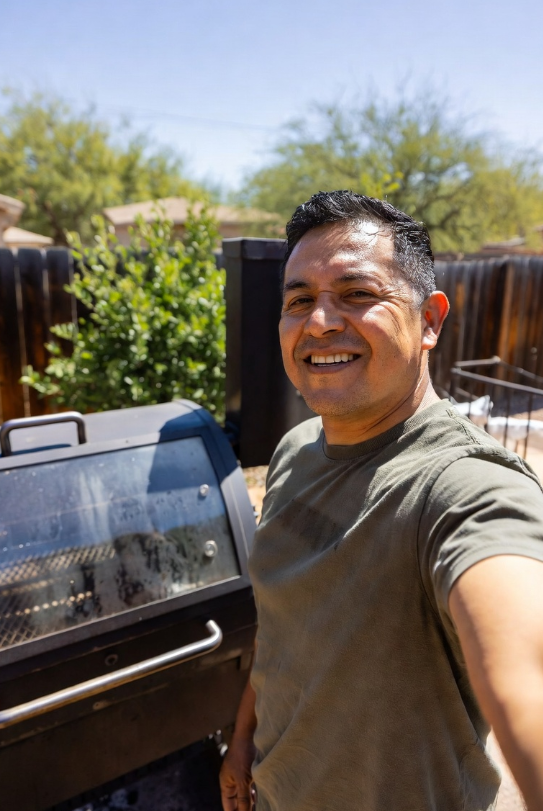
By The Phoenix Spring Championship is Saturday. Battalion Chief exam passed, promotion pending, and now back to the fire — the competition fire, the one that burns in a parking lot at midnight while I obsess over bark formation and internal temperatures. The new smoker's first competition outing. Five hundred gallons of steel and fire, hauled on a trailer behind the Silverado, set up in a parking lot in Gilbert, surrounded by thirty other teams with their own rigs and their own dreams and their own sleepless nights ahead.
I entered brisket only. The ribs can wait. This competition is about one thing: can the new smoker produce a competition-grade brisket? The old Weber Smokey Mountain served me well for six years. But the offset smoker is a different animal — bigger firebox, more consistent heat, better airflow, and the capacity to cook a brisket without the temperature swings that plagued the Weber in wind. The trade-off: the offset requires more fire management, more wood additions, more attention. It is a relationship, not a tool. You have to learn its personality the way you learn a person's.
The brisket went on at midnight. Sofia arrived at dawn with her notebook (the third competition notebook — she is keeping a series, which Jessica calls "The Sofia Rivera BBQ Archive" and which I call "the most important books I own"). Roberto arrived at sunrise with his water bottle and his lawn chair and his silence. Jessica managed the cooler, the supplies, and my anxiety. The team. The family. The fire.
The result: first place brisket. Grand Champion. The score: 98 — tying my personal best from the Mesa Grill Masters. The new smoker delivered: the bark was the darkest I have ever produced, the smoke ring was an inch deep, and the flat — Roberto's nemesis, the cut that has plagued me since my first competition — was moist from edge to edge. No dry edges. No rushed pull. I waited. I trusted the fire. The fire rewarded the trust.
Roberto's review: "Better than the old smoker." One clap. One nod. The ritual. The approval. The passing of judgment from a man who has judged fire since before I was born.
Six competition wins. Six trophies. The shelf in the garage is full. Jessica said, "We need a trophy case at the restaurant." I said, "We need a restaurant." She said, "We are ahead of schedule." The refrain. The mantra. The beat of the drum that is driving us toward the corner in Mesa where Rivera's will stand. Ahead of schedule. Always ahead. The fire accelerates. The dream approaches. Just show up. Keep showing up.
After a Grand Champion win and a score of 98, the brisket speaks for itself — but what you serve alongside it at the table matters just as much as what you pull off the smoker. Ever since Roberto gave that single approving nod in Gilbert, I’ve been asked by nearly every judge and spectator what condiment we had on the board next to the sliced flat. The answer is always this Spicy Bavarian Beer Mustard: coarse-ground, sharp with a long finish, and complex enough to hold its own against a deep bark and an inch of smoke ring. Sofia already has the recipe in Notebook Three. Now you can have it too.
Spicy Bavarian Beer Mustard
Prep Time: 10 minutes | Cook Time: 15 minutes | Total Time: 25 minutes (plus 24 hours resting) | Servings: 24 (about 1 1/2 cups)
Ingredients
- 1/2 cup yellow mustard seeds
- 1/4 cup brown mustard seeds
- 3/4 cup dark Bavarian-style beer (such as a dunkel or dark lager)
- 1/4 cup apple cider vinegar
- 2 tablespoons whole-grain prepared mustard
- 1 tablespoon brown sugar, packed
- 1 teaspoon kosher salt
- 1/2 teaspoon smoked paprika
- 1/4 teaspoon cayenne pepper (add more to taste)
- 1/4 teaspoon ground allspice
- 1/8 teaspoon ground cloves
Instructions
- Soak the seeds. Combine the yellow and brown mustard seeds in a small bowl. Pour the dark beer and apple cider vinegar over the seeds, stir to combine, cover, and let soak at room temperature for at least 8 hours or overnight. The seeds will absorb most of the liquid and swell considerably.
- Blend the base. Transfer the soaked seeds and any remaining soaking liquid to a blender or food processor. Add the whole-grain mustard, brown sugar, salt, smoked paprika, cayenne, allspice, and cloves. Pulse 10–15 times to break down roughly half the seeds, leaving plenty of texture — you want a coarse, grainy consistency, not a smooth paste.
- Cook to develop flavor. Transfer the blended mustard to a small saucepan over medium-low heat. Stir constantly and cook for 12–15 minutes until the mustard thickens slightly and the raw edge mellows. Do not boil. Remove from heat and let cool to room temperature.
- Rest before serving. Spoon the mustard into a clean glass jar, seal, and refrigerate for at least 24 hours before serving. The heat and complexity deepen significantly as it rests — patience here mirrors the patience of a long smoke. Keeps refrigerated for up to 6 weeks.
- Serve. Bring to room temperature before plating alongside sliced smoked brisket, sausage, or charcuterie. A small ramekin on the competition board goes a long way with judges.
Nutrition (per serving)
Calories: 30 | Protein: 1g | Fat: 1g | Carbs: 3g | Fiber: 1g | Sodium: 95mg