Ten years since the knee injury. January 2007 — I was seventeen, on the court at Southeastern High School, going up for a rebound. I came down wrong. The pop. The scream. The gym floor. The end. I do not mark the anniversary intentionally, but my body remembers. The knee aches more in January, not because of the cold (though the cold does not help) but because trauma has a calendar, and my knee knows what month it is.
I do not talk about the injury often. It is the kind of loss that people think they understand but do not. They say, "At least you're healthy." They say, "Everything happens for a reason." They say, "Maybe basketball wasn't meant to be." These are things people say when they cannot imagine your specific grief and want to fill the silence with something that sounds helpful. It is not helpful. What happened to me on that gym floor was the death of a future self — the version of DeShawn Carter who played college basketball, who walked onto a campus with a purpose, who became something other than a factory worker. That person died in January 2007, and I have been mourning him ever since, quietly, privately, in the way that men mourn the selves they did not get to become.
But here is what I have, ten years later: a son who plays with a foam basketball and laughs when it bounces off the wall. A job that pays the bills and gives me health insurance. A family that gathers every Sunday around a table that has never been empty. A mother who cooks with the conviction that food is love, and a father who shows up every day to a life he never complains about. I have a marriage that is struggling but still standing. I have a bad knee and a good heart and two hands that can build a Jeep Grand Cherokee in less time than it took me to type this paragraph.
Ten years is a long time. Ten years is nothing. Both are true.
Mama made her spaghetti this week — not baked, just regular spaghetti, but her version: ground beef and Italian sausage browned together, a homemade sauce with canned San Marzano tomatoes and garlic and onion and basil, simmered for three hours, served over spaghetti with grated Parmesan on top. It is not Ragu. It is not from a jar. It is the kind of spaghetti that makes you realize what you have been settling for, and then makes you settle for it anyway because who has three hours on a Tuesday to make sauce? Mama does. Mama always has time for the things that matter, and sauce matters.
Aiden is twenty-one months old. He will not remember any of this. He will not remember the apartment, or the arguments, or the play kitchen, or the snow on his boots. But he will remember, somehow, the feeling of being held. And that is what I am giving him: the feeling.
Mama’s spaghetti showed up at exactly the right moment—the kind of meal that doesn’t ask anything of you except to sit down and eat. I couldn’t give Aiden ten years of memories yet, but I could give him this: a table, a smell he’ll carry somewhere in his body long after he’s forgotten the apartment. So I asked Mama to walk me through it, and I made it myself, because some things are worth the three hours.
Spaghetti Bolognese
Prep Time: 20 minutes | Cook Time: 3 hours | Total Time: 3 hours 20 minutes | Servings: 6
Ingredients
- 1 lb ground beef (80/20)
- 1 lb mild Italian sausage, casings removed
- 1 medium yellow onion, finely diced
- 6 cloves garlic, minced
- 2 cans (28 oz each) whole San Marzano tomatoes, crushed by hand
- 1 can (6 oz) tomato paste
- 1/2 cup dry red wine (optional but recommended)
- 1/2 cup whole milk
- 1 tsp dried oregano
- 1 tsp dried basil, plus fresh basil for finishing
- 1/2 tsp crushed red pepper flakes
- 1 tsp sugar
- Salt and black pepper to taste
- 2 tbsp olive oil
- 1 lb spaghetti
- Freshly grated Parmesan, for serving
Instructions
- Brown the meat. Heat olive oil in a large heavy-bottomed pot or Dutch oven over medium-high heat. Add ground beef and Italian sausage. Break apart with a wooden spoon and cook until deeply browned, about 10–12 minutes. Do not rush this — color means flavor. Drain excess fat, leaving about 2 tablespoons in the pot.
- Soften the aromatics. Reduce heat to medium. Add diced onion and cook, stirring occasionally, until soft and translucent, about 6 minutes. Add minced garlic and cook 1 minute more until fragrant.
- Build the sauce. Stir in tomato paste and cook for 2 minutes, letting it caramelize slightly against the bottom of the pot. Add the red wine if using and scrape up any browned bits. Let the wine reduce by half, about 2 minutes.
- Add the tomatoes. Pour in the crushed San Marzano tomatoes with their juices. Stir in oregano, dried basil, red pepper flakes, and sugar. Season generously with salt and black pepper.
- Simmer low and slow. Bring sauce to a gentle boil, then reduce heat to the lowest setting. Partially cover and simmer for at least 2 1/2 to 3 hours, stirring every 20–30 minutes. The sauce will thicken and deepen. This is the part you cannot shortcut.
- Finish with milk. In the last 15 minutes of cooking, stir in the whole milk. This rounds out the acidity and gives the sauce its characteristic richness. Taste and adjust salt. Tear in a few fresh basil leaves.
- Cook the pasta. Bring a large pot of heavily salted water to a boil. Cook spaghetti according to package directions until al dente. Reserve 1/2 cup pasta water before draining.
- Combine and serve. Toss drained spaghetti with a ladle of sauce, adding a splash of pasta water if needed to loosen. Plate with generous sauce over the top. Finish with freshly grated Parmesan and a few torn basil leaves.
Nutrition (per serving)
Calories: 680 | Protein: 38g | Fat: 28g | Carbs: 65g | Fiber: 5g | Sodium: 820mg
About the cook who shared this
DeShawn Carter
Week 44 of DeShawn’s 30-year story
· Detroit, Michigan
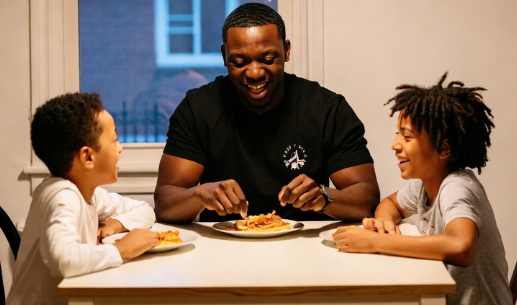
DeShawn is a thirty-six-year-old single dad, auto plant worker, and a man who didn't learn to cook until his wife left and his five-year-old asked, "Daddy, can you cook something?" He called his mama, who came over with two bags of groceries and spent six months teaching him the basics. Now he's the dad at the cookout who brings the ribs, the guy at the plant whose leftover gumbo starts fights, and living proof that it's never too late to learn.
